


Listen to the article
Controversial Film “The Taj Story” Reignites Historical Debate Over Iconic Monument
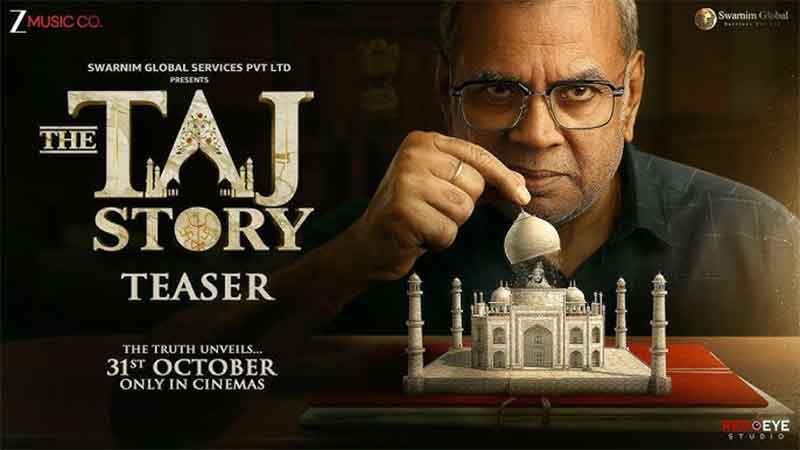
A new Bollywood film has sparked fresh controversy by reviving long-debunked claims about the Taj Mahal’s origins. “The Taj Story,” starring veteran actor and BJP supporter Paresh Rawal, is set to release later this month, with its teaser already generating significant public backlash.
The promotional material for the film depicts Rawal opening the Taj Mahal’s dome to reveal an image of Lord Shiva inside, suggesting the monument was originally a Hindu temple. Following immediate criticism, the filmmakers released another teaser stating the movie aims to “uncover the mystery” behind the Taj Mahal.
This narrative resurrects a discredited theory first proposed in 1965 by P.N. Oak in his book “Taj Mahal is a Rajput Palace.” Oak claimed the iconic monument was originally a 4th-century Hindu temple called “Tejo Mahalaya” that was repurposed by Mughal Emperor Shah Jahan.
Historians have consistently refuted Oak’s assertions. His claims stemmed from a misreading of a 17th-century Persian text, “Padshahnama,” which documented Shah Jahan purchasing land from Raja Jai Singh I of Amber. While the text mentions a palace built by Jai Singh’s ancestor on the site, Oak’s interpretation incorrectly dated this structure to the 4th century.
Prominent historian Giles Tillotson has noted that the architectural techniques used in the Taj Mahal simply did not exist in pre-Mughal India. The monument’s distinctive features—including its bulbous dome, Timurid arches, pietra dura inlay work, and charbagh garden layout—are unmistakably Mughal in origin.
Oak’s theories gained little traction in academic circles, but they found resonance within certain political movements. In 2000, he petitioned the Supreme Court of India to declare the Taj Mahal a Hindu structure. The Court dismissed his plea, citing lack of evidence. A similar petition filed by Hindutva ideologue Amar Nath Mishra in the Allahabad High Court in 2005 met the same fate.
In 2017, the Archaeological Survey of India (ASI) released an official statement confirming that no historical or archaeological evidence suggests the Taj Mahal was ever a temple, effectively ending the academic debate.
“The persistence of these claims reflects a broader political narrative rather than historical fact,” explains Dr. Sanjay Sharma, professor of medieval history at Delhi University. “Such theories align with revisionist attempts to portray Mughal rule as a period of cultural appropriation rather than cultural synthesis.”
The timing of “The Taj Story” is notable, coming shortly after filmmaker Vivek Agnihotri’s “The Bengal Files” failed at the box office. Agnihotri, who previously found success with “The Kashmir Files,” reportedly claimed financial difficulties following his latest film’s poor performance.
The Taj Mahal, recognized as a UNESCO World Heritage Site and one of the Seven Wonders of the World, attracts millions of visitors annually. Built between 1632 and 1653 as a mausoleum for Mughal Emperor Shah Jahan’s wife Mumtaz Mahal, the monument represents the pinnacle of Indo-Islamic architecture.
Critics worry that “The Taj Story” risks using cinema as a tool for historical distortion rather than artistic expression. Film analyst Rajiv Kumar notes, “There’s a fine line between creative interpretation and deliberate misinformation. When entertainment platforms propagate debunked theories, it can have real social consequences.”
The controversy highlights ongoing tensions between historical scholarship and popular narratives in India’s increasingly polarized cultural landscape. As “The Taj Story” prepares for release, historians and archaeologists continue to emphasize the importance of evidence-based understanding of India’s complex architectural heritage.
Whether the film will resonate with audiences remains to be seen. As one social media commenter noted, “The Taj Mahal has stood for nearly 400 years. It will continue standing long after these controversies fade.”
Fact Checker
Verify the accuracy of this article using The Disinformation Commission analysis and real-time sources.

12 Comments
It’s disappointing to see the Taj Mahal’s legacy being undermined by nationalist rhetoric in this new Bollywood film. Historians should be the authoritative voices on the monument’s origins and significance.
Agreed. Responsible storytelling requires grounding in reliable historical sources, not unsubstantiated claims that serve political agendas.
While creative license is understandable in filmmaking, distorting the well-established history of the Taj Mahal seems like a concerning trend. Audiences deserve accuracy, not nationalist mythology.
You raise a valid point. The line between artistic expression and historical revisionism can be blurry, but it’s important to uphold factual integrity, especially for such an iconic landmark.
The Taj Mahal is an iconic symbol of India’s rich cultural heritage. Distorting its history for nationalist propaganda is concerning and could undermine public understanding of the past.
You make a good point. Responsible storytelling about history is important, especially for such a renowned monument like the Taj Mahal.
This is an interesting film that aims to stir up controversy around the origins of the Taj Mahal. While the historical claims seem dubious, it’s worth examining the motivations behind such revisionist narratives.
I agree, the Taj Mahal’s history has been well-documented by historians. Any attempts to rewrite it seem politically motivated rather than grounded in facts.
It’s troubling to see Bollywood films being used to push revisionist historical agendas. The Taj Mahal’s legacy deserves to be presented objectively, not through a nationalist lens.
I agree, the artistic medium of film should not be hijacked for political propaganda. Balanced, evidence-based narratives are crucial when depicting historical sites and events.
I’m curious to learn more about the historical basis, or lack thereof, for the claims made in this new Bollywood film. Reliable sources will be key to evaluating the merits of this narrative.
Absolutely, reputable historians should be consulted to provide factual context around the origins and significance of the Taj Mahal.