


Listen to the article
Protests, Propaganda & Power: The New Frontiers of India’s Internal Security Challenge
In a rapidly evolving geopolitical landscape, India stands as a remarkable point of stability amid global turbulence. As 2025 unfolds, the nation maintains its position as an economic beacon despite neighboring conflicts and internal security challenges that continue to test its resilience.
While much of the world grapples with post-pandemic inflation and cost-of-living crises, India has managed to preserve positive citizen sentiment, reflected in robust markets and the government’s sustained political popularity. This stability comes despite occasional attacks by hostile state actors and homegrown extremist elements.
Security experts note that India’s approach to internal threats has evolved significantly. The crackdown on Naxalite insurgency, often referred to as Red Terror, has been particularly effective, with unprecedented success in dismantling operational networks. However, authorities remain vigilant about the potential for ideological resurgence, especially as extremist messaging finds new channels of distribution.
“The challenge isn’t just eliminating active threats but preventing their resurrection through ideological indoctrination,” explains Dr. Rajan Mishra, a security analyst with the Delhi Policy Research Institute. “We’ve seen this pattern with Khalistani separatism, which has experienced a surprising resurgence in recent years, largely fueled by foreign-based operations in Canada and the United States.”
A concerning trend has emerged where legitimate civic protests are being co-opted by fringe elements with broader political agendas. In New Delhi, what began as demonstrations by animal welfare advocates responding to the Supreme Court’s stray dog control measures quickly transformed into a platform for political messaging.
International figures like Irish influencer Niall Harbison inserted themselves into the discourse, directing protesters toward specific political alignments while creating narrative distortions for global audiences. Security officials view such foreign intervention in domestic issues with growing concern.
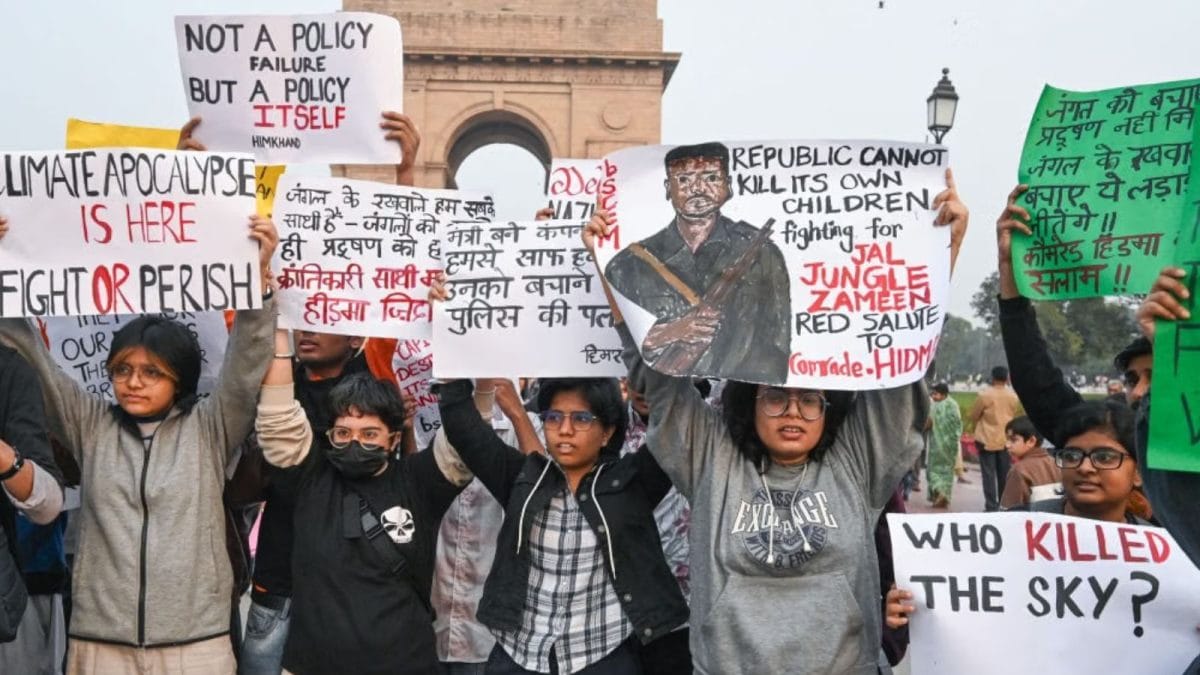
Similarly, environmental protests focused on Delhi’s air quality crisis were hijacked by elements expressing support for banned Naxalite groups before pivoting to unrelated social issues. This pattern of protest co-option has raised alarms about the existence of what some describe as a “protest industry” – organized networks that mobilize demonstrators for various causes while maintaining consistent anti-government messaging.
“Many young participants are unaware they’re being manipulated by entities with vested interests,” says Priya Sharma, who researches social movements at Jawaharlal Nehru University. “These organizers exploit legitimate grievances to advance political agendas, often leaving naive participants facing legal consequences while the orchestrators remain insulated.”
The phenomenon is particularly troubling in university settings, where some observers have noted a concerning pattern of ideological indoctrination. Critics argue that certain academic environments have become breeding grounds for extreme viewpoints rather than spaces for critical thinking and balanced debate.
“India’s future depends on nurturing young talent in critical sectors like semiconductors, automotive engineering, infrastructure, and aeronautics,” states education reformer Dr. Vikram Singh. “But if our education system produces graduates more focused on activism than innovation, we risk falling behind in global competitiveness.”
Security analysts emphasize that addressing these challenges requires a multifaceted approach. While law enforcement must respond to immediate threats, long-term solutions demand educational reform, media literacy programs, and increased transparency around foreign funding of domestic activism.
As India navigates these complex issues, the balance between protecting legitimate civic expression and preventing exploitation by extremist elements remains delicate. The nation’s continued stability and growth may well depend on how effectively it meets this challenge in the coming years.
With terrorism evolving beyond conventional threats into more insidious forms of ideological warfare, India’s security apparatus faces new frontiers that will test both its tactical capabilities and its commitment to democratic principles. The outcome of this struggle will likely shape the country’s trajectory for decades to come.
Fact Checker
Verify the accuracy of this article using The Disinformation Commission analysis and real-time sources.

20 Comments
The cost guidance is better than expected. If they deliver, the stock could rerate.
Good point. Watching costs and grades closely.
If AISC keeps dropping, this becomes investable for me.
Good point. Watching costs and grades closely.
The cost guidance is better than expected. If they deliver, the stock could rerate.
Good point. Watching costs and grades closely.
Exploration results look promising, but permitting will be the key risk.
Good point. Watching costs and grades closely.
Good point. Watching costs and grades closely.
Silver leverage is strong here; beta cuts both ways though.
Exploration results look promising, but permitting will be the key risk.
Good point. Watching costs and grades closely.
Good point. Watching costs and grades closely.
Interesting update on India’s Internal Security Challenge: Navigating Protests, Propaganda and Power. Curious how the grades will trend next quarter.
Good point. Watching costs and grades closely.
Good point. Watching costs and grades closely.
Interesting update on India’s Internal Security Challenge: Navigating Protests, Propaganda and Power. Curious how the grades will trend next quarter.
Good point. Watching costs and grades closely.
Good point. Watching costs and grades closely.
Uranium names keep pushing higher—supply still tight into 2026.