


Listen to the article
In a significant shift, Wikipedia has revised its characterization of the film “Dhurandhar: The Revenge,” removing the controversial “propaganda film” label that had previously sparked heated debates among the platform’s editors and users.
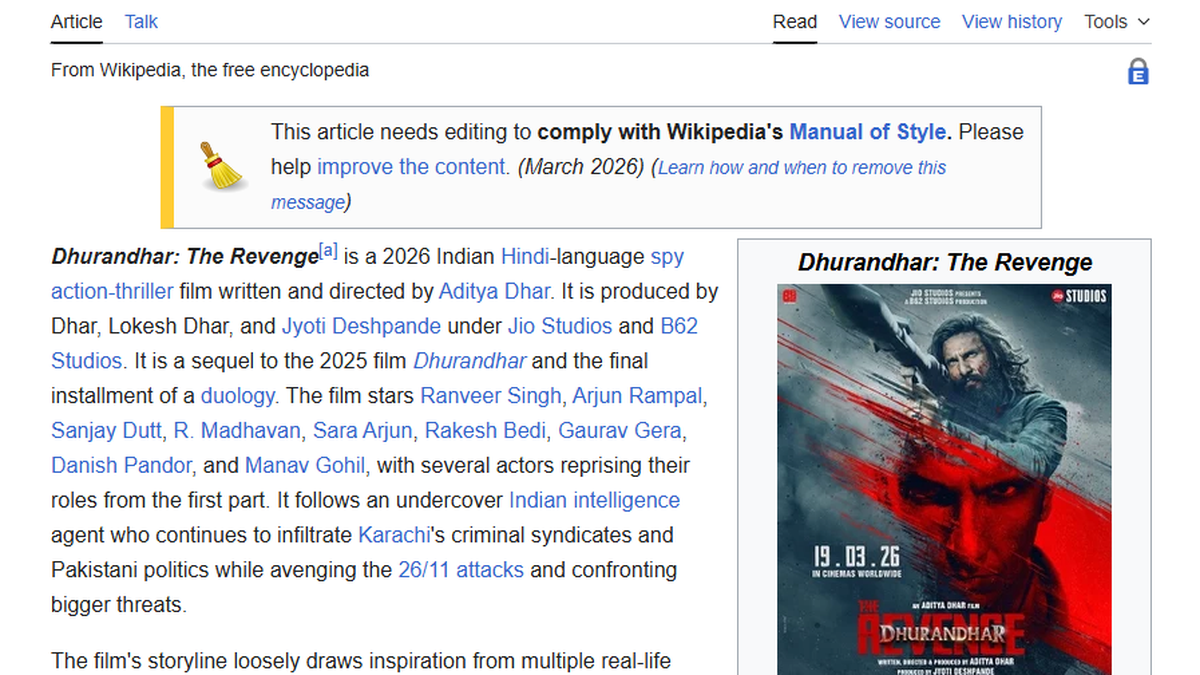
The film’s Wikipedia page now simply describes the production as a “2026 Indian Hindi-language spy action-thriller film written and directed by Aditya Dhar.” This modification follows extensive discussions between authorized Wikipedia editors regarding whether a minority critical viewpoint about the film had been given disproportionate emphasis in the original description.
Despite the change in description, both “Dhurandhar” and its sequel “Dhurandhar: The Revenge” remain under strict editing restrictions on Wikipedia. The pages display a lock symbol with an ‘E’ in the top corner, indicating “extended confirmed protection” status. This restriction limits editing capabilities to users with extended confirmed access, administrators, and bots – a measure Wikipedia implements to maintain integrity on contentious topics vulnerable to vandalism or biased editing.
The Ranveer Singh-starring “Dhurandhar” franchise has received widespread acclaim for its technical merits, including cinematography, storytelling, and musical score. The films have resonated with audiences across India, generating substantial box office success. However, they have not escaped controversy, with several critics accusing the productions of promoting Islamophobic narratives and aligning with the political messaging of India’s ruling Bharatiya Janata Party.
This situation reflects a broader pattern affecting Indian films that touch on sensitive political and religious themes. Wikipedia has implemented similar protective measures on pages for other controversial Indian productions, particularly those that have found favor with right-wing Hindu audiences while attracting criticism for their portrayal of religious dynamics.
“The Kerala Story” and its sequel, which faced accusations of negatively depicting interfaith relationships between Hindu women and Muslim men by allegedly connecting them to terrorism or demographic conspiracy theories, are currently under the same “extended confirmed protection” status on Wikipedia.
Similarly, “The Kashmir Files,” which portrays the violence against Kashmiri Hindus, operates under “semi-protection” status until 2027, allowing edits only from registered users. “The Bengal Files,” another production from the same director, Vivek Agnihotri, has also been placed under extended confirmed protection.
These protective measures highlight Wikipedia’s ongoing challenge in maintaining balanced, factual information on contentious cultural products that intersect with India’s complex political landscape. The platform’s editing restrictions serve as a mechanism to prevent edit wars while ensuring that articles about controversial films reflect a balanced perspective rather than becoming battlegrounds for competing ideological viewpoints.
The controversy surrounding “Dhurandhar: The Revenge” exemplifies the increasingly polarized reception of Indian cinema that engages with nationalist themes, where critical acclaim for artistic and technical elements often coexists with concerns about political messaging and representation of religious communities.
As Indian cinema continues to explore politically charged narratives, the question of how these films are categorized and described on public information platforms like Wikipedia remains a contentious issue, reflecting broader debates about media representation, political influence, and cultural narratives in contemporary India.
Fact Checker
Verify the accuracy of this article using The Disinformation Commission analysis and real-time sources.

30 Comments
Removing the ‘propaganda film’ label is a significant change, though the pages remain locked down. This suggests there may still be some underlying controversy or debate around how to properly characterize these films on Wikipedia.
Agreed. The extended protections imply Wikipedia editors are still navigating tricky waters when it comes to the ‘Dhurandhar’ franchise. Balancing different perspectives will be key.
Glad to see the description updated to focus on the film itself rather than loaded labels. Wikipedia should strive for impartial, fact-based entries, even on controversial topics.
I hope the editing restrictions don’t prevent important nuances and context from being added over time as the conversation evolves.
The evolution of the Wikipedia entry for ‘Dhurandhar’ is an interesting case study in how online platforms navigate sensitive political and artistic debates. Transparency around their decision-making would be valuable.
I hope Wikipedia can maintain a balanced and objective perspective on this film, even as the broader conversation around it continues to evolve.
Removing the ‘propaganda’ label is a positive step, but the continued editing restrictions suggest there’s still a lot of sensitivity around this film. I wonder what the core issues are.
It will be interesting to see if the entry evolves further as new information or perspectives emerge. Balanced, fact-based descriptions are ideal for Wikipedia.
The ‘Dhurandhar’ franchise has received a lot of buzz, both positive and negative. Curious to see how Wikipedia will handle the balance between acknowledging the films’ acclaim and addressing any lingering concerns about potential propaganda elements.
Maintaining neutrality on contentious topics like this is always a challenge for Wikipedia. The editing restrictions indicate they’re trying to preserve integrity, but it will be interesting to see how the page evolves over time.
Interesting development with the Wikipedia page on the ‘Dhurandhar’ films. Seems like the controversial ‘propaganda film’ label has been removed, though the pages remain tightly restricted. Wonder what led to this change in characterization?
Likely an effort to avoid potential bias and ensure a more neutral representation of the films on Wikipedia. The extended editing protections suggest these remain sensitive topics.
The ‘Dhurandhar’ franchise seems to be generating a lot of interest and debate. I’m curious to learn more about the film’s themes and artistic merits, beyond the political controversies.
It’s good that Wikipedia is aiming for a balanced portrayal, even if the process involves some protections. Transparency around their decision-making would be valuable.
Interesting to see the Wikipedia entry for this film evolving. Removing the ‘propaganda’ label suggests there was a balanced discussion on how to accurately describe it.
I wonder what led to the change in characterization. Was there new evidence or a shift in the broader perspective on the film?
Curious to see how the Wikipedia page updates will impact perceptions around these films. The shift away from the ‘propaganda’ label, yet continued tight editing control, creates an interesting dynamic.
Indeed. It’ll be worth monitoring how this plays out and whether the page description continues to evolve over time as more information and viewpoints emerge.
Removing the ‘propaganda’ label from the Wikipedia entry for ‘Dhurandhar’ seems like a step in the right direction, but the continued editing restrictions suggest there are still unresolved issues. I’m curious to learn more about the nuances of this debate.
Maintaining the integrity of Wikipedia’s content is crucial, especially on sensitive topics. I’m glad to see they’re taking a thoughtful approach, even if the details aren’t fully transparent.
The extended protection on the Wikipedia page indicates this is a highly contentious topic. Curious to learn more about the debates and perspectives involved.
It’s good Wikipedia is working to maintain integrity on this sensitive issue, even if the details remain opaque to the public.
The ‘Dhurandhar’ films seem to be at the center of an ongoing debate about nationalism, propaganda, and artistic expression. I hope Wikipedia can navigate this complex issue objectively.
Maintaining the integrity of Wikipedia entries on sensitive political topics is crucial. I’m glad to see they’re taking steps to ensure balanced coverage, even if the process is challenging.
The ‘Dhurandhar’ franchise seems to be a complex and sensitive topic for Wikipedia. Removing the ‘propaganda’ label is a noteworthy change, but the tight editing restrictions suggest there are still unresolved concerns.
Absolutely. Wikipedia is walking a fine line here, trying to present a more neutral take while still acknowledging the ongoing debates around these films. It’s a delicate balancing act.
Interesting that Wikipedia has shifted away from the ‘propaganda film’ characterization for ‘Dhurandhar.’ Seems like a recognition that the previous label may have been too broad or contentious. But the continued tight controls indicate there’s still work to be done.
Definitely. The Wikipedia editors are clearly trying to navigate a nuanced and potentially polarized topic. Maintaining impartiality while addressing various perspectives will be key going forward.
It’s good to see Wikipedia updating their description to focus more on the film itself rather than loaded labels. Objective, fact-based coverage is important, even for controversial works.
The continued editing restrictions suggest there are still unresolved tensions around this film. I wonder what the core issues are and how Wikipedia is managing them.