


Listen to the article
The Dangerous Power of Propaganda: Hannah Arendt’s Lessons on Totalitarianism
The mechanisms that enabled the Third Reich to seize power in 1930s Germany continue to offer sobering lessons for modern democracies. While paramilitary intimidation and political opportunism played crucial roles, it was the sophisticated propaganda machine—orchestrated by Minister of Propaganda Joseph Goebbels—that created the social conditions necessary for atrocities to unfold.
Goebbels’ systematic purging of Jewish and leftist voices from German arts and media coincided with his construction of an extensive propaganda infrastructure. According to PBS analyses, this media apparatus played “probably the most important role in creating an atmosphere in Germany that made it possible for the Nazis to commit terrible atrocities against Jews, homosexuals, and other minorities.”
The question of how a minority party managed to break the collective will of the German people has haunted scholars for decades after World War II. Two prominent post-war intellectuals, Theodor Adorno and Hannah Arendt, approached this question from different but complementary angles.
Adorno focused on the psychological profile of individuals susceptible to totalitarian messaging. His contribution to the landmark study “The Authoritarian Personality” included the development of the F-Scale (“F” for “fascism”), which sought to measure predispositions toward authoritarian thinking.
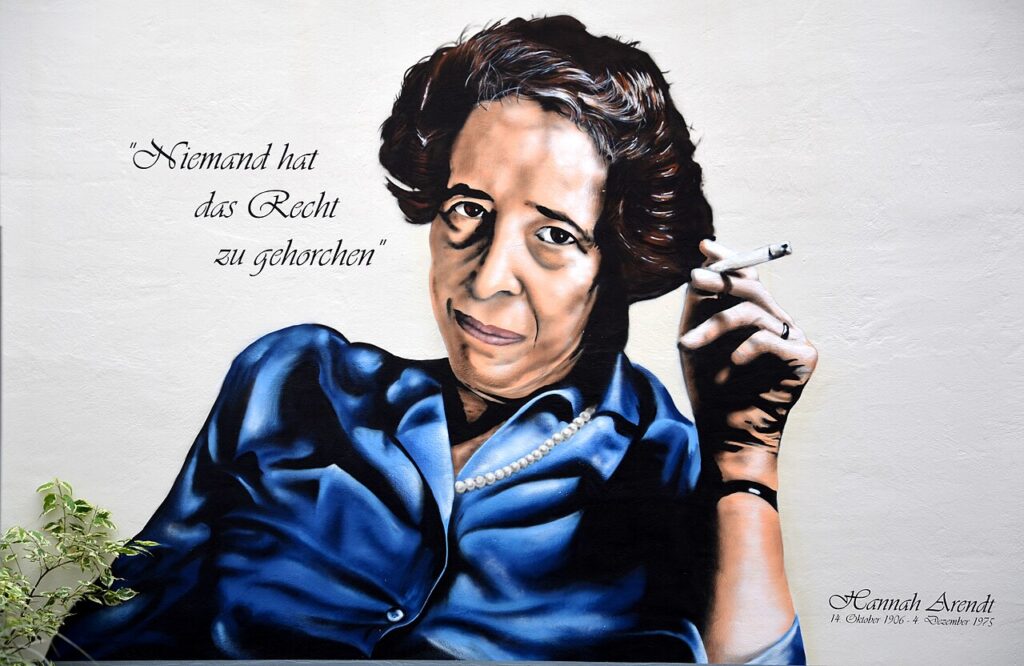
Arendt, meanwhile, examined the operational mechanics of the Hitler and Stalin regimes, particularly the role of propaganda in creating what she described as “a curiously varying mixture of gullibility and cynicism” among citizens. In her seminal 1951 work “Origins of Totalitarianism,” she observed that this psychological state became “prevalent in all ranks of totalitarian movements.”
“In an ever-changing, incomprehensible world the masses had reached the point where they would, at the same time, believe everything and nothing, think that everything was possible and nothing was true,” Arendt wrote. She argued that totalitarian leaders deliberately exploited this confusion, knowing people would “believe the most fantastic statements one day” and then, when proven false, “take refuge in cynicism” rather than reject their leaders.
This constant barrage of obvious falsehoods served multiple strategic purposes. As McGill University political philosophy professor Jacob T. Levy explains, requiring subordinates to repeat blatant untruths functions as “a particularly startling display of power over them” that was “endemic to totalitarianism.” Forcing someone to publicly endorse obvious lies creates bonds of shame and complicity that tie them to the regime.
Perhaps more insidiously, Arendt recognized that an overwhelming volume of lies serves to disorient an entire population. The phenomenon we now call “gaslighting” destroys “the sense by which we take our bearings in the real world,” she wrote. With their epistemological foundation undermined, citizens become dependent on the leader’s proclamations, regardless of factual accuracy.
The ultimate aim, according to Arendt, was to establish the principle that “The Fuehrer is always right” as the only reliable touchstone in a world where truth had lost all meaning. This principle, she argued, was “as necessary for the purposes of world politics, i.e., world-wide cheating, as the rules of military discipline are for the purposes of war.”
Although Arendt wrote “Origins of Totalitarianism” based on research conducted in the 1940s, her analysis carries striking relevance today. As Jeffrey Isaacs noted in The Washington Post, her work “raises a set of fundamental questions about how tyranny can arise and the dangerous forms of inhumanity to which it can lead.”
The danger, Arendt suggests, lies in allowing blatant falsehoods to become so normalized that they seem inconsequential. When societies begin dismissing systematic lies as mere political theater rather than recognizing them as fundamental attacks on shared reality, they lower critical defenses against authoritarian encroachment.
Her warning resonates across generations: The normalization of dishonesty in public discourse isn’t just a moral issue—it represents an existential threat to democratic governance and human dignity.
Fact Checker
Verify the accuracy of this article using The Disinformation Commission analysis and real-time sources.

8 Comments
Goebbels’ systematic manipulation of the media and suppression of dissenting voices is a chilling blueprint that authoritarian leaders may still attempt to emulate. Vigilance and a strong commitment to press freedom are essential to prevent such scenarios from unfolding.
This is a fascinating examination of how propaganda can undermine truth and morality. Arendt’s insights on totalitarianism offer crucial lessons for modern democracies to be vigilant against the misuse of media and information.
Adorno and Arendt’s complementary perspectives offer valuable frameworks for analyzing the psychological and sociopolitical factors that enable the rise of authoritarian regimes. Their work is crucial for understanding the complexities of maintaining a healthy democracy.
This article is a timely reminder of the fragility of truth and the need to safeguard against the malicious use of media and information. Arendt’s lessons on the corrosive power of propaganda are as relevant today as they were in the post-war era.
This analysis highlights the enduring relevance of Arendt’s work in understanding the dynamics of totalitarianism. Her insights on the corrosive effects of propaganda remain essential reading for anyone concerned with protecting democratic values.
It’s troubling how Goebbels’ propaganda tactics bear eerie similarities to modern information warfare tactics used to sow division and erode trust in institutions. We must be vigilant against such attempts to undermine the foundations of a free society.
Goebbels’ systematic propaganda campaign is a chilling example of how controlling the narrative can pave the way for atrocities. It’s a sobering reminder of the power of media manipulation and the fragility of democratic norms.
Absolutely, the Nazi propaganda machine demonstrated how quickly a minority party can seize control by dominating the public discourse. Maintaining a free and independent media is vital to upholding truth and accountability.