


Listen to the article
In a significant revelation that sheds light on Hamas’s communication strategy, a propaganda handbook seized during Israeli military operations in Gaza has exposed the terror organization’s deliberate approach to public messaging. The document reveals a calculated effort to present a sanitized image to Western audiences while maintaining deeply antisemitic rhetoric in Arabic-language materials distributed internally.
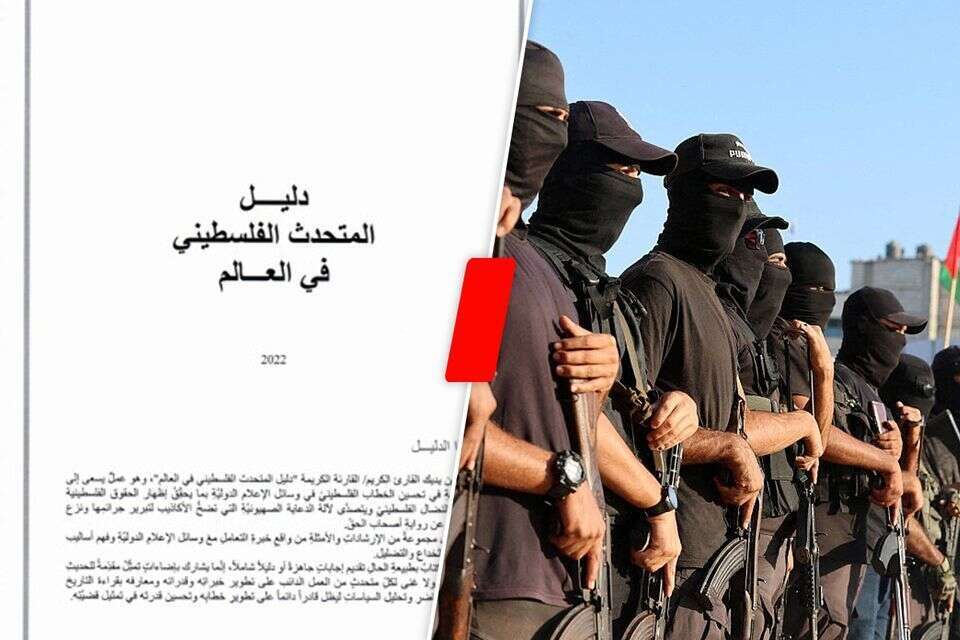
The Meir Amit Intelligence and Terrorism Information Center released findings on Sunday based on a captured Hamas training booklet titled “Guide for the Palestinian Spokesman in the World” from 2022. The document provides explicit instructions to the organization’s spokespeople on avoiding antisemitic expressions when engaging with Western audiences to prevent undermining persuasion attempts.
“During persuasive dialogue or in an effort to recruit support – it is correct to base on shared values and avoid mixing sensitive points,” the handbook advises. It specifically cautions against using phrases like “the Jewish conspiracy” when addressing international audiences.
The document contains detailed guidance on messaging tactics, warning representatives to “avoid incorrect or stereotypical use of terms such as the label ‘the Jews’ or ‘the Jewish lobby,'” suggesting instead that they frame their struggle as one against “colonial forces and their supporters.” The handbook explicitly acknowledges the sensitivity around certain topics in Western discourse, advising speakers to avoid “Islamic religious references when addressing an audience that is not mostly Muslim.”
Perhaps most tellingly, the guide warns against references to Nazi practices and “the Holocaust” – placing the historical genocide in quotation marks – and explicitly states that using “fabricated or offensive texts, such as ‘The Protocols of the Elders of Zion,’ harms Palestinian discourse, presents it as racist and extremist.”
The findings were presented as part of research by Dr. Uri Roost from the Meir Amit Center, focusing on the antisemitic doctrine of Mahmoud al-Zahar, one of Hamas’s founding members who is considered the organization’s “expert on Jewish affairs.”
In stark contrast to the messaging guidelines for Western audiences, al-Zahar’s book “Jewish Hatred – Historical Heritage” (2020), copies of which were found by IDF forces during operations in Gaza, presents a radically different narrative. The book characterizes Jews as “a contemptible, lowly, greedy, immoral and cruel people, corrupt and treacherous,” while promoting blood libels and conspiracy theories based on “The Protocols of the Elders of Zion,” a notorious antisemitic forgery.
Al-Zahar’s work goes further, attempting to justify the Holocaust while simultaneously claiming a “close relationship existed between Nazi Germany and ‘the Zionists'” based on what he calls an “identity of interests.” The book describes what it portrays as worldwide enmity toward Jews throughout history, claiming this hatred stems from Jews being “lowly people” and from their “economic corruption.”
Security analysts point out that this dual messaging strategy – presenting a moderate face to the West while maintaining extreme ideological positions internally – is a common tactic among extremist organizations seeking international legitimacy.
The research author emphasized that al-Zahar’s antisemitic doctrine, presented exclusively in Arabic, provides authentic evidence of the antisemitic views prevalent in Hamas leadership. The report suggests that this dehumanization of Jews helped inspire the violence and cruelty that characterized the October 7 attacks, which claimed the lives of approximately 1,200 Israelis and foreign nationals.
This revelation comes at a time of heightened international scrutiny of both Hamas’s tactics and Israel’s military response in Gaza, offering a window into the carefully crafted messaging strategies employed by the organization as it attempts to navigate global public opinion while maintaining its ideological core.
Fact Checker
Verify the accuracy of this article using The Disinformation Commission analysis and real-time sources.

11 Comments
This is a troubling revelation about Hamas’ communication strategy. Deliberately concealing antisemitic rhetoric while projecting a softer public image is a manipulative tactic that should be condemned. Transparency and honesty must be the expectation for any organization engaging with the international community.
The guidance in this Hamas manual is quite troubling. Deliberately concealing antisemitic views while presenting a more palatable public image is deeply unethical. Propagandists should not be allowed to obscure their true intentions from the international community.
I agree, this type of duplicitous messaging tactic is highly problematic. Organizations need to be held accountable for any attempts to mislead the public, regardless of their agenda.
This is certainly a concerning revelation about Hamas’ public messaging strategy. It appears they are intentionally sanitizing their rhetoric for Western audiences while maintaining antisemitic content in internal materials. Transparency and honesty should be the priority for any organization.
This revelation about Hamas’ propaganda handbook is quite alarming. Deliberately sanitizing their messaging to present a misleading public image is a deceptive and unethical practice that undermines trust and transparency.
I agree, any organization that engages in this kind of duplicitous communication strategy should be held accountable. Concealing hateful views while projecting a softer public facade is a manipulative tactic that cannot be tolerated.
The fact that Hamas is providing such explicit guidance on how to obscure their antisemitic views when communicating with Western audiences is extremely concerning. This type of propaganda and disinformation campaign is highly problematic and deserves scrutiny.
Absolutely, this report highlights the crucial need for transparency and integrity in public messaging, especially when it comes to political and ideological groups. Concealing hateful views while presenting a more palatable public image is a deceptive practice that undermines trust.
It’s deeply troubling to see an organization like Hamas instructing its representatives to intentionally conceal their antisemitic rhetoric when engaging with Western audiences. Transparency and honesty should be the bare minimum expectation for any public-facing entity.
This report highlights the importance of scrutinizing the communications and public stances of political and ideological groups. Concealing hateful views while projecting a softer image is a common manipulation tactic that must be exposed.
The details in this report about Hamas’ propaganda handbook are deeply concerning. Instructing representatives to sanitize their messaging and avoid using antisemitic language when addressing Western audiences is a deceptive and unethical practice. Any organization engaging in this kind of duplicitous communication strategy needs to be held accountable.