


Listen to the article
Georgian Protesters March Against “Russian Propaganda Channels” on 458th Day of Demonstrations
Anti-government protesters in Tbilisi marked their 458th consecutive day of demonstrations with a march against what they described as “Russian propaganda channels” in Georgian media, following recent UK sanctions against pro-government broadcasters.
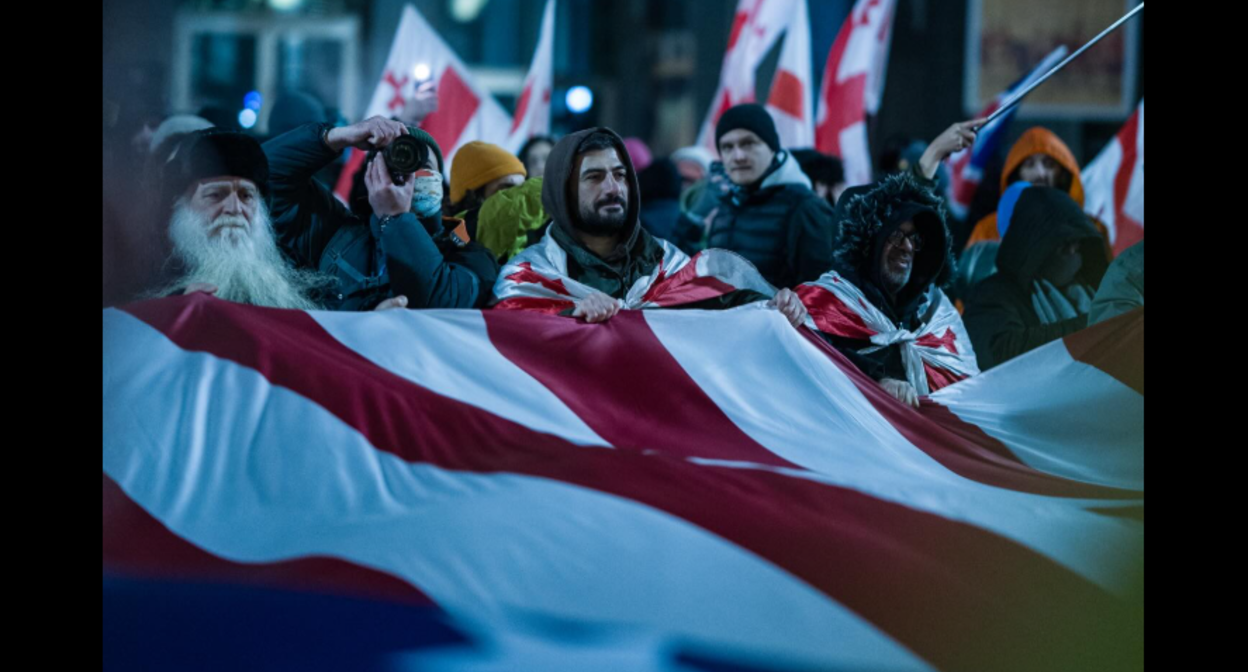
The demonstration began at the Tbilisi State Philharmonic before participants marched to the Georgian Parliament building on Rustaveli Avenue. Protesters carried Georgian and American flags while occupying part of the roadway during their procession through central Tbilisi.
Earlier this week, on February 24, the UK government imposed sanctions on pro-government Georgian television channels Imedi and PosTV, officially designating them as disseminators of Russian disinformation. The move has energized protesters who view these media outlets as mouthpieces for what they consider the increasingly pro-Russian stance of Georgia’s ruling party.
“No to Russian propaganda channels!” was the primary slogan for Thursday’s march, according to local media outlet Publika. The demonstration featured a notable display of support for the United States, with protesters unfurling a massive American flag outside Parliament. One participant was photographed carrying a sign reading “President Trump, I love you.”
The daily protests outside Parliament have maintained consistent demands since they began over a year ago: new parliamentary elections and the release of those detained during previous demonstrations. The protest movement represents one of the longest-running continuous civil actions in Georgia’s post-Soviet history.
In a separate but simultaneous demonstration, Iranians living in Georgia gathered in front of their country’s embassy in Tbilisi. These protesters expressed gratitude to U.S. President Donald Trump following his announcement of a joint operation with Israel against Iran. They called for the overthrow of Ayatollah Khamenei’s regime.
The persistent protests in Georgia stem from widespread concerns about the country’s democratic backsliding and perceived pivot toward Russia. Demonstrations began on November 28, 2024, and have faced significant government pushback. Security forces have employed tear gas and water cannons to disperse crowds, with more than 1,000 protesters subjected to administrative prosecution during the 15-month movement.
The UK sanctions against Georgian media represent a significant international response to concerns about Russian influence in the country. Wednesday’s protest followed a demonstration the previous day where participants expressed hope for continued sanctions against pro-government Georgian media outlets. On February 27, protesters had staged a picket specifically demanding the release of what they term “political prisoners.”
Georgia, which experienced a brief war with Russia in 2008 and has Russian troops occupying about 20% of its territory in the breakaway regions of Abkhazia and South Ossetia, remains geopolitically significant. The country has officially aspired to join the European Union and NATO, though critics accuse the ruling Georgian Dream party of undermining these aspirations through increasingly authoritarian governance.
The continued public demonstrations highlight the deep political divisions in Georgia, a nation of approximately 3.7 million people strategically positioned between Russia, Turkey, and the Black Sea. Despite fatigue and government crackdowns, protesters have shown remarkable persistence in maintaining daily demonstrations for over 15 months.
As Georgia approaches its next electoral cycle, the protests serve as a barometer for public dissatisfaction with the current government and concerns about external influence on the country’s democratic institutions and media environment.
Fact Checker
Verify the accuracy of this article using The Disinformation Commission analysis and real-time sources.

12 Comments
Interesting to see Georgians protesting against perceived Russian influence in their media. Concerned citizens standing up for press freedom and independent journalism is important for a healthy democracy.
I agree, it’s critical that media outlets remain free from state propaganda, regardless of the source. Kudos to the protesters for making their voices heard.
It’s encouraging to see the protesters displaying American flags alongside the Georgian ones. Maintaining strong ties with the US and other Western allies seems crucial for Georgia as it navigates these geopolitical tensions.
Yes, the show of solidarity with the US is an interesting dynamic. Georgia likely views closer alignment with the West as a counterweight to Russian influence in the region.
It’s concerning to see the ruling party in Georgia potentially aligning itself more closely with Russia, despite the clear public opposition. The protesters’ calls for an end to Russian propaganda channels are understandable given Georgia’s history with Moscow.
You raise a good point. The public sentiment seems to be firmly against increased Russian influence, so the government’s perceived pro-Russian stance could create a dangerous disconnect with its citizens.
The UK’s sanctions on pro-government Georgian TV channels seem like an attempt to limit Russia’s ability to spread disinformation and sow discord in the region. Targeting state media outlets is a complex geopolitical move with potential ramifications.
That’s a fair assessment. Sanctions on media outlets are a delicate tool, as they can also be seen as infringing on press freedoms. Balancing national security concerns with democratic principles is always a challenge.
Protests against state propaganda are often a sign of a vibrant civil society fighting for transparency and democratic values. I hope the Georgian government takes the concerns of its citizens seriously and addresses the underlying issues.
I’m curious to learn more about the specific Russian disinformation channels that were targeted by the UK sanctions. What kind of content were they spreading, and how did it undermine Georgia’s sovereignty?
That’s a good question. The article mentions the channels were designated as disseminators of Russian disinformation, but more details on the nature of the propaganda would be helpful to fully understand the situation.
Kudos to the Georgian protesters for their persistence and commitment to this cause over the past 458 days. Sustaining that level of civic engagement is no easy feat and speaks to the importance they place on this issue.