


Listen to the article
In a groundbreaking analysis of urban dynamics and media representation, researchers have unveiled patterns that demonstrate how cities’ prominence in news coverage follows mathematical principles similar to those governing physical growth and population distribution.
The study builds upon George Zipf’s pioneering 1949 work on the “Principle of Least Effort,” which has been influential in understanding urban hierarchies and information distribution. By applying scaling laws traditionally used to analyze city growth patterns, scientists have now documented how media coverage of urban centers follows predictable mathematical relationships.
“Urban scaling laws have been well-established for population growth, economic activity, and innovation rates,” explains urban science expert Dr. Mikhail Batty, whose work is cited in the research. “What’s fascinating is seeing these same principles apply to how cities are represented in media narratives.”
The research draws on extensive datasets, including historical urban population figures from NASA’s Socioeconomic Data and Applications Center and European population records dating back to 700 CE. By correlating these figures with media mentions, researchers observed that larger cities receive disproportionately more coverage relative to their population size.
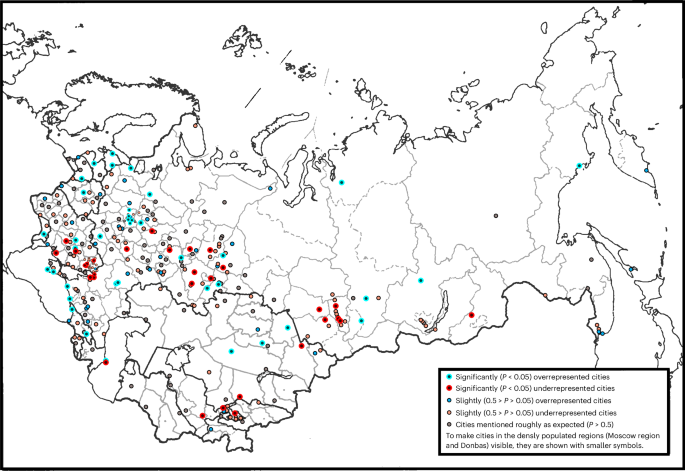
This scaling relationship is particularly evident in the analysis of Soviet-era media, where Moscow and Leningrad (now St. Petersburg) dominated coverage to an extent that exceeded what would be predicted by population alone. This reflects what scholars have termed “spatial hierarchies” in Soviet political geography.
“The Soviet Union presents a fascinating case study,” notes historian Elena Gilburd, whose work on Soviet cultural diplomacy is referenced in the research. “Media representation wasn’t just about reporting reality but actively constructing it according to ideological priorities that emphasized certain urban centers.”
The international dimension of media representation reveals complex geopolitical patterns. During the Cold War era, Western European cities received significantly more coverage in Soviet media than their Eastern European counterparts despite the latter’s formal alliance with the USSR. This paradoxical pattern highlights the cultural prestige attributed to cities like Paris, which featured prominently in Soviet media as symbols of high culture.
Finland’s unusual media prominence in Soviet coverage illustrates another aspect of this phenomenon. Despite its modest size, Helsinki received disproportionate attention, reflecting the special relationship between Finland and the USSR under the policy of “Finlandization” during the Cold War.
Researchers employed sophisticated statistical methods, including Akaike Information Criterion (AIC) modeling, to identify the most significant factors determining media coverage. Their findings confirm that simple population size is insufficient to explain media representation patterns, with geopolitical significance and cultural capital playing crucial roles.
The study also highlights the concept of “absent cities” – urban centers that receive virtually no media coverage despite substantial populations. This phenomenon creates what researchers term a “visibility gap” that can have profound implications for regional development and public perception.
“When certain cities are systematically underrepresented in media discourse, it creates a feedback loop that can affect everything from tourism to investment,” explains urban economist Marc Keuschnigg, whose work on regional divides is cited in the study.
The implications extend beyond historical analysis to contemporary media environments. As news consumption increasingly shifts online, understanding these mathematical patterns could help identify blind spots in coverage and address potential biases in how different regions are represented.
For urban planners and policymakers, the research offers valuable insights into how media representation correlates with economic development trajectories. Cities that punch above their weight in media visibility often enjoy advantages in attracting investment and human capital.
As urbanization continues to accelerate globally, with the UN projecting that 68% of the world’s population will live in urban areas by 2050, understanding these patterns of representation becomes increasingly critical for addressing regional inequalities and ensuring balanced development.
Fact Checker
Verify the accuracy of this article using The Disinformation Commission analysis and real-time sources.

9 Comments
Fascinating analysis on how media coverage of cities follows predictable mathematical patterns. I’d be curious to see if these scaling laws hold true across different media types and time periods. Seems like an insightful way to study urban representation in the news.
Interesting to see how urban scaling laws can be applied to media coverage. I wonder if this extends beyond just Soviet propaganda to other news sources and regions. Could provide useful insights into biases in reporting.
Applying mathematical principles to analyze media representation of cities is an ingenious approach. I’d be curious to learn more about the implications for understanding cultural data patterns and potential propaganda effects.
Applying urban science principles to analyze media representation is a clever approach. I’m curious to learn more about how this research could inform our understanding of cultural data patterns and potential propaganda effects.
The findings that media coverage of cities follows mathematical laws similar to urban growth patterns is really thought-provoking. I wonder how this could inform our understanding of the drivers behind news reporting and information distribution.
This is a fascinating study that shows how even seemingly subjective media coverage is influenced by underlying mathematical and cultural patterns. I’d be curious to see if these findings hold true for other regions and time periods.
Fascinating to see how mathematical principles can be used to analyze media coverage and uncover potential biases. I’m curious to learn more about how this research could inform our understanding of cultural data patterns and the distribution of information.
This is a really fascinating application of urban scaling laws to media analysis. I’m impressed by how the researchers were able to uncover patterns in Soviet propaganda’s urban focus. Curious to see if similar trends emerge in other news sources and regions.
This research on the urban focus of Soviet propaganda highlights the power of data-driven approaches to uncover hidden biases. Applying scaling laws to media coverage seems like a promising avenue for further study.