


Listen to the article
From Top Gun to Marvel: Hollywood’s Mastery of Propaganda
Oscar Wilde once famously declared that works of art are incapable of morality—they are simply good or bad, and only “brutes and illiterates” discuss the morality of art. This statement came during his ill-fated defamation trial against the Marquess of Queensberry, which ultimately led to Wilde’s own downfall when private detectives proved the accusations against him.
Wilde’s insistence that art exists beyond moral judgment feels particularly relevant when examining Hollywood’s century-long relationship with propaganda. While critics and audiences often debate whether certain films constitute “propaganda,” the reality is that Hollywood has perfected the art of ideological messaging so thoroughly that viewers rarely recognize it as such.
From its earliest days, American cinema has served as an extension of national identity, foreign policy, and cultural values. The political establishment quickly recognized that film studios could accomplish what no government white paper could: reach the masses with powerful messaging without appearing preachy. Even seemingly apolitical films have functioned as emotional fortifications of American virtue.
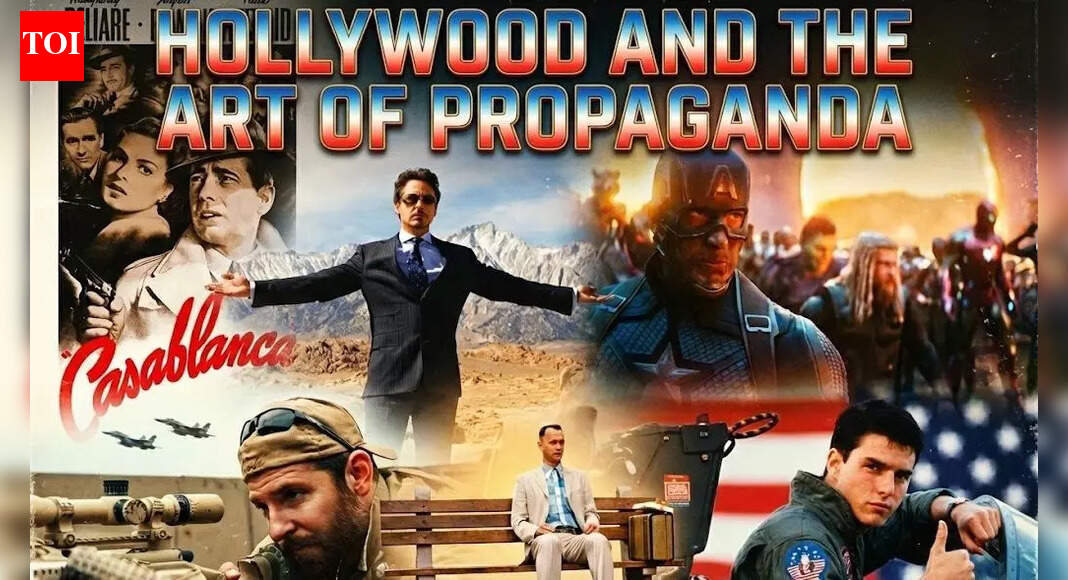
During World War II, Hollywood entered into an almost military-grade partnership with Washington. Films weren’t just entertainment—they were civic instruction manuals with scripts vetted for ideological clarity. Every hero embodied democratic virtues, while villains represented existential threats to the American way of life. Even romantic classics like “Casablanca” served as effective recruitment tools, packaging wartime ideology in a love story that audiences could emotionally connect with.
“Hollywood mastered the art of telling a nation’s story through the journey of a single protagonist, allowing geopolitics to be reduced to something you could feel rather than analyze,” explains film historian Robert Thompson.
After Hitler’s defeat, Soviet communism became Hollywood’s new antagonist. The studios pivoted seamlessly, with entire genres retooled to reflect Cold War anxieties. Science fiction films depicted alien invasions as thinly veiled metaphors for communist infiltration, while psychological thrillers explored fears of brainwashing and ideological subversion. Films like “Invasion of the Body Snatchers” transformed communism into biological horror, while “The Manchurian Candidate” elevated political paranoia into Shakespearean tragedy.
The industry’s commitment to anti-communist messaging went beyond storytelling—it became institutionalized during the blacklist era, when writers and directors were interrogated about their political beliefs. Hollywood didn’t merely participate in propaganda; it became one of its most zealous enforcers.
Vietnam disrupted this narrative machinery for the first time. As the American public absorbed disturbing war footage on nightly television, Hollywood’s attempts to package the conflict as a noble crusade fell flat. The industry responded by reinventing itself, shifting from triumphalism to vulnerability. Films like “Apocalypse Now” and “The Deer Hunter” portrayed soldiers not as paragons of virtue but as conflicted participants in a morally ambiguous war.
Yet even this aesthetic of disillusionment served a purpose: it allowed Americans to process defeat without questioning the legitimacy of global intervention. The fault lay with politicians, not with American heroism itself. Years later, “Forrest Gump” would provide a comforting revisionist narrative of the Vietnam era, reminding audiences that America’s heart remained pure despite its mistakes.
The Reagan presidency ushered in a cinematic renaissance of muscular patriotism. Films like “Rambo,” “Rocky IV,” and particularly “Top Gun” resurrected the myth of American invincibility, serving as cultural therapy for a nation eager to move past Vietnam’s humiliations.
“‘Top Gun’ represented the moment when the line between cinema and military recruitment blurred completely,” notes cultural critic Susan Jeffords. “Tom Cruise in an F-14 did more for Naval recruitment than any PR budget could achieve.”
The post-9/11 era brought a more nuanced approach to American interventionism. Films became darker and more introspective, yet still anchored to the belief that American action was necessary for global order. The soldier was presented not as triumphant hero but as tragic martyr—flawed, conflicted, yet indispensable to civilization’s defense.
Marvel’s superhero universe represented the next evolution in cinematic influence, with superheroes functioning as ideological avatars embodying American values in mythic form. Iron Man’s journey from weapons dealer to cosmic savior reframed the military-industrial complex as a series of ethical learning opportunities, while Captain America served as the living embodiment of American moral aspiration.
In recent years, Hollywood has navigated complex relationships with both progressive politics and Chinese censorship. The industry embraced themes of representation and inclusion partly due to genuine cultural evolution but also because diversity became commercially valuable. Meanwhile, China’s massive market power quietly shaped content, as studios removed potential political complications—Tibetan characters became Celtic, Chinese villains disappeared, and maps were carefully sanitized to avoid offending Beijing.
“China demonstrated that the most effective censorship doesn’t silence dissent; it prices it out of existence,” observes international relations scholar Elizabeth Economy.
The ultimate irony is that while Hollywood often positions itself as progressive, the entire industry operates on aggressively capitalist principles. Studios may produce films critiquing capitalism and corporate greed, but they do so with money drawn from corporations demanding predictable returns and global market access.
Hollywood’s “wokeness” is not a rebellion against capitalism but capitalism in new packaging—ideology has simply become marketable. The director’s artistic vision remains dependent on the producer’s financial backing, which in turn depends on market sentiment.
And so, contrary to Wilde’s assertion that art exists beyond morality, Hollywood has demonstrated that art and commerce are inseparable—and those who control the money ultimately shape the moral universe portrayed on screen. This might be the industry’s most enduring propaganda achievement: convincing the world that ideology can be beautiful, righteous, and entertaining, as long as it earns a return on investment.
Fact Checker
Verify the accuracy of this article using The Disinformation Commission analysis and real-time sources.

8 Comments
The article’s analysis of Hollywood’s mastery of propaganda techniques is both illuminating and troubling. It underscores the power of the film industry to shape public perceptions and reinforce certain ideological positions, often in subtle and insidious ways. This is an important topic that deserves more attention.
This article raises important questions about the role of art and entertainment in shaping public perceptions and national narratives. The idea that even ‘apolitical’ films can function as propaganda is quite sobering. It’s a topic worth deeper exploration.
Absolutely. The blurring of lines between art, entertainment, and propaganda is a complex issue that deserves close examination. It speaks to the immense power of visual media and storytelling to influence hearts and minds.
A thought-provoking examination of Hollywood’s longstanding relationship with propaganda. The article highlights how the industry has evolved in its approach, seamlessly weaving ideological messaging into popular films. It’s a concerning trend that warrants further discussion.
Interesting analysis of Hollywood’s long history of incorporating propaganda into its films. While some may view this as manipulation, others see it as a powerful way to shape cultural narratives and national identity. It’s a complex issue without easy answers.
This is a fascinating and unsettling look at the ways in which Hollywood has become an effective tool for propagating certain narratives and values. The article raises important questions about the ethics of using entertainment as a vehicle for propaganda, even if it’s done subtly. It’s a complex issue worth unpacking further.
Fascinating look at the evolution of propaganda in Hollywood films, from Top Gun to the Marvel cinematic universe. It highlights how effectively the film industry can weave ideological messaging into seemingly apolitical entertainment. Definitely food for thought.
I agree, it’s a nuanced topic. While propaganda can be troubling, the way Hollywood has mastered blending it with popular entertainment is quite remarkable from a strategic perspective, if not always from an ethical one.