


Listen to the article
George Orwell’s War Propaganda Quote Finds New Relevance Amid Modern Conflicts
A quote attributed to British novelist George Orwell has been circulating widely across social media platforms as international tensions escalate. The passage, which reads, “All the war propaganda, all the screaming and lies and hatred, comes invariably from people who are not fighting,” has gained traction following recent military actions between the U.S., Israel, and Iran.
The attribution to Orwell is indeed accurate. The observation appears in his 1938 memoir “Homage to Catalonia,” which chronicles his experiences as a volunteer during the Spanish Civil War. In its full context, the original sentence reads: “One of the most horrible features of war is that all the war-propaganda, all the screaming and lies and hatred, comes invariably from people who are not fighting.”
The quote’s resurgence coincides with heightened global conflicts. On March 3, an X user shared the quote alongside Orwell’s photograph, just days after the United States and Israel initiated military strikes that ignited conflict with Iran. The message quickly spread across multiple platforms including Facebook, Instagram, Threads, TikTok, and Bluesky.
Orwell’s observations on war journalism emerged from his firsthand combat experience. In the fifth chapter of “Homage to Catalonia,” he reflects on the disconnect between battlefield realities and media portrayal: “It is not a nice thing to see a Spanish boy of fifteen carried down the line on a stretcher, with a dazed white face looking out from among the blankets, and to think of the sleek persons in London and Paris who are writing pamphlets to prove that this boy is a Fascist in disguise.”
The author’s criticism extends to media outlets across the political spectrum. He laments: “One of the dreariest effects of this war has been to teach me that the Left-wing press is every bit as spurious and dishonest as that of the Right.” This disillusionment with wartime journalism stemmed from his observation that those creating inflammatory content remained “safe at home, at worst in the newspaper offices in Valencia, hundreds of miles from the bullets and the mud.”
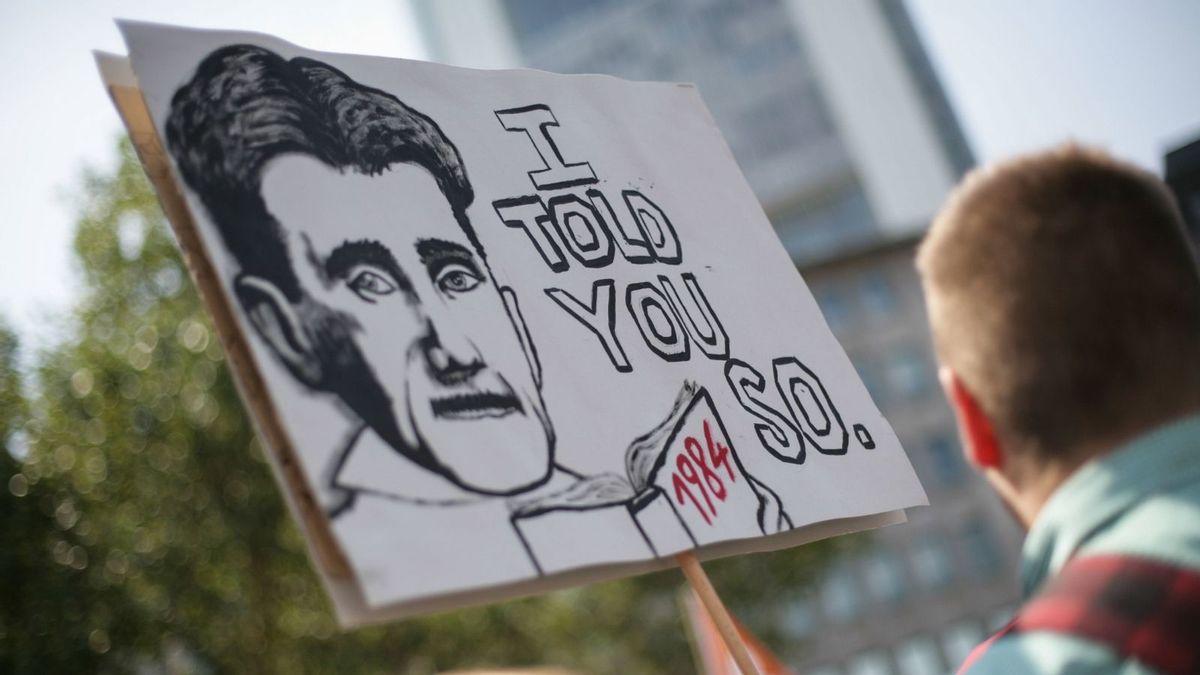
Orwell’s perspective carries particular weight given his military service. Before becoming the acclaimed author of dystopian classics like “1984” and “Animal Farm,” he served as a militia member for the Workers’ Party of Marxist Unification during the Spanish conflict. This experience informed his nuanced understanding of war’s complexities and the often simplified narratives portrayed in media coverage.
The renewed interest in Orwell’s commentary reflects how his insights continue to resonate with modern audiences grappling with media coverage of contemporary conflicts. His critique highlights the ethical challenges in war reporting and raises questions about who shapes public perception during times of conflict.
Literary scholars note that “Homage to Catalonia” represents a pivotal moment in Orwell’s intellectual development. His experiences in Spain profoundly influenced his subsequent political writings and his commitment to truth-telling in journalism. The memoir stands as both a personal account and a warning about propaganda’s power.
As reports indicate that approximately 140 U.S. troops were wounded in the Iran conflict by March 2026, with eight suffering severe injuries, Orwell’s observations about the disconnect between combat realities and media narratives continue to provide a framework for critical media consumption during wartime.
The endurance of Orwell’s quote across generations underscores how certain truths about war and its representation remain constant, even as the specific conflicts and communication technologies evolve.
Fact Checker
Verify the accuracy of this article using The Disinformation Commission analysis and real-time sources.

16 Comments
Orwell’s insights into the dynamics of wartime propaganda remain profoundly relevant, even decades after he penned them. This quote underscores the importance of questioning the motivations and experiences of those driving the narrative.
While the quote may be familiar, it’s a timely reminder to approach discussions of international conflicts with a critical eye and an openness to diverse perspectives.
This quote highlights an important dynamic – those most directly impacted by war are often not the ones driving the inflammatory rhetoric and propaganda. It’s a sobering observation that warrants careful consideration.
As we navigate the complexities of modern global conflicts, Orwell’s insight serves as a valuable check on our own tendencies to be swayed by sensationalism and one-sided narratives.
This Orwell quote is a compelling reflection on the disconnect between those who advocate for war and those who must endure its consequences. It’s a sobering reminder of the need for nuance and skepticism in the face of inflammatory rhetoric.
As global tensions continue to escalate, Orwell’s words serve as a valuable touchstone for evaluating the validity and motives behind the narratives we’re presented.
Orwell’s keen observation about the disconnect between war rhetoric and war experience is a sobering reflection on human nature. It’s a reminder to be wary of those quick to stoke the flames of conflict from the sidelines.
As we navigate the current global tensions, it’s worth revisiting Orwell’s wisdom and considering how it might inform our own critical analysis of the information we consume.
It’s interesting to see this Orwell quote resurface amid the ongoing global conflicts. His insights into wartime propaganda and the disconnect between those who wage war and those who experience it firsthand remain highly relevant.
Orwell’s perspectives offer a timely reminder to be critical consumers of information during times of heightened tensions and rhetoric.
Orwell’s insights into the dynamics of wartime propaganda offer a valuable lens through which to view the current global tensions. His observation about the disconnect between those who wage war and those who experience it firsthand is a sobering reality that warrants careful consideration.
As we navigate the complexities of modern conflicts, Orwell’s words serve as a timely reminder to approach information with a critical eye and to seek out diverse perspectives that challenge our assumptions.
Orwell’s astute observation about the origins of war propaganda is a poignant reminder of the need for critical thinking and fact-checking, especially during times of heightened conflict and uncertainty.
While the quote may be familiar, its message remains as relevant as ever – we must be vigilant in parsing truth from rhetoric, and seek out diverse perspectives to inform our understanding of complex global issues.
Orwell’s words ring true – the loudest voices in times of war often come from those far removed from the realities of combat. This underscores the importance of seeking out diverse perspectives and verifying information sources.
While the quote may be decades old, its message about the dangers of unchecked propaganda remains painfully relevant in today’s geopolitical landscape.