


Listen to the article
Drones Emerge as Powerful Propaganda Weapons for African Armed Groups
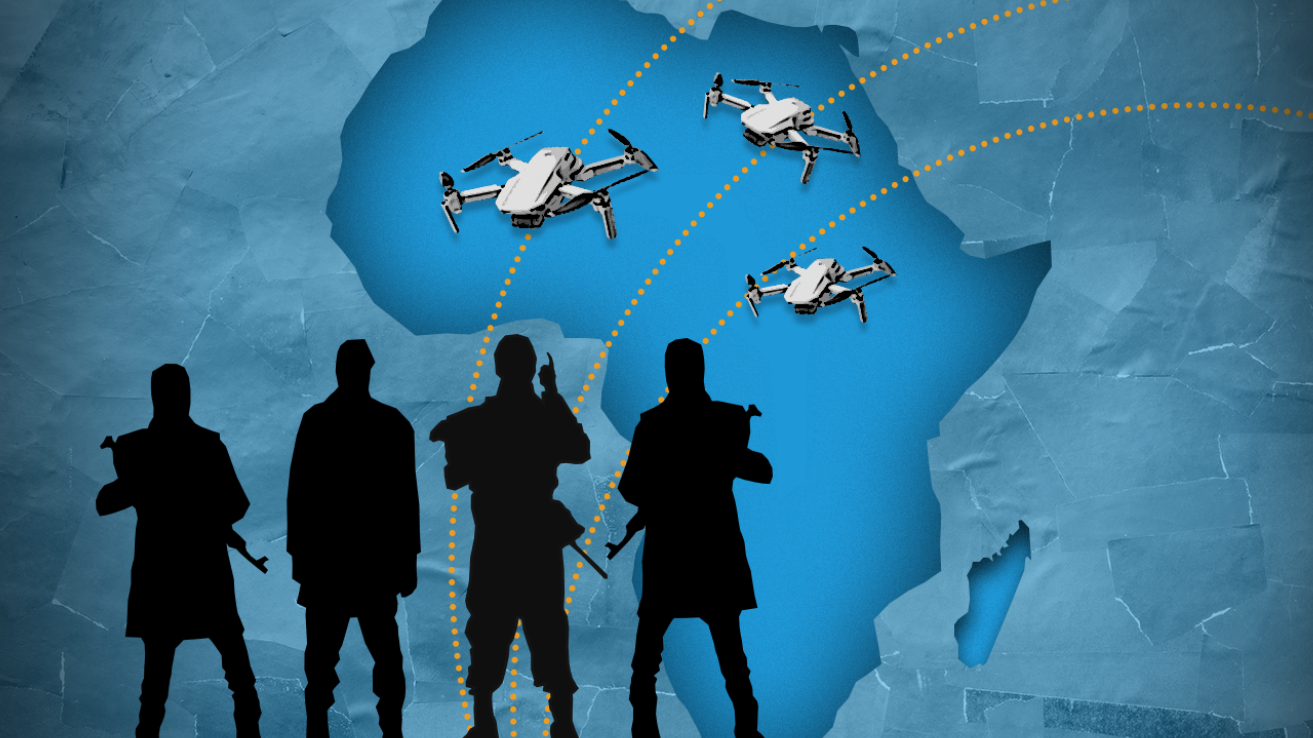
Africa is witnessing a rapid expansion in drone technology adoption, with implications extending far beyond the battlefield. While unmanned aerial systems (UAS) provide intelligence and lethal force capabilities, they’re increasingly being leveraged by non-state armed groups as powerful propaganda tools.
Intelligence reports suggest approximately nine armed groups across Africa have acquired military-grade drones. These groups operate in Burkina Faso, Democratic Republic of the Congo (DRC), Kenya, Libya, Mali, Mozambique, Nigeria, Somalia and Sudan, signaling a concerning trend in technological proliferation.
Security experts highlight how violent non-state actors are strategically using drones for propaganda generation, both to showcase their aerial capabilities and to publish striking footage of their operational activities. This dual-purpose usage amplifies their messaging reach while projecting an image of technological sophistication.
The democratization of drone technology is evident in how both African militaries and insurgent groups deploy various models—from sophisticated military-grade systems to inexpensive hobbyist drones and locally manufactured variants. This technological convergence is steadily eroding the capability gap between state and non-state actors.
The ongoing Ukraine-Russia conflict has served as both inspiration and technological testing ground. Ukraine’s recent “Operation Spider’s Web” demonstrated the evolving scale of drone warfare, with the country reportedly using 117 pre-positioned drones to target Russian military infrastructure. Such operations provide tactical blueprints that African armed groups are studying closely.
Propaganda benefits from drone deployment manifest in two key ways. First, merely claiming drone capability sends a powerful psychological message that can elevate a group’s perceived threat level. According to Maria-Louise Clausen of the Danish Institute for International Studies, “the status and prestige associated with possessing drones can itself become a primary objective” for these organizations.
Second, drones function as information-gathering tools, capturing video, images and audio that are disseminated across online platforms and messaging applications. This content feeds sophisticated propaganda operations that project power beyond a group’s actual military capabilities.
Yemen’s Houthi movement (Ansar Allah) exemplifies this approach. Kerry Chávez, who studies non-state actor drone usage, notes that the Houthis “explicitly market their drone use,” with the mere act of “launching a UAV makes a statement.” Their tactical and symbolic successes could potentially influence allied groups in Somalia as cross-regional extremist partnerships strengthen.
Somalia’s al-Shabaab has already demonstrated their understanding of drones’ propaganda potential. Their media channels featured images of a downed military-grade drone in 2016, showcasing both technological awareness and propaganda sophistication. The Combating Terrorism Center described al-Shabaab’s media apparatus as “particularly adept at psychological operations” following their deadly January 2020 attack on Manda Bay, Kenya, which featured drone footage.
In the Sahel region, Boko Haram and Islamic State West Africa Province are experimenting with drone-captured propaganda videos. Francis Okpaleke, writing for the Global Network on Extremism and Technology, argues these videos “serve not only as a tool for recruitment but also to demonstrate technological prowess, enhancing the group’s perceived legitimacy and power” while potentially attracting financial support.
The Allied Democratic Forces in the DRC have been documented using drones to “record videos and take pictures of its camps for propaganda,” according to the UN Institute for Disarmament Research. This assessment was based on interviews with former combatants and abductees.
The integration of artificial intelligence with drone footage represents a concerning evolution. Chávez notes that feeding drone imagery into AI systems allows armed groups to “economize their propaganda production and dissemination” by enabling rapid content creation and distribution across multiple platforms.
While the UN Security Council has adopted numerous resolutions addressing drone misuse, more focused initiatives like the Berlin Memorandum on Good Practices for Countering Terrorist Use of Unmanned Aerial Systems are emerging. However, in regions where weapons smuggling is already endemic, illicit trade in drone components presents a significant monitoring challenge.
The recent Ukrainian drone operations against Russia—where over a hundred drones reportedly evaded detection—underscores the evolving nature of this threat and its potential to reshape regional security dynamics across Africa as non-state actors continue adapting these technologies for both kinetic and propaganda purposes.
Fact Checker
Verify the accuracy of this article using The Disinformation Commission analysis and real-time sources.

14 Comments
Drones are a powerful technology, and it’s concerning to see them being used for propaganda by armed groups in Africa. This underscores the importance of robust regulations and international cooperation to prevent misuse.
You make a good point. Restricting access and use of advanced drone technology by non-state actors should be a top priority for regional and global security efforts.
The use of drones for propaganda by armed groups in Africa is a worrying development that underscores the need for robust regulations and control measures to prevent the misuse of this technology.
You make a valid point. Preventing the weaponization of drones for propaganda and other illicit purposes should be a top priority for policymakers and security agencies.
This is a concerning trend that demonstrates the dual-use potential of drone technology. Effective countermeasures are needed to prevent armed groups from exploiting these systems for propaganda and other nefarious purposes.
Agreed. The proliferation of drone tech in the hands of non-state actors is a serious security challenge that requires coordinated efforts to address at regional and global levels.
The increasing use of drones for propaganda by armed groups in Africa is a troubling development. It highlights the need for comprehensive strategies to address the proliferation and misuse of this technology.
Absolutely. Mitigating the risks posed by the weaponization of drones for propaganda will require a multi-faceted approach involving improved regulations, enhanced monitoring, and international cooperation.
This highlights the dual-edged nature of drone technology – it can be a powerful tool for both military and propaganda applications. Careful oversight is needed to prevent misuse by extremist groups.
You’re right, the democratization of drone tech means it’s becoming increasingly accessible to a wide range of actors, including those with malicious intentions. Robust control measures are essential.
Worrying to see how armed groups are leveraging drone technology for propaganda purposes. Curious to understand what can be done to restrict their access and use of these systems.
Agreed, the proliferation of drone technology is a concerning development, especially in the hands of non-state actors. Stricter regulations and enforcement will be crucial.
The use of drones for propaganda purposes is a worrying trend that needs to be addressed. Security experts will have to stay vigilant and find ways to limit the proliferation of these systems.
Definitely a complex issue. Technological advancements often have unintended consequences, and this case underscores the need for proactive policies to mitigate the risks.