


Listen to the article
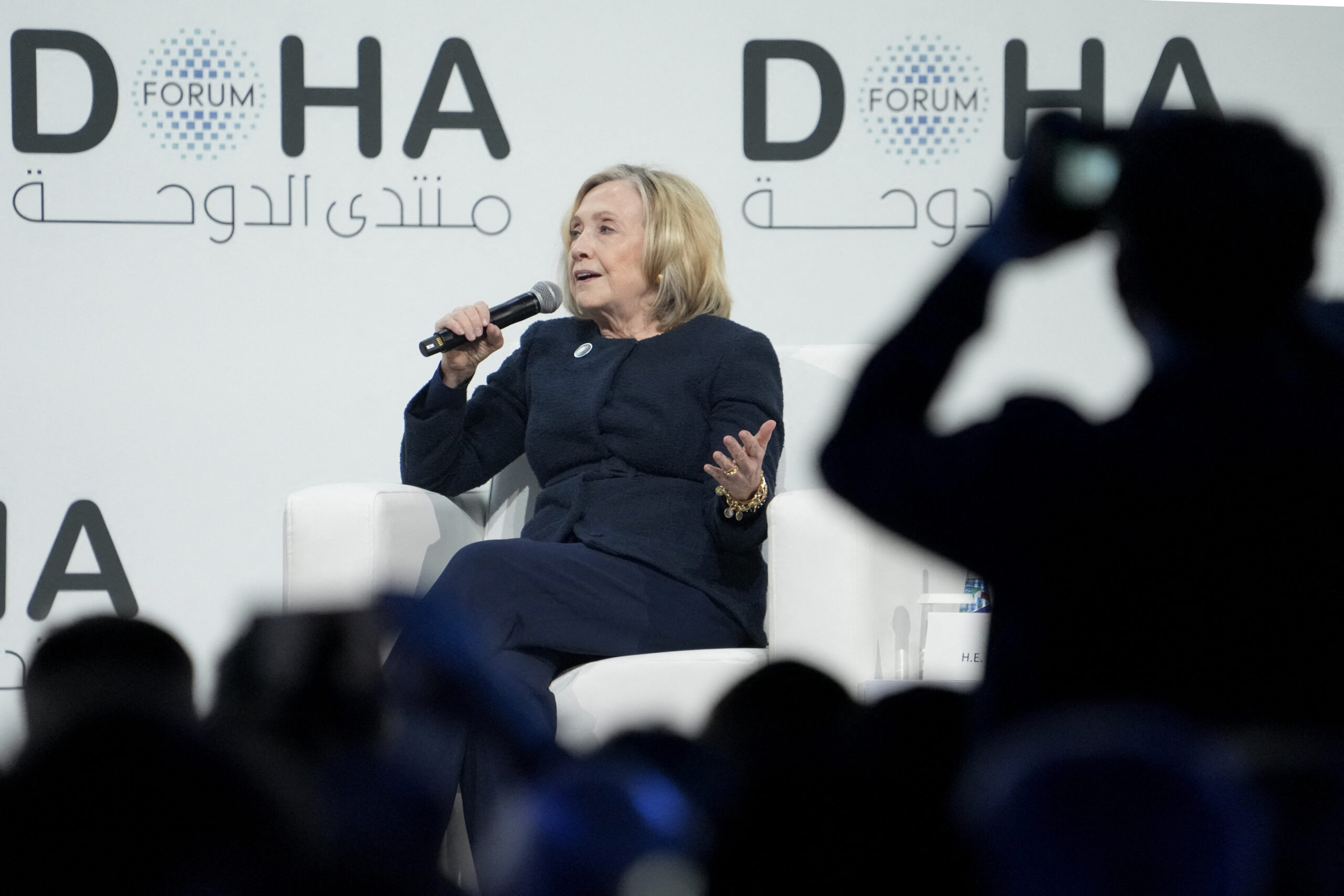
In a candid exchange at the Doha Forum in Qatar, former Secretary of State Hillary Clinton defended her recent statements about American youth’s perspectives on the Israel-Hamas conflict, reiterating her belief that social media consumption and historical knowledge gaps are shaping their views.
Clinton, speaking during a panel discussion on global power dynamics and former President Donald Trump’s foreign policy, addressed questions about controversial remarks she made at the Israel Hayom Summit, where she suggested young Americans lack proper context on the conflict and are influenced by online propaganda.
Moderator Ravi Agrawal, editor-in-chief of Foreign Policy magazine and a noted critic of Israel’s military operations in Gaza, pressed Clinton to elaborate on these statements and the controversy they sparked.
“I’ve had many conversations with very smart young people,” Clinton responded, referencing her teaching experience at Columbia University’s School of International Public Affairs. “In talking with them about their views, which they are entitled to based on whatever information they had, they did not always know why they were saying what they said.”
The former presidential candidate emphasized that her concern centers on historical literacy. “All I’m asking for is that people have a historical context, both for what has happened to the Palestinians and what has happened to the Israelis,” she explained.
To illustrate her point, Clinton referenced encounters with young Americans chanting “from the river to the sea” – a slogan popular within the Palestinian movement that many Jewish and pro-Israel organizations interpret as calling for the elimination of Israel. According to Clinton, when questioned about which river and sea the phrase referred to, these students couldn’t specify.
“I think it is a provable fact that most Americans, and an even bigger percentage of young Americans, get their news from social media. If that is controversial, then people are not paying attention,” Clinton asserted.
Agrawal challenged this characterization, suggesting that beyond misinformation concerns, genuine anger exists among young people who are “grappling with witnessing images that are livestreamed” from conflict zones like Gaza.
The exchange highlights growing generational divides in American politics regarding the Israel-Palestine conflict, which has intensified following Hamas’ October 7 attack on Israel and Israel’s subsequent military campaign in Gaza. Polling data has consistently shown younger Americans expressing more sympathy for Palestinians compared to older demographics, who tend to align more with Israel.
Clinton broadened her response to encompass global humanitarian concerns, suggesting that focusing exclusively on Gaza neglects other significant international crises.
“I’m angry about all of the human rights abuses. I’m angry about all of the excessive use of force,” she said. “So, of course, the suffering in Gaza is horrific. Full stop. Suffering everywhere is horrific. I think that the emphasis on one terrible conflict sort of doesn’t do justice to the challenges that we are confronting.”
The former Secretary of State’s comments come amid intensifying debate within the Democratic Party over U.S. policy toward Israel and growing criticism of the Biden administration’s handling of the conflict. College campuses across America have witnessed sustained protests against Israel’s military operations in Gaza, which have resulted in thousands of Palestinian casualties according to health authorities in the Hamas-controlled territory.
The debate illustrates broader tensions between established Democratic leaders like Clinton, who have historically maintained strong support for Israel, and younger progressive voters who increasingly question this alignment, especially in light of the humanitarian situation in Gaza.
Fact Checker
Verify the accuracy of this article using The Disinformation Commission analysis and real-time sources.

12 Comments
Interesting that Clinton is focusing on how social media and knowledge gaps shape young Americans’ views on Israel-Hamas. Curious to hear more about her perspective on this complex geopolitical issue.
I agree, it’s a nuanced topic that deserves thoughtful discussion. The influence of social media on political views is an important issue to explore.
Clinton’s comments underscore the importance of providing comprehensive, factual information to young people on complex geopolitical issues like the Israel-Hamas conflict. Nuance and historical context are crucial.
Agreed. Addressing knowledge gaps and combating misinformation should be a priority, while respecting principles of free speech and diverse perspectives.
Clinton’s comments raise important questions about the role of social media in shaping political views, especially among younger generations. Addressing knowledge gaps is a complex challenge.
Absolutely. Balancing free speech principles with the need to combat misinformation is an ongoing challenge that policymakers will continue to grapple with.
Clinton’s comments highlight the challenges of shaping public opinion on contentious global conflicts. Providing historical context and balanced information is crucial, especially for younger audiences.
Absolutely. Combating misinformation and propaganda requires a multi-pronged approach targeting both the supply and demand sides of information consumption.
As someone with extensive foreign policy experience, Clinton’s insights on how to better inform young Americans about the Israel-Hamas conflict are valuable. I’m curious to hear more of her recommendations.
Agreed. Engaging youth on these issues in a thoughtful, nuanced way is crucial for promoting greater understanding and informed debate.
It’s interesting that Clinton is focusing on the Israel-Hamas conflict as an example of how social media and knowledge gaps can influence young Americans’ perspectives on global issues.
Given Clinton’s extensive foreign policy experience, her insights on this topic are certainly worth considering, even if one may not agree with all of her views.