


Listen to the article
South Chungcheong Governor Denounces “Black Propaganda” Over Failed Merger with Daejeon
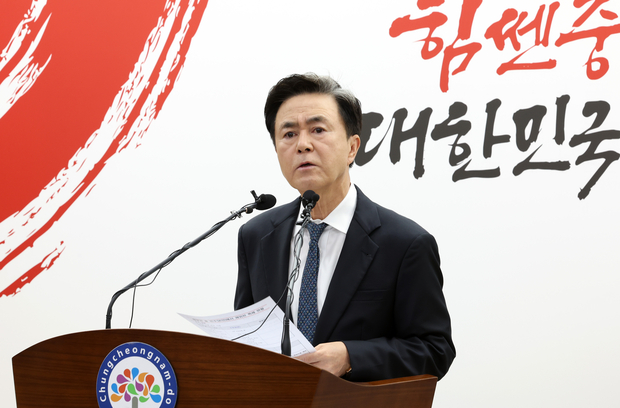
South Chungcheong Province Governor Kim Tae-heum has launched a scathing critique against what he describes as “black propaganda” surrounding the collapsed administrative merger between his province and Daejeon Metropolitan City.
Speaking at a press briefing on Tuesday, Kim declared the proposed merger “virtually impossible” following the conclusion of February’s extraordinary legislative session. “Black propaganda such as ‘They rejected 20 trillion won’ and ‘Chungnam will be left out’ is running rampant,” Kim stated, addressing widespread criticism of his position on the failed integration.
The governor directed much of his frustration toward the Democratic Party, which holds a majority in South Korea’s National Assembly. “The Democratic Party is deflecting responsibility, claiming the merger failed due to opposition from me and the People Power Party,” Kim said. “But isn’t this a legislative dictatorship where the ruling party passes all laws unilaterally?”
Kim questioned the theatrical nature of opposition tactics, noting that if the Democratic Party had truly wanted the merger, they could have pushed it through with their numerical advantage rather than resorting to “fasting protests, head-shaving, and sit-ins.” He urged the party to “stop deceiving the public and apologize for pushing a bill with no fiscal provisions or authority transfers.”
The governor took particular issue with claims regarding 20 trillion won (approximately $15 billion) in promised financial support for the merger, dismissing it as an unsubstantiated figure. “The 20 trillion won figure came from a single remark by Prime Minister Kim Min-seok. Nothing is specified in the bill—no funding sources, no distribution methods. It has no substance,” he explained.
Kim revealed that his administration had actually proposed a more substantial funding package. “Why did they reject our demand for 36 trillion won over four years, or 9 trillion won permanently each year?” he asked, suggesting the Democratic Party’s unwillingness to commit concrete resources to the merger.
The administrative reorganization debate extends beyond Daejeon and South Chungcheong, forming part of a broader national conversation about regional consolidation. Similar merger discussions have occurred between Daegu and North Gyeongsang, as well as Gwangju and South Jeolla provinces—regions with distinct political leanings in South Korea’s regionally divided political landscape.
Kim portrayed the opposition’s strategy as deliberately divisive. “They pressured us saying, ‘Daegu-North Gyeongsang is doing it, so Daejeon-Chungnam will miss a good opportunity.’ But I believe their intention from the start was to pass only the Gwangju-South Jeolla merger,” he claimed.
The merger initiatives are part of an ongoing effort to address South Korea’s longstanding regional imbalances, with the Seoul Capital Area housing nearly half the nation’s population while other regions experience population decline and economic stagnation. Administrative consolidation has been proposed as one solution to strengthen regional competitiveness and governance.
Despite his firm opposition to the current proposal, Kim emphasized that he remains open to merger discussions under different terms. “Even if integration is delayed, we must address these problems and create a merger bill that includes the fiscal and authority transfers we demand, to be implemented in two to four years. A hasty merger driven by time pressure is unacceptable,” he said.
The governor called for establishing “an equal-representation special committee in the National Assembly and a pan-government body” to draft legislation ensuring equitable treatment for all regions involved in potential mergers.
Concluding his remarks, Kim appealed directly to opposition leader Lee Jae-myung, urging him to “present a permanent integration plan that realizes true local autonomy, resolves the concentration of power in the capital region, and achieves balanced national development.”
As South Korea continues to grapple with demographic challenges and regional inequities, the debate over administrative mergers highlights the complex political and economic considerations that accompany attempts at structural reform in the country’s governance system.
Fact Checker
Verify the accuracy of this article using The Disinformation Commission analysis and real-time sources.

5 Comments
The governor’s accusation of ‘black propaganda’ is a serious charge. If true, it’s concerning and undermines public trust. However, without more details, it’s difficult to assess the validity of his claims. Transparent and impartial investigation may be warranted.
This merger debate highlights the complexities of local/regional governance and the political tensions that can arise. I hope the various stakeholders can find a path forward that serves the public interest, even if it means compromising on certain positions.
As an observer, I’m struck by the heated rhetoric around this failed merger. Both sides appear to be playing partisan politics rather than focusing on the real merits and challenges of the proposed integration. More measured, fact-based discussion would be helpful.
This seems like a complex political issue with strong views on both sides. I’m curious to learn more about the factors behind the failed merger attempt and the accusations of ‘black propaganda’. Transparency and open dialogue seem important for resolving such disputes.
The governor’s accusations of a ‘legislative dictatorship’ by the ruling party are quite strong. While I don’t have enough context to assess the validity of his claims, it’s concerning if the merger process was not handled in a fair and impartial manner.