


Listen to the article
In a historic chapel on Howard University’s campus, a progressive approach to faith is redefining inclusivity for LGBTQ+ Christians.
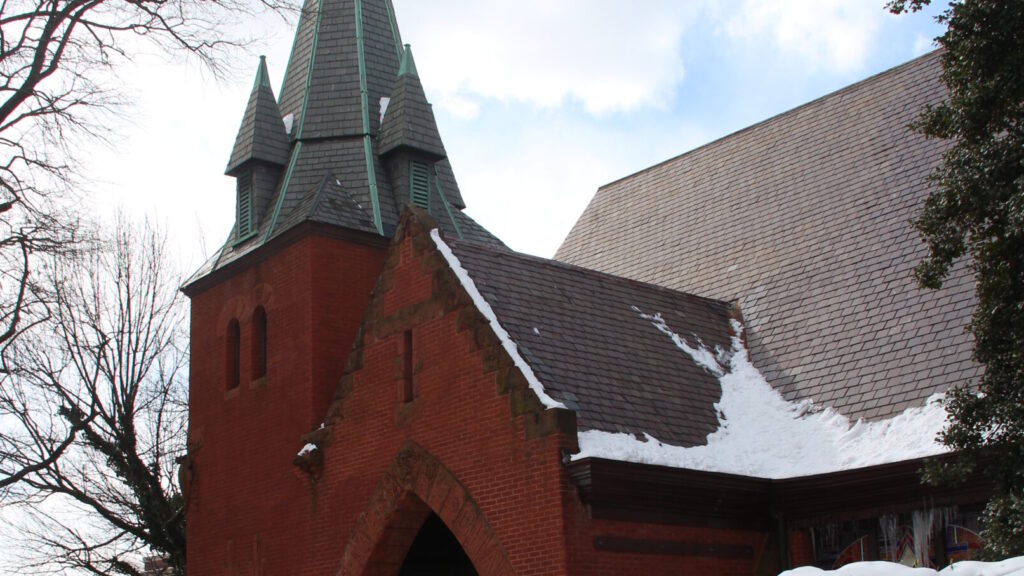
The Andrew Rankin Memorial Chapel stands as a beacon of progressive theology on Howard University’s campus, where traditional religious spaces often exclude marginalized communities. This sacred venue actively counters what student leaders describe as “white Christian propaganda” by creating an environment where faith and inclusion coexist without contradiction.
“The legacy of the Rankin pulpit challenges us to think critically about faith as a tool for justice,” explains Elijah Strong, a second-year Master of Divinity student and the Evans E. Crawford graduate assistant. “The Chapel remains committed to equipping students with an informed, justice-oriented faith — one capable of resisting half-truths, prejudice and propaganda.”
This commitment to inclusive theology is exemplified through the experience of Khalil Callender, a senior classical voice major from Boston. Callender, who discovered his passion for singing at age three within church settings, has flourished at Howard as a member of multiple university choirs, including the Chapel Choir.
“There have been not-so-progressive church leaders in the Black community,” Callender notes. “I feel as though the Chapel is a great example of what Black ministries in America should be.”
Callender’s talents have earned him invitations to perform at prestigious venues like the Metropolitan Opera House in New York and for organizations including the National Institutes of Health and the Denyce Graves Foundation, which promotes equity for Black artists in classical music.
The Chapel’s approach contrasts sharply with trends affecting American religious institutions. A study by the Williams Institute at UCLA School of Law in partnership with Utah State University found that nearly two-thirds of LGBTQ+ individuals raised in Christian environments eventually leave their faith traditions, often citing internalized homophobia and transphobia stemming from church experiences.
For Callender, Howard’s Chapel provided unprecedented acceptance. He began wearing makeup shortly after arriving at Howard and, for the first time in a religious setting, didn’t feel he was “going against God.” The affirmation he received from peers, mentors, and Dean Richardson taught him “never to settle for anything less from anyone.”
This inclusivity represents what Strong calls “decolonizing faith” — recognizing how selective interpretations of religious texts have been normalized to justify exclusion. The Chapel creates space for students to question inherited beliefs, understand their historical context, and imagine faith beyond harmful limitations.
The issue has broader implications as religious institutions across America face declining attendance. Many observers attribute this trend partly to the treatment of LGBTQ+ individuals and other marginalized communities within traditional church settings. While some congregations attempt to maintain relevance by reinterpreting religious texts, Howard’s Chapel models an alternative approach centered on authentic inclusion.
During Howard’s 2025 Homecoming week, Callender showcased his extraordinary vocal talent, performing “City Called Heaven,” a sorrow song in the tradition of surge-singing. The performance, which moved the congregation to fervent applause, carried additional significance as what W.E.B. Du Bois termed a “Negro spiritual” expressing the suffering and resilience of enslaved African Americans. For Callender, performing this piece represented a connection not only to historical legacies but also to a present-day community affirming his complete identity.
The Chapel has become a self-sustaining force of inspiration that consistently draws students and community members to its services. Chapel gatherings are described as an art form that captures “the complexities, the layering and the nuance of interpersonal experiences” while reducing them to their “essential narrative bone in song and spirit.”
This progressive approach suggests a potential path forward for religious institutions struggling with inclusion. As one observer notes, “If the Chapel could allow Callender — a devoted Christian, scion of a striving class, patron saint of the twice as good — to reclaim his faith by rejecting White Christian propaganda in favor of truth, inclusion and love, then what’s stopping the rest of us from doing the same?”
In an era when many Americans are “deconstructing” their faith, Howard’s Chapel demonstrates that religious spaces can embrace both tradition and inclusion, potentially reversing the exodus of those who feel unwelcome in conventional religious settings.
Fact Checker
Verify the accuracy of this article using The Disinformation Commission analysis and real-time sources.

16 Comments
Exploration results look promising, but permitting will be the key risk.
If AISC keeps dropping, this becomes investable for me.
Good point. Watching costs and grades closely.
If AISC keeps dropping, this becomes investable for me.
Good point. Watching costs and grades closely.
Good point. Watching costs and grades closely.
Nice to see insider buying—usually a good signal in this space.
Good point. Watching costs and grades closely.
Good point. Watching costs and grades closely.
Exploration results look promising, but permitting will be the key risk.
The cost guidance is better than expected. If they deliver, the stock could rerate.
If AISC keeps dropping, this becomes investable for me.
Good point. Watching costs and grades closely.
Nice to see insider buying—usually a good signal in this space.
Good point. Watching costs and grades closely.
Good point. Watching costs and grades closely.