


Listen to the article
A rare act of defiance during China’s most-watched broadcast has ignited speculation about growing fractures within the country’s tightly controlled media system.
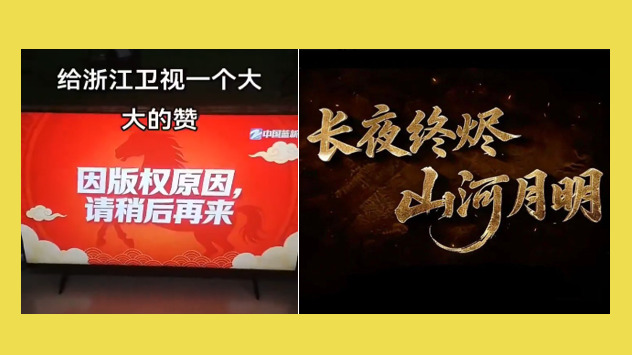
A 16-second clip from Zhejiang Satellite TV showing nothing but a static screen reading “Due to copyright reasons, please come back later” has become one of the most discussed moments of the 2026 Chinese New Year season across overseas Chinese social media platforms. The brief footage, which quickly went viral on X (formerly Twitter) and YouTube, has been interpreted by many as a symbolic act of resistance.
In China’s state-controlled media landscape, provincial satellite television stations have traditionally been required to carry the annual Spring Festival Gala produced by CCTV, the Chinese Communist Party’s primary propaganda outlet. The gala represents one of the regime’s most significant yearly propaganda events, carefully crafted to project an image of national unity and Party loyalty.
For a provincial station to decline broadcasting this centerpiece of Party messaging is virtually unprecedented, leading observers to view the incident as potentially significant. Multiple accounts on overseas platforms quickly amplified the footage, with commentators describing it as everything from “open rebellion” to “the biggest black swan of the 2026 Spring Festival Gala.”
According to posts on X, a mainland media figure allegedly leaked an assessment suggesting Zhejiang Satellite TV used “copyright” as a pretext to refuse rebroadcasting CCTV’s programming. If accurate, this would represent a remarkable breach in the top-down control structure that has governed Chinese media for decades.
The Zhejiang incident follows another contentious broadcasting event just days earlier. On February 14, Henan Satellite TV’s own Spring Festival broadcast was abruptly cut mid-show, triggering widespread online discussion. Viewers speculated about the reasons, with many pointing to the program’s emphasis on traditional Chinese culture as potentially threatening to Party ideology.
A social media user identified as “Shifangju” claimed on Douyin (China’s version of TikTok) that “Henan’s Spring Festival show was sabotaged. The crew was ready backstage, but the programs couldn’t go to air. The screen filled with wall-to-wall advertisements, and the hosts were pulled off.”
Some observers have drawn connections between the two incidents, suggesting they represent a pattern of growing resistance within regional media outlets. “From Henan to Zhejiang, these local stations’ actions are clearly connected, a chain reaction,” wrote one internet user. “This is a signal of nonviolent noncooperation. It suggests the system has already begun to quietly loosen from within.”
Analysts on social media platforms have offered various interpretations of the Henan broadcast’s cancellation. Some suggested the program’s style of celebrating pre-communist Chinese civilization through classical dance, traditional costumes, and mythological storytelling resembled performances by Shen Yun Performing Arts, a world-renowned classical Chinese dance company that the CCP has long targeted for suppression.
Shen Yun, which presents traditional Chinese culture untouched by communist influence, tours globally each year and has faced documented pressure campaigns from Chinese authorities attempting to cancel its performances abroad. The company was founded by practitioners of Falun Dafa (also known as Falun Gong), a spiritual practice rooted in Buddhist and Daoist traditions that has been persecuted in China since 1999.
The audience response to the Henan broadcast’s cancellation was notably defiant on Chinese social media. “I watch Henan’s show, and the more they try to ban it, the more I want to see it,” wrote one user. Others framed the issue in cultural terms: “Stand together. The revival of Chinese culture is upon us.”
While it remains difficult to verify the exact motivations behind these broadcasting anomalies, the incidents have revealed unusual cracks in China’s normally seamless propaganda apparatus during what is traditionally the country’s most carefully managed media event of the year.
Fact Checker
Verify the accuracy of this article using The Disinformation Commission analysis and real-time sources.

8 Comments
The Spring Festival Gala is a major propaganda piece for the CCP, so for a local station to break ranks is significant. I wonder if this reflects growing discontent or simply an isolated incident. Either way, it’s an interesting development worth watching.
Absolutely. Even a brief 16-second clip refusing to air the broadcast speaks volumes. Curious to see if this sparks any wider ripple effects within China’s tightly controlled media environment.
A provincial TV station declining to air the Spring Festival Gala is an unusual and potentially significant event. The gala is a major propaganda piece for the CCP, so this could signal growing tensions or fractures within China’s controlled media landscape. I’ll be following this story closely.
Agreed, this bears close watching. Even a small act of defiance like this against the Party’s propaganda efforts could have wider ramifications. It will be interesting to see if this incident remains an isolated case or if it leads to further challenges to Beijing’s control of the media.
This is certainly an intriguing development in China’s tightly controlled media environment. The Spring Festival Gala is a key annual propaganda event, so for a provincial station to refuse to air it is quite remarkable. I wonder what prompted this decision and whether it could signal growing discontent or fractures within the system.
Interesting development in China’s media landscape. Defying orders to air the Spring Festival Gala could signal growing tensions or fractures within the tightly controlled system. Curious to see if this leads to any wider pushback against Beijing’s propaganda efforts.
Agreed, this could be a symbolic act of resistance, even if small. The optics of a provincial station declining to carry the Party’s signature propaganda event is quite noteworthy.
This is an intriguing situation. The Spring Festival Gala is a key annual propaganda event for Beijing, so for a provincial station to defy the order to air it is quite bold. I’m curious to learn more about the motivations and potential implications of this defiance.