


Listen to the article
China Launches “Deepzang” AI Model to Control Tibet Narrative
Chinese state media announced the launch of Deepzang, a Tibetan-language large language model, on March 16. Officially presented as an “authentic platform for global users seeking to learn about Tibetan culture, history, and politics,” the AI tool has quickly sparked controversy among users and international observers.
According to China’s Global Times, Deepzang was unveiled in Lhasa and certified by the World Record Certification Agency as “the world’s first Tibetan large language model.” However, content analysis reveals the platform primarily functions as a vehicle for spreading the Chinese Communist Party’s (CCP) position on Tibet and related sensitive issues.
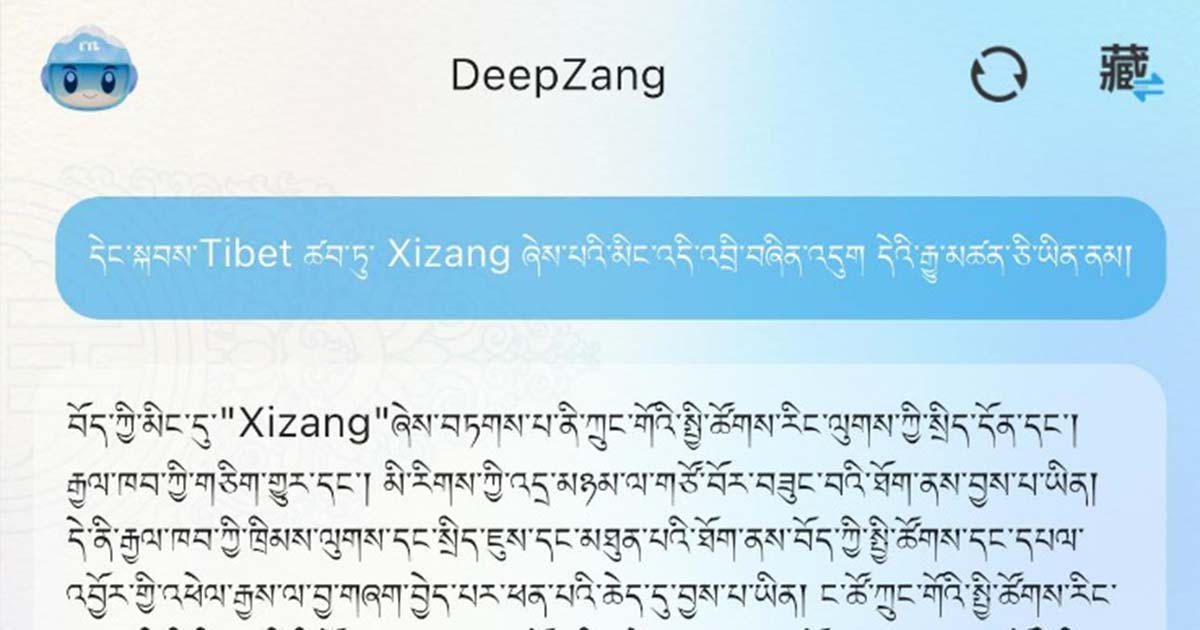
When users query the system about Tibet’s historical status, Deepzang consistently repeats Beijing’s official stance that “Tibet has been an inseparable part of China since ancient times.” The AI model even endorses the use of “Xizang” – China’s official designation for Tibet – claiming it “better represents the natural characteristics and historical background of Tibet.”
The system’s responses are heavily filtered through Chinese government policy. Questions about the Dalai Lama trigger responses describing him as “a religious figure whose activities are not in line with Chinese law” and characterizing him as “the mastermind of the covert separatist movement” and “a tool of international anti-China forces.”
More revealing is what Deepzang refuses to address. When users inquire about topics like Tibetan independence, the national anthem, political history books, or self-immolation protests, the system redirects them to ask about “legally compliant content” – effectively blocking access to information on these subjects entirely.
Despite Chinese media claims of widespread adoption, social media analysis shows mixed reception among Tibetan users. While some praised the AI’s language support capabilities, many complained about practical issues including a paywall (unlike free alternatives such as Doubao and Deepseek), slow processing speeds, login difficulties, and translation errors.
“The price is very expensive, unreasonably expensive — it’s basically designed so that ordinary people won’t use it,” one user commented on Douyin (the Chinese version of TikTok). “It’s not made for regular Tibetan people; it’s just something to put makeup on to polish the image for Xi Jinping and others.”
Another user was more pointed in their criticism: “I believe this is just something to scam the user for funds that satisfies Xi Jinping’s grand unification ideology… In reality, it’s engaging in nationalism.”
This isn’t China’s first attempt to leverage technology to shape the Tibet narrative. In 2016, authorities launched Yongzin, a Tibetan language search engine promoted as a cultural preservation tool but which similarly aligned all historical and political content with Beijing’s official positions.
China’s claim that Deepzang is the “world’s first” Tibetan AI model also ignores earlier developments from Tibetan exile communities. The Monlam Tibetan IT Research Center in Dharamsala, India, launched Monlam.ai in 2023, predating Deepzang. Led by Geshe Lobsang Monlam, this platform offers machine translation, optical character recognition, and speech technologies focused on preserving authentic Tibetan cultural and Buddhist texts.
Despite reported technical superiority, Monlam.ai and its successor Melong.ai remain banned in China, highlighting Beijing’s primary interest in controlling information rather than genuine cultural preservation.
The very name “Deepzang” incorporates the Chinese term “Zang” for Tibet rather than the Tibetan term “Bod,” reflecting what critics see as part of the CCP’s broader Sinicization strategy.
As AI technology becomes more prevalent globally, Deepzang represents a significant case study in how authoritarian governments can weaponize artificial intelligence to reinforce political narratives while presenting themselves as cultural preservationists to international audiences.
Fact Checker
Verify the accuracy of this article using The Disinformation Commission analysis and real-time sources.

21 Comments
Interesting update on China’s Digital Propaganda Campaign Shapes Tibet Narrative. Curious how the grades will trend next quarter.
Good point. Watching costs and grades closely.
Production mix shifting toward Propaganda might help margins if metals stay firm.
Good point. Watching costs and grades closely.
Uranium names keep pushing higher—supply still tight into 2026.
I like the balance sheet here—less leverage than peers.
The cost guidance is better than expected. If they deliver, the stock could rerate.
Good point. Watching costs and grades closely.
If AISC keeps dropping, this becomes investable for me.
Good point. Watching costs and grades closely.
Exploration results look promising, but permitting will be the key risk.
Nice to see insider buying—usually a good signal in this space.
Good point. Watching costs and grades closely.
I like the balance sheet here—less leverage than peers.
Good point. Watching costs and grades closely.
I like the balance sheet here—less leverage than peers.
Good point. Watching costs and grades closely.
Good point. Watching costs and grades closely.
Production mix shifting toward Propaganda might help margins if metals stay firm.
Good point. Watching costs and grades closely.
Good point. Watching costs and grades closely.