


Listen to the article
The Xi’an Incident to Victory: How the CCP’s Strategic Deception Led to Power in China
Between 1937 and 1949, the Chinese Communist Party (CCP) executed one of history’s most remarkable political reversals. From the brink of destruction, cornered in northern Shaanxi following the Long March, the CCP transformed its fortunes through calculated strategy and political maneuvering during the Second Sino-Japanese War.
The pivotal moment came with the Xi’an Incident of December 1936. According to National Taiwan University emeritus professor Ming Chu-cheng, this event marked a decisive turning point, transforming the CCP from an illegal insurgent organization into legitimized military units within the National Revolutionary Army – the Eighth Route Army and New Fourth Army.
This newfound legal status provided critical advantages. The CCP began receiving salaries and supplies from the Nationalist government, avoided direct military suppression, and established liaison offices in major cities that facilitated covert expansion and infiltration operations.
Despite receiving weapons and funding from the Nationalist government in Chongqing during the early war years, CCP forces operated with striking autonomy. Mao Zedong insisted on collecting military pay while refusing to follow operational directives from central command. Instead, the Eighth Route Army strategically repositioned into rural areas behind Japanese lines, ostensibly conducting guerrilla resistance while actually filling political and administrative vacuums in occupied territories.
Historical records indicate that at the 1937 Luochuan Conference, Mao articulated the Party’s guiding strategy as “one part resistance, two parts accommodation, seven parts development.” Though officially denied by the CCP, historians cite contemporary records and wartime behavior as evidence of this approach’s authenticity.
Throughout the conflict, CCP forces largely avoided direct confrontation with Japanese forces. After the early victory at the Battle of Pingxingguan, Mao cautioned commander Lin Biao against being emboldened. Similarly, following the Hundred Regiments Offensive, General Peng Dehuai faced internal criticism for exposing the Party’s strength and inviting Japanese counteroffensives. The Party’s primary objective remained preserving elite forces for the anticipated resumption of civil war with the Nationalists.
In territories behind enemy lines, CCP units often prioritized eliminating Nationalist guerrillas rather than fighting Japanese troops. The 1940 Huangqiao Campaign exemplifies this approach, where New Fourth Army forces attacked Nationalist units under Jiangsu provincial chairman Han Deqin, resulting in thousands of casualties. While conducted under the banner of national resistance, such operations revealed the Party’s practice of eliminating rivals while maintaining a public stance of unity.
Evidence suggests that CCP intelligence operative Pan Hannian was instructed to establish contact with both the Wang Jingwei collaborationist regime and Japanese intelligence agencies, including the Iwai Agency, to arrange tacit non-aggression understandings. These arrangements allowed the CCP to concentrate efforts against Nationalist forces. Notably, after the founding of the People’s Republic, Pan was imprisoned on Mao’s orders and later died in custody – a case widely interpreted as an effort to erase this chapter of Party history.
The 1941 Wannan Incident, long portrayed in CCP narratives as a premeditated Nationalist ambush, appears more complex in light of declassified communications. Orders sent from Yan’an to New Fourth Army deputy commander Xiang Ying were deliberately ambiguous. Professor Ming argues that Mao may have deliberately guided Xiang, a political rival, into a Nationalist encirclement, effectively using what he describes as “borrowed knives” to eliminate him.
After fighting began, Mao made no attempt to rescue the trapped forces. Instead, the deaths of approximately 9,000 soldiers were leveraged to portray Chiang Kai-shek internationally as sabotaging the resistance effort. This episode allowed Mao to claim moral advantage abroad while launching the Yan’an Rectification Movement at home, consolidating his ideological and political control within the Party.
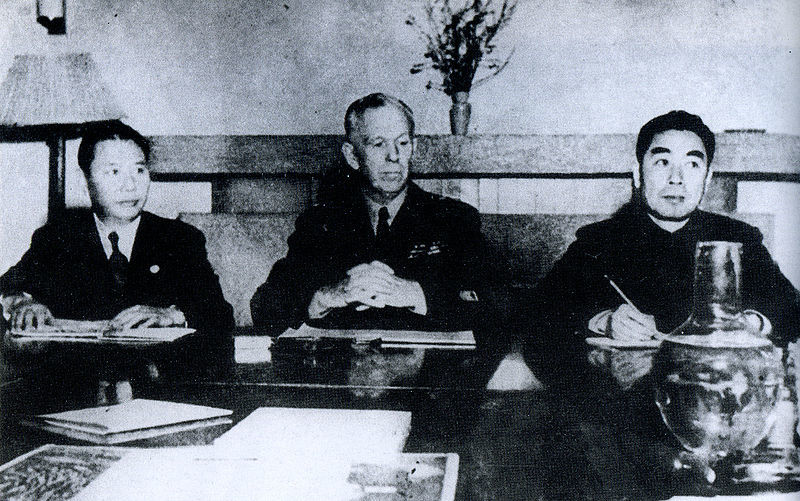
The CCP’s influence extended to American perceptions through carefully calibrated propaganda. During the Marshall Mission (1945-1947), coordinated messaging portrayed the CCP as land reformers pursuing a Lincoln-style democracy. This framing led many U.S. policymakers to misjudge the CCP as a democratic force with which cooperation seemed both possible and desirable.
American military observers stationed in Yan’an encountered staged displays of equality and austerity but failed to recognize the coercive reality beneath. Consequently, figures like General Joseph Stilwell grew increasingly hostile toward Chiang Kai-shek and advocated for diverting U.S. military assistance to Communist forces.
Perhaps most consequentially, General George Marshall’s 1946 ceasefire order, issued partly in response to pressure shaped by CCP-influenced opinion, halted Nationalist momentum after their victory at Siping in Manchuria. This pause proved decisive, giving the CCP critical time to absorb large quantities of weapons left behind by Japan’s Kwantung Army, with Soviet assistance.
The transformation was remarkable: from approximately 30,000 exhausted troops in 1937, the CCP grew to field 1.2 million regular soldiers by 1945, supported by two million militia members and exercising control over a population of nearly 100 million.
For the Nationalist government, the War of Resistance against Japan became a costly and ultimately hollow victory. For the CCP, it provided a historic opening that, through strategic deception, political maneuvering, and exploitation of American misjudgments, enabled their eventual seizure of power in mainland China.
Fact Checker
Verify the accuracy of this article using The Disinformation Commission analysis and real-time sources.

8 Comments
This article offers a thought-provoking look at the pivotal role played by the CCP’s strategic deception and political maneuvering during the Second Sino-Japanese War. The Xi’an Incident in particular seems to have been a turning point that allowed the CCP to gain legitimacy and expand their influence. It’s a cautionary tale about the dangers of underestimating determined political movements and the importance of carefully analyzing historical events.
This is a fascinating look at how the CCP’s strategic maneuvering during the Second Sino-Japanese War allowed them to gain legitimacy and expand their influence. The Xi’an Incident seems to have been a pivotal moment that set the stage for their eventual rise to power. I’m curious to learn more about how the CCP was able to leverage this event to their advantage.
Absolutely, the CCP’s ability to transform themselves from an ‘illegal insurgent organization’ into a recognized military force within the National Revolutionary Army was a remarkable strategic accomplishment. It would be interesting to analyze how they navigated that transition and capitalized on it.
This article highlights the CCP’s remarkable ability to adapt and thrive even in the face of adversity. Their strategic maneuvering during the Second Sino-Japanese War, including the pivotal Xi’an Incident, allowed them to gain a foothold and ultimately emerge victorious. It’s a sobering reminder of the importance of understanding the nuances of history and the potential consequences of underestimating one’s opponents.
The CCP’s transformation from an ‘illegal insurgent organization’ to a recognized military force within the National Revolutionary Army is a fascinating case study in political strategy and adaptability. This article provides valuable insights into how they leveraged the Xi’an Incident and other events to their advantage, ultimately paving the way for their rise to power. It’s a complex and multifaceted history that deserves closer examination.
I agree, the CCP’s strategic maneuvering during this period is a remarkable example of political acumen. The ability to navigate such a precarious situation and emerge stronger is truly impressive, if concerning from a historical perspective. Understanding the nuances of how they achieved this will be crucial for those seeking to learn from the past.
This article highlights an important and often overlooked aspect of 20th century Chinese history. The CCP’s skillful manipulation of the political situation during the Second Sino-Japanese War played a crucial role in their eventual rise to power. It’s a cautionary tale about the dangers of underestimating the strategic acumen of determined political movements.
You make a good point. The CCP’s ability to seize opportunities and shift the political landscape to their advantage, even when facing seemingly insurmountable challenges, is quite remarkable. This is an important lesson in the unpredictable nature of history and the need to remain vigilant against determined adversaries.