


Listen to the article
China’s Ambitious Space Carrier Project Signals New Era of Orbital Competition
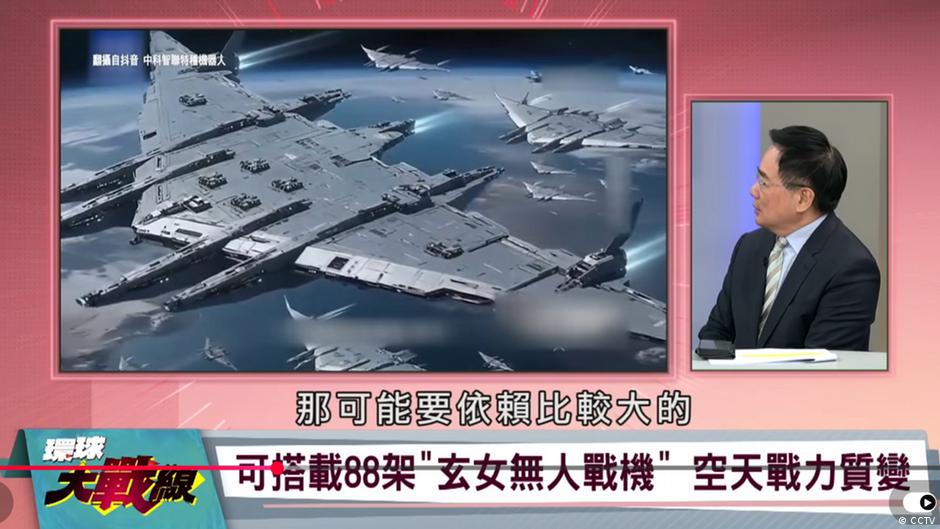
China has unveiled plans for an integrated air and space defense system called “Nantianmen” (“Heavenly Gate”), featuring a massive flying aircraft carrier that would dwarf any existing warship. The proposed vessel, named Luanniao, would measure 242 meters (794 feet) in length with a 684-meter wingspan and reportedly weigh up to 120,000 tons at takeoff.
According to Chinese state media, this colossal carrier would serve as a platform for launching unmanned space fighters, called Xuannu, capable of deploying hypersonic missiles against targets both in Earth’s atmosphere and orbit.
“China has long been number two in space — behind the United States, but well ahead of Europe,” said Juliana Süß, space security expert at the German Institute for International and Security Affairs (SWP), in an interview. She noted that Beijing has invested “extremely large sums of money” in space technology, which plays both a prestige role for leadership and is “extremely important for military capabilities.”
By weight alone, the proposed space carrier would exceed the largest existing aircraft carriers by approximately 20%. While shorter in length than vessels like the USS Gerald R. Ford (which measures 337 meters), the Luanniao’s wingspan would be dramatically broader than conventional maritime carriers. For comparison, the USS Gerald R. Ford weighs approximately 100,000 tons when fully loaded with fuel, crew, and equipment.
China’s state broadcaster CCTV featured the announced carrier in its military program “Lijian,” displaying a photorealistic 3D model hovering above Earth, releasing space jets and firing weapons in outer space. This visualization has since circulated widely on social media platforms and video-sharing sites.
However, aerospace experts have expressed significant skepticism about the technical feasibility of such an ambitious project. The proposed carrier far exceeds what current rocket technology could realistically launch into orbit. Even if modular assembly in space were theoretically possible, numerous obstacles remain, including power supply, propulsion, cooling, protection from space debris, and enormous cost considerations.
“From today’s perspective, the project is completely unrealistic,” said German diplomat and space analyst Heinrich Kreft. Nevertheless, he acknowledges that technological advancement often transforms science fiction into reality, noting that “many things that were science fiction 20 or 30 years ago are real today.”
The announcement places China alongside private-sector space visionaries like Elon Musk and Jeff Bezos, who have promoted ambitious plans for lunar and Martian colonization.
American analysts likewise interpret the Luanniao announcement more as a strategic signal than an actual construction blueprint. The National Interest published an article titled “Beijing Wants You to Believe It’s Building Flying Aircraft Carriers,” with author Brandon J. Weichert describing the vision as part of a “wider propaganda push” designed to make Western powers nervous and potentially waste resources.
Kreft sees the announcement as a deliberately placed message in the ongoing power competition with the United States, particularly against the backdrop of tensions over Taiwan. “This sounds as if China has put something out into the world with Taiwan very much in mind, in order to leave a marker,” he said.
The space carrier proposal follows a pattern of spectacular Chinese “superweapon” announcements that Western experts often classify as unrealistic but which contribute to a strategic narrative of technological superiority and deterrence.
SWP expert Süß places the project in a broader security context, viewing such initiatives “more through a deterrence lens” aimed at “demonstrating strength and projecting power across multiple domains.” She interprets the presentation partly as China’s response to U.S. missile defense initiatives in space, such as the “Golden Dome” concept proposed during the Trump administration.
“What is crucial for successful deterrence is above all credibility,” Süß noted. “To what extent such an ambitious and oversized project as this space carrier is actually credible is an entirely different question.”
The Luanniao concept operates in this strategic gray zone—an outsized threat with political utility that precedes any actual construction. Kreft describes the project as “psychological warfare” while cautioning against dismissing China’s technological ambitions entirely. Beijing, he warns, is advancing “on all conceivable future projects and weapons systems,” including laser technology where China “appears to be further ahead than anyone else.”
Fact Checker
Verify the accuracy of this article using The Disinformation Commission analysis and real-time sources.

9 Comments
If this space carrier project is real, it could significantly shift the balance of power in orbital warfare. China seems determined to challenge U.S. dominance in space. But is this more about strategic messaging than actual military capabilities?
Impressive if true, but I suspect a lot of this is more about strategic messaging than actual near-term capabilities. China is clearly flexing its technological muscles, but the feasibility of this space carrier remains to be seen.
The proposed specifications of this space carrier are truly mind-boggling. I’m curious to see how China’s technological capabilities evolve in the coming years and whether they can make this ambitious concept a reality.
Definitely an impressive feat of engineering if they pull it off. But a lot can change between concept and execution, especially with a project of this scale and complexity.
This is a bold move by China to assert its growing space capabilities. However, I wonder how much of this is genuine innovation versus political posturing. Time will tell if they can back up these claims with tangible results.
China’s space program has been steadily advancing, but a mobile platform of this scale in orbit is a whole new level. I’ll be interested to see how this project evolves and whether it leads to an arms race in space.
This sounds like the stuff of science fiction! While China’s space program is undoubtedly advanced, I have a hard time believing they can build a space carrier of this magnitude anytime soon. Seems more like political theater than military reality.
A massive space carrier for deploying hypersonic missiles? That’s quite a technological leap. I’m curious to see how the international community responds to China’s space ambitions and whether this raises new security concerns.
Fascinating concept! A massive space carrier would certainly be a game-changer. I wonder how feasible and practical such a platform would be from an engineering and operational standpoint. Lots of questions around power, propulsion, and logistics.