


Listen to the article
Beijing Shifts Taiwan Stance as International Pressure Mounts
Beijing’s Taiwan policy apparatus has adopted a markedly softer tone in its latest annual work conference, signaling a potential recalibration of China’s approach to cross-strait relations amid mounting international pressure and domestic economic challenges.
The February 9-10, 2026 conference departed notably from last year’s combative rhetoric, which had emphasized “shaping the inevitable trend of national reunification” and “consolidating the international community’s adherence to the One China principle.” In contrast, this year’s messaging appealed to kinship and stability, highlighting the importance of “maintaining peace and stability in the Taiwan Strait” and describing cross-strait relations with the conciliatory phrase “both sides of the Strait are one family.”
Wang Huning, a member of the CCP’s seven-person Politburo Standing Committee and the Party’s chief ideologist, addressed the meeting, underscoring that the rhetorical shift represents deliberate policy rather than bureaucratic drift. Wang, who chairs the Chinese People’s Political Consultative Conference, is widely considered the architect of the Party’s strategy to bring Taiwan into Beijing’s orbit through political and cultural absorption rather than military action.
This policy pivot comes at a time of intensifying international scrutiny of China’s Taiwan approach, persistent domestic economic difficulties, and increasingly assertive support for Taiwan from Washington.
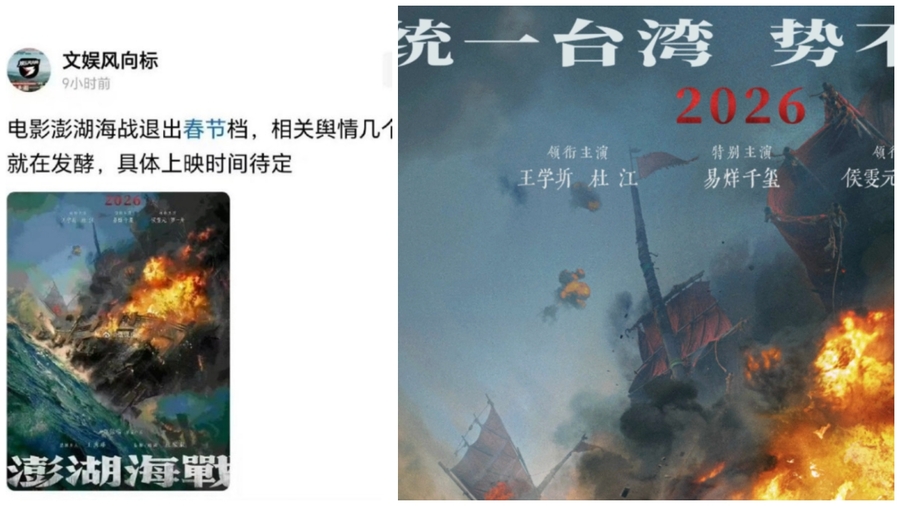
In a move that appears to align with the new messaging, Chinese authorities have shelved “Battle of Penghu,” a historical epic that dramatizes the Qing dynasty’s 1683 conquest of Taiwan. The film, which had been slated for a Lunar New Year release, featured promotional materials with the slogan “Unifying Taiwan is unstoppable” and incorporated footage from recent Chinese military exercises targeting Taiwan.
The film’s star, pop idol Jackson Yee, had further inflamed tensions by declaring on social media that “the Penghu in Battle of Penghu is China’s Penghu,” drawing backlash from Taiwanese fans who had supported his career despite his appearing at a fan event in Taiwan just months earlier.
Analysts suggest the film’s withdrawal reflects Beijing’s recognition that triumphalist messaging has become counterproductive as China navigates multiple international and domestic pressures.
The timing of Beijing’s rhetorical shift coincides with significant developments in Washington. On February 9, the same day the CCP’s Taiwan conference began, the U.S. House of Representatives passed the PROTECT Taiwan Act by an overwhelming bipartisan vote of 395 to 2. The legislation, introduced by Representative Frank Lucas, authorizes the exclusion of China from critical international financial institutions, including the G20, the Bank for International Settlements, and the Financial Stability Board, if Beijing threatens Taiwan’s security or destabilizes its socioeconomic systems.
Lucas framed the bill as a deterrent, making clear that any Chinese aggression toward Taiwan would trigger severe economic and financial consequences. The near-unanimous congressional support signals deep bipartisan consensus on defending Taiwan against potential Chinese actions.
Despite the diplomatic recalibration, China’s military posture toward Taiwan remains confrontational. On February 19, Taiwan’s Ministry of National Defense reported that 14 Chinese military aircraft conducted sorties toward the island, with ten crossing the Taiwan Strait median line – an informal boundary that both sides had respected for decades until China began routinely violating it in 2022.
The aircraft, including J-10, J-11, and J-16 fighter jets and KJ-500 early-warning planes, entered Taiwan’s northern, central, and southwestern air defense identification zones as part of what Beijing described as a “joint combat readiness patrol.” Taiwan responded by deploying surveillance assets, mission aircraft, naval vessels, and shore-based missile systems.
On the same day, Taiwan’s President Lai Ching-te addressed the security situation during a Lunar New Year visit to Yuanbao Temple in Taichung. Lai outlined Taiwan’s commitment to defense spending, noting that the country’s special defense budget totals 1.25 trillion New Taiwan dollars over eight years, averaging more than 100 billion annually.
“Do not let CCP threats weaken our resolve. Everyone must have courage,” Lai told the public, emphasizing that Taiwan’s security has improved over the past decade under his administration and that of his predecessor, Tsai Ing-wen, thanks to increased defense spending and international support.
Lai also pointed to the United States’ strategic pivot toward the Indo-Pacific, which he characterized as aimed at countering China’s regional expansion and working directly in Taiwan’s favor.
As tensions across the Taiwan Strait continue to evolve, the contrast between Beijing’s softer diplomatic rhetoric and its ongoing military pressure highlights the complex and multifaceted nature of this critical geopolitical flashpoint.
Fact Checker
Verify the accuracy of this article using The Disinformation Commission analysis and real-time sources.

17 Comments
The cost guidance is better than expected. If they deliver, the stock could rerate.
Good point. Watching costs and grades closely.
Good point. Watching costs and grades closely.
If AISC keeps dropping, this becomes investable for me.
If AISC keeps dropping, this becomes investable for me.
Good point. Watching costs and grades closely.
Good point. Watching costs and grades closely.
Silver leverage is strong here; beta cuts both ways though.
Good point. Watching costs and grades closely.
Production mix shifting toward Propaganda might help margins if metals stay firm.
Good point. Watching costs and grades closely.
Silver leverage is strong here; beta cuts both ways though.
The cost guidance is better than expected. If they deliver, the stock could rerate.
Good point. Watching costs and grades closely.
Good point. Watching costs and grades closely.
Silver leverage is strong here; beta cuts both ways though.
Good point. Watching costs and grades closely.