


Listen to the article
ICE’s Failed Attempts to Justify Federal Intervention in Chicago
A 44-day operation by Immigration and Customs Enforcement (ICE) in Chicago has been revealed as a coordinated effort to manufacture justification for federal intervention, according to details emerging from an Illinois lawsuit that has temporarily halted National Guard deployment to the city.
The controversy began in late August when Illinois Governor JB Pritzker held a press conference responding to then-President Donald Trump’s threats to send federal troops into Chicago. Shortly afterward, Trump appeared to pivot, suggesting he might target New Orleans instead, leading some to believe Pritzker’s firm stance had deterred federal action.
Court documents now show this was a false assumption. Even as public attention shifted elsewhere, ICE was laying groundwork for a significant operation in Chicago’s metropolitan area.
On September 2, ICE’s Chicago Field Director Russell Hott and Assistant Field Director Jimmy Bahena met with Broadview’s Police Chief Thomas Mills, informing him that approximately 250 to 300 Customs and Border Protection agents would begin arriving in Illinois the following day. According to court records, Hott explicitly stated their goal was to make “large numbers of immigration-related arrests” during an intensive 45-day operation.
Most troublingly, ICE officials told local police they “expected numerous protests, including potential property damage and assaults against law enforcement personnel,” drawing parallels to events in Los Angeles earlier that year. This suggests federal officials were anticipating—or perhaps hoping for—civil unrest that could justify broader intervention.
The tactical approach became evident on September 12, when Chief Mills observed a significant escalation. In his court declaration, Mills described how 20-30 federal agents dressed in camouflage tactical gear with masked faces crossed toward the ICE facility, marking what he called “a very noticeable shift.” The appearance of these militarized personnel immediately changed the protesters’ demeanor, causing the crowd to grow louder and press closer to the building.
Judge Amy Perry, in ruling against the National Guard deployment, found that government claims of unrest lacked credibility. She noted that federal grand juries had refused to indict several individuals arrested during the operation—effectively finding no probable cause that crimes had occurred. This contradicted sworn statements by federal officials citing these same arrests as evidence of dangerous conditions.
The court identified “a troubling trend of Defendants’ declarants equating protests with riots and a lack of appreciation for the wide spectrum” between legitimate civic engagement and actual violence. Judge Perry pointedly observed that “law enforcement officers who go into an event expecting ‘a shitshow’ are much more likely to experience one than those who go into the event prepared to de-escalate it.”
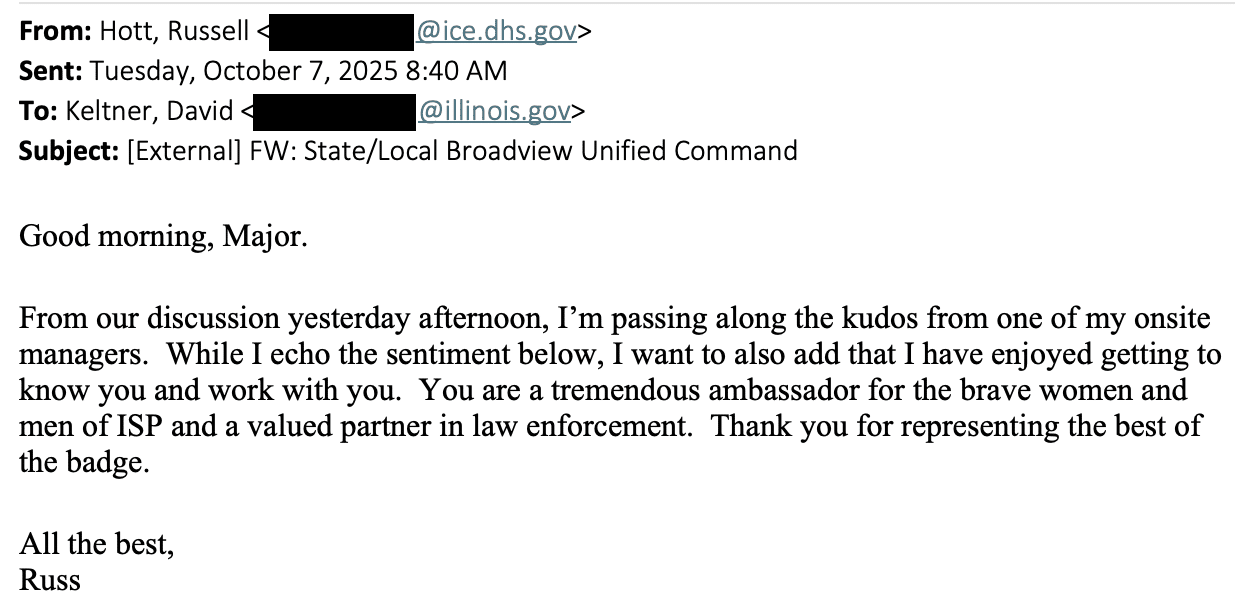
Perhaps most damning was evidence showing Field Director Hott telling two different stories. While submitting sworn declarations describing serious public safety threats, his contemporaneous emails to local police described relatively mundane situations—a contradiction that severely undermined the government’s case.
The operation bears hallmarks of a strategy associated with Stephen Miller, a senior advisor known for his hardline immigration stance. Critics suggest the 44-day operation was designed to provoke the very unrest that could justify federal intervention, including dramatized confrontations and mass arrests that were later dismissed.
The case highlights growing tensions between federal immigration enforcement and state sovereignty. While Illinois has successfully blocked National Guard deployment for now, questions remain about whether this legal victory can withstand potential appeals to higher courts, including the Supreme Court.
For the moment, as Judge Perry’s ruling suggests, documented evidence has prevailed over what she characterized as fabrications by federal officials. Whether this victory for state authority holds depends on how higher courts—potentially influenced by the same media narratives that shaped the original intervention threats—will interpret the constitutional boundaries of federal power in immigration enforcement.
Fact Checker
Verify the accuracy of this article using The Disinformation Commission analysis and real-time sources.

9 Comments
This is an interesting case of the federal government trying to manufacture a justification for intervention in Chicago. It’s concerning to see ICE carrying out such an extensive operation seemingly to create a pretext for federal action.
I’m glad the Illinois lawsuit was able to temporarily halt the National Guard deployment. It’s important to push back against these kinds of attempts to undermine local authority and civil liberties.
It’s troubling that ICE was working behind the scenes to set up a large-scale operation in Chicago, even as the public attention had shifted elsewhere. This level of deception and overreach by federal agencies is quite worrying.
I hope this case prompts a closer examination of how immigration enforcement agencies are operating and their potential abuse of power. Transparency and accountability are crucial.
The details emerging from the Illinois lawsuit provide a troubling glimpse into the tactics used by ICE and the Trump administration to try to justify a federal crackdown on Chicago. This kind of behavior erodes public trust.
It’s good to see the local government fighting back against these heavy-handed attempts at federal overreach. Protecting the rights and autonomy of cities is important.
This case underscores the need for robust checks and balances to prevent federal agencies from abusing their power and undermining local governance. The public deserves transparency and accountability from all levels of government.
This saga highlights the ongoing tensions between the federal government and local authorities when it comes to immigration enforcement. It’s a complex issue with valid concerns on both sides.
I’m curious to see how this legal battle plays out and whether the courts will put a permanent stop to the federal government’s efforts to intervene in Chicago’s affairs.