


Listen to the article
Brazil’s famed Carnival is taking a political turn this year as one samba school prepares to honor President Luiz Inácio Lula da Silva in its parade, sparking controversy and debate across the politically divided nation.
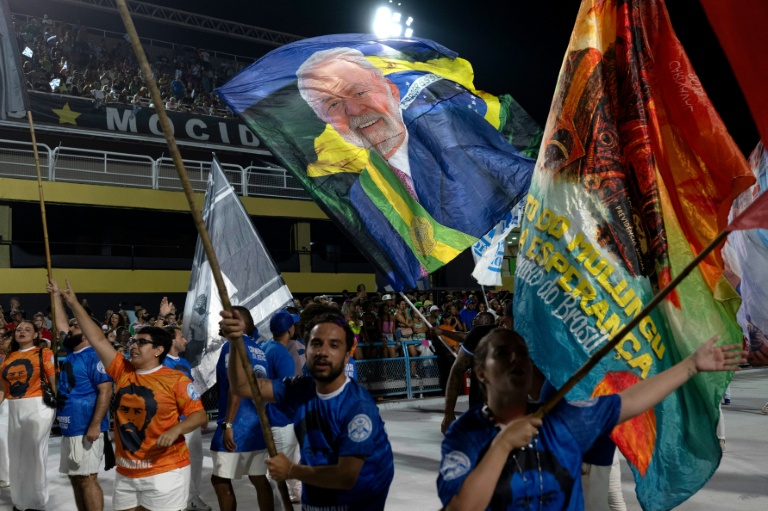
Academicos de Niteroi, one of the prestigious samba schools competing in Rio de Janeiro’s iconic Carnival parade, will kick off the three-day competition on February 15 with a tribute to the 80-year-old leftist president. During rehearsals, thousands of spectators have already been heard chanting the refrain of the school’s theme song: “Ole, ole, ole, ola; Lula, Lula!”
The decision has raised eyebrows and drawn criticism, particularly since it comes just eight months before Brazil’s presidential elections in which Lula is seeking a fourth term. Critics view the parade as tantamount to a campaign event well before the official campaigning period begins in August.
“This is not propaganda, it’s a tribute,” defended Hamilton Junior, one of the school’s directors, in an interview with AFP. “Many people in our school were able to get an education thanks to the president’s public policies.”
According to Junior, the tribute tells the story of “a man from Brazil’s poor north-east who faced many hardships and became one of Brazil’s greatest presidents.”
The Carnival parade, Brazil’s most celebrated cultural spectacle, will feature twelve competing samba schools. Each will present elaborate productions with thousands of participants, massive floats, thundering percussion sections, and dancers adorned in minimal, glittering costumes. Schools traditionally choose themes connected to Brazilian culture, history, or notable figures.
During technical rehearsals at the Sambodrome, which themselves draw substantial crowds, dancers appeared dressed as steelworkers—a nod to Lula’s past occupation before his political career. The accompanying song chronicles Lula’s journey from impoverished childhood in rural Pernambuco to his migration to São Paulo, union activism, and the social policies implemented during his previous administrations.
While the song makes no direct reference to the upcoming election, it doesn’t shy away from current political tensions. It mentions “tariffs and sanctions” imposed by U.S. President Donald Trump to punish Brazil for putting his ally, former far-right leader Jair Bolsonaro, on trial for allegedly plotting a coup. The lyrics also include the phrase “no amnesty,” alluding to efforts by Bolsonaro supporters to reduce his 27-year prison sentence that began in November.
The political nature of the display continued with a large screen mounted on a truck showing images mocking Bolsonaro—depicting him in prison attire or with blood-stained hands, referencing his controversial stance during the COVID-19 pandemic.
The tribute has predictably drawn the ire of opposition politicians. Center-right lawmaker Kim Kataguiri filed a lawsuit demanding that Academicos return the one million reais ($180,000) in federal funding that each competing school receives.
“It is unacceptable that the president sends one million reais, and even worse in an election year, to a samba school to celebrate a festival whose main theme is the president himself,” Kataguiri told AFP.
Similarly, lawmakers from the right-wing Partido Novo have asked Brazil’s Federal Court of Auditors to block the funding, while a senator allied with Bolsonaro has demanded courts prohibit television broadcast of the parade.
In response, Embratur, the Brazilian agency for international tourism promotion that provides the funds, stated it “respects the artistic autonomy and freedom of expression of the samba schools.”
For some spectators, the politically charged parade represents a bold artistic choice. Adriano Santos, a 43-year-old social worker from the Rocinha favela who attended the rehearsal, praised the samba school for “being brave, innovative.”
“There will be those who like it and those who don’t,” Santos acknowledged, “but I believe this parade will represent Brazil.”
The controversy highlights Brazil’s deep political polarization as the country moves toward another electoral contest with Lula seeking to extend his presidency while Bolsonaro has positioned his eldest son, Senator Flavio Bolsonaro, as his political heir and presidential candidate.
Fact Checker
Verify the accuracy of this article using The Disinformation Commission analysis and real-time sources.

8 Comments
Carnival has always been a platform for political expression in Brazil, so this tribute to Lula isn’t too surprising. It will be important to closely examine whether it crosses the line into outright electioneering, or if it is a genuine celebration of his social programs.
You raise a good point. The line between honoring past achievements and campaigning for the future can be blurry, especially in the charged political climate of Brazil. It will be worth watching how this plays out.
It’s interesting to see political themes emerging in Brazil’s iconic Carnival parade. While some may view it as propaganda, others see it as a tribute to Lula’s social policies. It will be fascinating to see how the public reacts to this political element in the celebrations.
While I can understand the school’s desire to pay tribute to Lula’s social programs, it does seem that this could stir up controversy and politicize the Carnival celebrations. It will be interesting to see how the public and other samba schools react to this decision.
This is a complex issue that highlights the intersection of politics, culture, and national identity in Brazil. I’m curious to see if the Lula tribute generates more unity or division among Carnival goers. Maintaining the spirit of the celebrations will be crucial.
Carnival is a beloved tradition in Brazil, so it’s understandable that there would be concerns about politicizing the celebrations. While honoring past achievements can be meaningful, it will be crucial for the organizers to ensure the parade maintains an inclusive, non-partisan spirit. The public’s reaction will be telling.
The decision to honor Lula in the Carnival parade is certainly a bold one that will likely generate strong reactions. It will be important to closely monitor whether this is a genuine tribute or if it crosses the line into electioneering. Carnival should remain a unifying celebration, not a platform for partisan politics.
Carnival is a time for revelry and unity in Brazil, but it’s concerning to see it potentially being co-opted for political purposes, even if the intentions are to honor past policies. I hope the celebrations can maintain a spirit of inclusivity and avoid becoming too divisive.