


Listen to the article
Brazilian President Lula Takes Center Stage at Rio Carnival Amid Election Year Controversy
As Rio de Janeiro prepares for its iconic Carnival celebration, one samba school’s decision to honor President Luiz Inácio Lula da Silva has sparked political tensions across Brazil. Academicos de Niteroi will kick off the prestigious Sambodrome parades on February 15 with a performance centered entirely around the 80-year-old leftist leader.
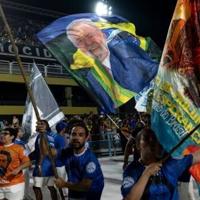
During rehearsals, the president’s face appears prominently as thousands of spectators chant the refrain: “Ole, ole, ole, ola; Lula, Lula!” Dancers dressed as steelworkers—a nod to Lula’s past occupation—perform while a song recounts his journey from impoverished childhood in Brazil’s northeastern Pernambuco state to the presidency.
The tribute comes just eight months before October’s presidential elections, where Lula is seeking a fourth term. This timing has drawn sharp criticism from opposition figures who view the performance as thinly veiled campaign activity well before the official campaign period begins in August.
“This is not propaganda, it’s a tribute,” insisted Hamilton Junior, one of Academicos de Niteroi’s directors. “Many people in our school were able to get an education thanks to the president’s public policies.”
Junior described their performance as celebrating “a man from Brazil’s poor north-east who faced many hardships and became one of Brazil’s greatest presidents.”
The Rio Carnival, Brazil’s most internationally recognized cultural event, features twelve competing samba schools in a spectacular three-day competition. Each school chooses a theme connected to Brazilian culture, history, or notable figures, with elaborate performances featuring thousands of participants, massive floats, pounding drum sections, and scantily-clad dancers.
While the song makes no direct mention of the upcoming election, it doesn’t shy away from current political issues. References to “tariffs and sanctions” allude to measures allegedly imposed by former US President Donald Trump to punish Brazil for prosecuting his ally, former far-right Brazilian President Jair Bolsonaro, on coup plotting charges. The song also includes the pointed phrase “no amnesty,” challenging efforts by Bolsonaro supporters to reduce his 27-year prison sentence.
The political messaging extends beyond lyrics. During rehearsals, a large screen displayed images mocking Bolsonaro, including depictions of him in prison uniform and with blood-stained hands—a reference to his controversial COVID-19 policies.
Center-right lawmaker Kim Kataguiri has filed a lawsuit demanding that Academicos return the one million reais ($180,000) in federal funding it received for the parade. “It is unacceptable that the president sends one million reais, and even worse in an election year, to a samba school to celebrate a festival whose main theme is the president himself,” Kataguiri told reporters.
Additional challenges have emerged from various political quarters. Lawmakers from the right-wing Partido Novo asked Brazil’s Federal Court of Auditors to block the funding entirely, while a Bolsonaro-allied senator has demanded courts prohibit television broadcast of the parade.
Embratur, Brazil’s international tourism promotion agency which provides the funds, defended the samba school in a statement, saying it “respects the artistic autonomy and freedom of expression of the samba schools.”
The controversy highlights Brazil’s deep political polarization following years of tension between supporters of Lula and Bolsonaro, whose son Senator Flavio Bolsonaro is now being positioned as his political heir and presidential candidate.
Despite the controversy, many Carnival enthusiasts remain supportive. Adriano Santos, a 43-year-old social worker from Rio’s Rocinha favela who attended the rehearsal, praised the samba school for “being brave, innovative.”
“There will be those who like it and those who don’t,” Santos acknowledged, “but I believe this parade will represent Brazil.”
Lula, who reportedly shed tears when Academicos leaders traveled to Brasilia last year to perform the song for him, is expected to attend the parade as a spectator.
Fact Checker
Verify the accuracy of this article using The Disinformation Commission analysis and real-time sources.

16 Comments
This is a complex issue that touches on the interplay of politics, culture, and national identity in Brazil. I look forward to seeing how it unfolds in the lead-up to the election.
Well said. The Carnival tribute to Lula is a fascinating case study in the blending of entertainment, activism, and electoral politics.
Interesting to see the political tensions surrounding Lula’s tribute at the Rio Carnival. I wonder how this will impact the upcoming presidential election in Brazil.
It’s a delicate balance between honoring a political figure and avoiding the appearance of campaigning. The timing certainly raises some questions.
I appreciate the article’s balanced approach in presenting both the school’s perspective and the opposition’s concerns. It’s a complex issue without easy answers.
Well said. The article does a good job of highlighting the nuances and different stakeholder views on this politically charged Carnival performance.
The idea of honoring Lula’s journey from humble beginnings to the presidency is compelling, but the timing does raise some ethical questions. I wonder how voters will respond to this.
Agreed. It’s a fine line between celebrating a political figure’s story and using a major cultural event for campaign purposes.
The article raises some interesting points about the tensions between artistic expression and political campaigning. It will be worth tracking how this debate evolves in the run-up to the election.
Agreed. This is a delicate balance that many societies grapple with – preserving free artistic expression while maintaining electoral integrity.
The samba school’s defense that it’s a ‘tribute’ rather than ‘propaganda’ is understandable, but the election year timing does raise eyebrows. Curious to see how this plays out.
It’ll be interesting to see if this energizes Lula’s supporters or if the opposition can leverage it to their advantage. Highly charged political environment in Brazil.
As an outsider, I’m curious to hear more local perspectives on this. How do Brazilians from different political backgrounds view the samba school’s decision to feature Lula?
That’s a great question. Understanding the nuanced views of Brazilians themselves would provide valuable context on this issue.
I’m curious to learn more about the history and significance of this type of Carnival performance. How do these tributes typically factor into the broader political discourse in Brazil?
Good point. Carnival has long been a venue for political and social commentary in Brazil. This seems to be a high-profile example of that tradition.