


Listen to the article
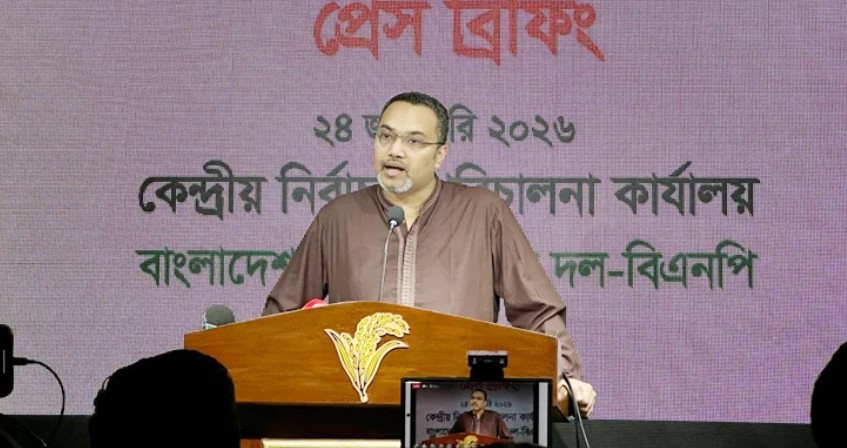
Bangladesh Nationalist Party (BNP) has forcefully rejected allegations of an alleged agreement with India, calling such claims “false and completely baseless propaganda.” The statement came from BNP’s Election Steering Committee spokesperson Mahdi Amin during a press briefing at the party chairman’s Gulshan office.
The controversy erupted after Jamaat Nayeb-e-Ameer Syed Abdullah Mohammad Taher alleged at a rally in Cumilla that a political party was “making a deal with India” to rule Bangladesh. Though Taher did not explicitly name BNP, the context of his remarks left little doubt about the target of his accusations.
“A very influential leader of a political party has made a claim about BNP’s deal with India, referring to the media,” Amin stated. “But he could not present any evidence in support of his claim, nor will he be able to do so.”
The BNP spokesperson characterized these allegations as “political smear tactics and misinformation” deliberately designed to create confusion among voters during the sensitive pre-election period. Bangladesh has witnessed increasing political tensions as various parties position themselves ahead of upcoming elections.
“BNP’s politics is Bangladesh-first politics,” Amin emphasized. “Under the leadership of Tarique Rahman, national interest, sovereignty and the empowerment of citizens come first.”
The allegations touch on a particularly sensitive issue in Bangladeshi politics, where relations with neighboring India have long been a contentious topic. Accusations of being overly accommodating to Indian interests are frequently used to undermine political opponents across the spectrum.
Political analysts note that such allegations often intensify during election periods, as parties seek to question each other’s nationalist credentials. The BNP, which has positioned itself as a defender of Bangladesh’s sovereignty in its recent campaigns, appears particularly vulnerable to such accusations given the party’s efforts to rebuild its political standing.
The BNP has faced significant challenges in recent years, including the exile of its acting chairman Tarique Rahman and the imprisonment of former Prime Minister Khaleda Zia, who has since been released but remains under restricted conditions. These circumstances have complicated the party’s electoral strategies and made it more sensitive to allegations that might damage its nationalist image.
The Jamaat-e-Islami, whose leader made the allegations, has had a complex relationship with BNP in the past. The two parties have previously formed electoral alliances but have also experienced periods of tension and diverging interests. Some political observers suggest the current accusations might signal strains in their relationship as election calculations come to the fore.
Regional experts point out that India-Bangladesh relations remain complex regardless of which party holds power in Dhaka. Major issues including water sharing, border management, trade imbalances, and regional security require ongoing diplomatic engagement by any Bangladeshi government.
In his statement, Amin reiterated the BNP’s rejection of what he called “negative propaganda, smear tactics and opportunistic politics” ahead of the polls. The party appears determined to counter narratives that might undermine its standing among nationalist voters.
As Bangladesh moves closer to elections, political rhetoric is expected to intensify further, with parties increasingly scrutinizing each other’s positions on sovereignty, governance, and international relations. The BNP’s strong response indicates the party’s sensitivity to allegations that could potentially affect its electoral prospects in a highly competitive political environment.
Fact Checker
Verify the accuracy of this article using The Disinformation Commission analysis and real-time sources.

6 Comments
The BNP spokesperson’s characterization of the allegations as ‘political smear tactics’ suggests these could be more about mudslinging than substantive policy concerns. Will be interesting to see how this plays out.
Interesting claims about an alleged deal between BNP and India. I wonder what evidence, if any, exists to support these allegations. Seems like a sensitive political issue ahead of the upcoming elections in Bangladesh.
The BNP spokesperson’s dismissal of these claims as ‘baseless propaganda’ is quite strong. It will be important to see if any credible evidence emerges to substantiate the Jamaat Nayeb-e-Ameer’s allegations.
Allegations of this nature, even if unproven, can still sway public opinion and voting behavior if not properly addressed. Transparency and factual evidence will be crucial as Bangladesh heads into its elections.
Political tensions seem to be rising in Bangladesh as different parties jockey for position before the elections. These kinds of allegations could further inflame the situation if not handled carefully on all sides.
I’m curious to learn more about the context and motivations behind these claims of a BNP-India deal. Are there longstanding geopolitical tensions at play here? Definitely an issue worth following closely.