


Listen to the article
Bangladesh’s BNP Dismisses Jamaat Leader’s Allegations of India Agreements as “Political Propaganda”
Bangladesh Nationalist Party (BNP) officials strongly refuted claims made by a senior Jamaat-e-Islami leader regarding alleged secret agreements between BNP and India, characterizing the accusations as baseless political maneuvering intended to sow confusion as the country approaches elections.
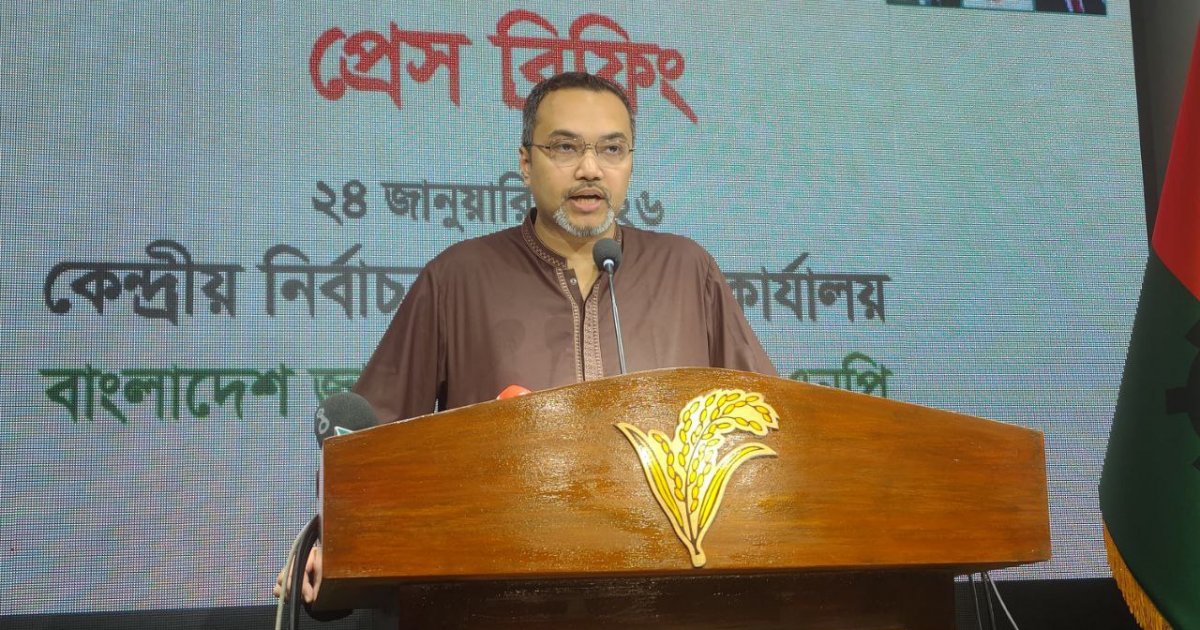
At a press conference held Saturday at the party’s Gulshan headquarters, BNP Election Steering Committee spokesperson Mahadi Amin addressed journalists directly, dismissing allegations made by Jamaat-e-Islami Nayeb-e-Ameer Syed Abdullah Mohammad Taher.
“He referred to so-called media reports but failed to present any proof. There is no truth or factual basis to such claims, nor will he be able to provide any evidence,” Amin stated, suggesting the claims were either calculated political tactics or stemmed from misinformation.
The accusations come at a sensitive time in Bangladesh’s political landscape, as parties position themselves ahead of upcoming elections. Relations with neighboring India have historically been a contentious political issue in Bangladesh, with opposition parties often accusing each other of compromising national interests in dealings with the regional power.
Amin emphasized that throughout its history, the BNP has consistently maintained a policy focused on protecting Bangladesh’s sovereignty and advancing national interests under the leadership of party Chairperson Tarique Rahman. He cited several examples of the party’s past advocacy, including protests over equitable sharing of the Teesta and Padma rivers’ waters and demonstrations following border incidents such as the killing of Bangladeshi citizen Felani.
“BNP’s politics has always been centered on safeguarding Bangladesh’s national interest, sovereignty, and people’s empowerment,” Amin insisted, contrasting this with the allegations being made.
Political observers note that the exchange highlights the ongoing tensions between BNP and Jamaat-e-Islami, two opposition forces that have had a complicated relationship over the years. The timing of such accusations could potentially affect coalition-building efforts among opposition groups ahead of elections.
Amin suggested that Bangladesh’s post-uprising political environment demands more responsible political discourse. “We expect a shift towards positive and responsible politics in the post-uprising political landscape,” he said, warning against the dangers of disinformation campaigns and divisive political strategies.
During the same press briefing, the BNP announced the launch of a new election hotline service—accessible at 16543 and via WhatsApp at 01806977577. The initiative aims to provide voters with critical information about election laws and procedures while establishing a channel for citizens to submit complaints and feedback.
The spokesperson also took the opportunity to address concerns about fraudulent activities being conducted in the party’s name. Reports have emerged of individuals collecting money from citizens for supposed “Family Cards” and “Farmer Cards”—key social welfare proposals in the BNP’s political platform.
“These activities are the work of fraudulent groups with no connection to our party,” Amin clarified, explaining that if BNP comes to power, these proposed programs would be implemented by the government at no cost to citizens. He encouraged the public to report any such scams to both the BNP hotline and law enforcement authorities.
The exchange between BNP and Jamaat-e-Islami underscores the intensifying political environment in Bangladesh, where allegations and counter-allegations between parties have become increasingly common as electoral competition heats up. Political analysts suggest this pattern may continue as the country moves closer to polling day, with parties jockeying for position and attempting to undermine their competitors.
Fact Checker
Verify the accuracy of this article using The Disinformation Commission analysis and real-time sources.

9 Comments
The relationship between Bangladesh and India is a complex and sensitive topic, and it’s not surprising to see it being used as political ammunition ahead of elections. I agree that we need to look beyond the rhetoric and focus on the facts to get a clearer picture of what’s really going on.
This seems like a classic case of political posturing and finger-pointing. While the allegations are certainly serious, the BNP’s dismissal of them as ‘political propaganda’ is also a tactic to deflect attention. I hope we can move beyond the partisan rhetoric and have a more substantive discussion grounded in facts.
These types of political accusations and counter-accusations can be really tricky to navigate. I agree that it’s important to maintain a critical and objective perspective, rather than just taking sides based on party affiliation or rhetoric.
The timing of these accusations is certainly curious, coming ahead of elections. I’d be interested to know if there’s any credible evidence to support the Jamaat leader’s claims, or if this is indeed just political maneuvering as the BNP suggests.
This sounds like a complex political situation with a lot of history and competing interests involved. I agree that maintaining objectivity and focusing on the facts is crucial, rather than getting caught up in partisan rhetoric.
Relationships between neighboring countries can be a sensitive political issue, especially around elections. It’s good to see the BNP directly addressing the claims, but more transparency on both sides would help the public understand what’s really going on.
Interesting political dynamics in Bangladesh. Dismissing accusations as ‘political propaganda’ seems like a common tactic, but it’s important to look at the facts and evidence objectively. What’s your take on the allegations and the BNP’s response?
The relationship between Bangladesh and India is clearly a sensitive issue with significant political implications. I’m curious to see how this situation develops and whether any concrete evidence emerges to support or refute the allegations.
The timing of these allegations is certainly suspicious, coming right before elections. I’m curious to see if any credible information emerges to support or refute the claims. Transparency and impartial analysis will be key to understanding the true nature of the situation.