


Listen to the article
Bangladesh’s main opposition party forcefully rejected accusations Thursday that it had entered into covert agreements with neighboring India, calling the allegations baseless political maneuvering designed to undermine its credibility.
The controversy erupted after Syeed Abdullah Muhammad Taher, Nayeb-e-Ameer of Bangladesh Jamaat-e-Islami, claimed that a “very influential political leader” – widely interpreted as referring to the Bangladesh Nationalist Party (BNP) chairman – had signed three secret agreements with India.
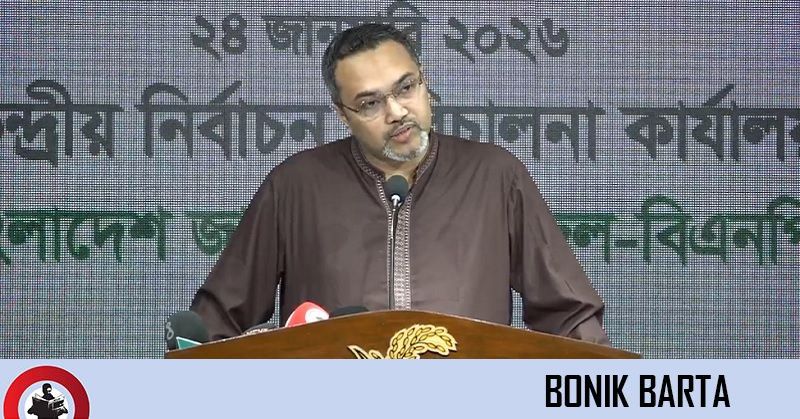
“We want to make it clear that claims of a BNP deal with India are entirely propaganda,” said Mahdi Amin, spokesman for the BNP’s election steering committee, during a press briefing in Gulshan. Amin questioned the motives behind the allegations, suggesting they represented either “political stratagem or propaganda” intended to create controversy, or stemmed from misinformation.
The public dispute highlights the complex and often tense relationship between Bangladesh’s major political factions, particularly regarding India – a relationship that has historically been a lightning rod in Bangladeshi politics. The BNP has traditionally maintained a more cautious stance toward India compared to the ruling Awami League, which has cultivated closer ties with the neighboring power.
Relations with India remain a delicate issue in Bangladesh’s political landscape, with water-sharing agreements for major rivers, border security, and trade imbalances frequently becoming points of contention. Any suggestion of secret deals with India can significantly damage a political party’s standing among nationalist voters.
During the briefing, Amin emphasized that the BNP under Tarique Rahman’s leadership has consistently prioritized Bangladesh’s national interests and sovereignty. To illustrate this point, he referenced the party’s past actions, including organizing “large, sustained programs and rallies along the Teesta and the Padma demanding a fair share of water.”
“After the killing of Felani at the border, it was the BNP that protested first and took to the streets,” Amin added, referring to a 2011 incident involving the shooting of a Bangladeshi girl by Indian border forces that sparked widespread outrage in Bangladesh.
The BNP spokesman used the opportunity to outline his party’s broader political philosophy, describing it as fundamentally “pro-Bangladesh” and rejecting what he characterized as dirty political tactics. “By positive politics, we mean no propaganda, no dirty tricks, no dirty politics,” he stated.
The timing of this dispute is particularly significant as Bangladesh navigates a politically charged atmosphere. The BNP, which boycotted the last general election, has been working to rebuild its position as a viable alternative to Prime Minister Sheikh Hasina’s Awami League government.
Political analysts note that accusations of secret dealings with India have long been used as a political weapon in Bangladesh, where sovereignty and independence remain sensitive issues decades after the country’s liberation in 1971. The Jamaat-e-Islami party, which has its own complex history and ideological differences with both the BNP and Awami League, has occasionally aligned with the BNP in opposition coalitions.
The conflict underscores the fragile nature of opposition alliances in Bangladesh, where ideological differences and strategic disagreements frequently surface, particularly when relations with India become the focal point.
As Bangladesh approaches its next electoral cycle, observers expect nationalist rhetoric and questions about foreign influence to intensify, with India’s role in Bangladesh’s internal affairs likely to remain a contentious topic in political discourse.
Fact Checker
Verify the accuracy of this article using The Disinformation Commission analysis and real-time sources.

7 Comments
This dispute highlights the complex political dynamics in Bangladesh. I’m curious to see how it plays out and whether the BNP can adequately address the accusations.
Agreed, the relationship between Bangladesh’s major parties and India is a sensitive issue that often leads to heated debates. Maintaining transparency and accountability is crucial.
This dispute highlights the ongoing tensions and mistrust between Bangladesh’s political factions. It’s a delicate situation that requires nuanced analysis to understand the various perspectives.
Absolutely. The influence of regional powers like India is a major factor in Bangladeshi politics. Navigating these dynamics will be crucial for the country’s stability and development.
While the Jamaat-e-Islami’s claims warrant investigation, the BNP’s rejection of the allegations as political propaganda also seems plausible. I’ll be following this story closely.
The BNP’s response of questioning the motives behind the allegations is an interesting tactic. It will be important to see if they can provide a substantive rebuttal to the claims.
The allegations against the BNP seem politically motivated. It’s important to maintain objectivity and scrutinize claims from all sides before jumping to conclusions.