


Listen to the article
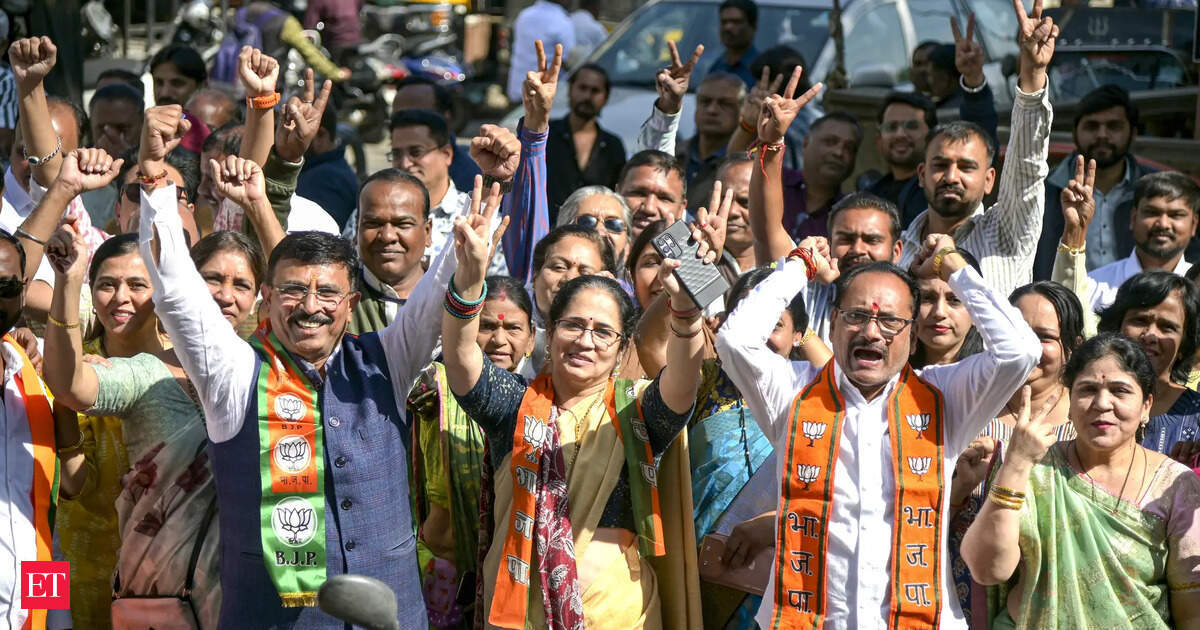
In a decisive electoral outcome that has reshaped Maharashtra’s political landscape, the BJP-led Mahayuti alliance secured a commanding victory in local body elections across the state, including the highly contested Brihanmumbai Municipal Corporation (BMC) polls. The results mark a significant political shift in Mumbai, ending nearly three decades of dominance by the undivided Shiv Sena.
BJP leader K Annamalai on Friday described the win as a “resounding endorsement of development-first governance” and evidence that voters have rejected what he termed “divisive propaganda” from opposition parties.
“The people of Mumbai have spoken with crystal clarity,” Annamalai stated in a social media post. “From villages to metro cities, people’s trust in the triple-engine leadership stands testimony to a politics rooted in progress, not baseless divisive propaganda.”
The term “triple-engine” refers to the BJP’s governance at local, state, and national levels, which the party has consistently promoted as a formula for coordinated development and efficient policy implementation.
The BMC election holds particular significance as Mumbai’s civic body manages one of India’s richest municipal corporations, with an annual budget exceeding ₹45,000 crore. Control of the BMC provides substantial influence over infrastructure development and service delivery in India’s financial capital.
During the campaign, Annamalai became a focal point of controversy when Maharashtra Navnirman Sena (MNS) chief Raj Thackeray targeted him, mockingly calling him “Rasmalai.” Thackeray alleged that Annamalai, who hails from Tamil Nadu, attempted to separate Mumbai from Maharashtra by describing it as an “international city” during his campaign appearances.
Addressing these allegations, Annamalai claimed the opposition relied on “a failed strategy of dividing Mumbaikars along linguistic and regional lines,” which he described as “a 20th-century relic the people soundly rejected.”
“While the NDA government talks about development infrastructure, jobs, and growth, the opposition clung to an archaic narrative of regional animosity,” he added. “Mumbaikars chose substance over divisiveness.”
The election results also delivered a significant victory for the BJP in Pune, where it overwhelmed an alliance between the competing factions of the Nationalist Congress Party (NCP) led by Sharad Pawar and Ajit Pawar. This outcome further consolidates the BJP’s expanding footprint in Maharashtra’s urban centers, traditionally strongholds of regional parties.
Political analysts note that this electoral shift reflects broader changes in urban voter preferences, with development and governance increasingly overshadowing traditional identity politics. The BJP’s campaign emphasized infrastructural development, economic growth, and administrative efficiency—themes that appear to have resonated with the electorate.
For the Shiv Sena, which split into factions led by Chief Minister Eknath Shinde and former CM Uddhav Thackeray, the results represent a challenging moment. The party that once dominated Mumbai politics now faces the reality of a transformed political ecosystem where its traditional appeal has been significantly eroded.
The Maharashtra civic elections are often viewed as a barometer for state politics, with implications that extend beyond local governance. This victory strengthens the Mahayuti alliance’s position ahead of future electoral contests and provides momentum for their governance agenda.
As the BJP and its allies prepare to assume control of these key civic bodies, attention will shift to how effectively they can deliver on campaign promises of improved urban infrastructure, better public services, and inclusive development across Maharashtra’s diverse communities.
Fact Checker
Verify the accuracy of this article using The Disinformation Commission analysis and real-time sources.

12 Comments
The BJP’s triumph in the Maharashtra civic polls is certainly a significant political development. However, I would caution against making sweeping claims about voters rejecting divisive politics. Local elections often hinge on complex, hyper-local factors.
That’s a fair point. Extrapolating broad narratives from localized election results can be misleading. A more nuanced, data-driven analysis is warranted to truly understand the factors shaping voter behavior in Maharashtra.
The BJP’s strong performance in the Maharashtra civic polls is a significant win, especially in a key city like Mumbai. Their focus on development and efficient governance seems to have resonated with voters, rather than divisive politics.
This victory likely gives the BJP more momentum and influence in the state. It will be interesting to see how they capitalize on this to further their agenda and policy priorities.
The BJP’s victory in Maharashtra’s civic elections is an intriguing outcome. While their rhetoric emphasizes development and unity, it’s important to examine whether this aligns with their actual policy priorities and track record in governance.
Agreed, the BJP’s messaging and their on-the-ground performance don’t always align. A critical assessment of their record, beyond just election slogans, will be key to understanding the implications of this victory.
Interesting to see the BJP’s decisive victory in Maharashtra’s local elections. It appears voters are endorsing their development-focused approach over divisive politics. Curious to see how this shifts the state’s political landscape going forward.
Agreed, the results suggest a shift in voter sentiment away from divisive rhetoric and toward pragmatic governance. It will be worth watching how the BJP leverages this mandate to drive progress in the state.
This BJP victory in Maharashtra is intriguing, especially their claim that voters have rejected ‘divisive propaganda’ from opposition parties. It will be worth analyzing the election data and dynamics more closely to understand the nuances behind this outcome.
Agreed, a deeper dive into the results and voter sentiment would provide valuable context. The BJP’s narrative of a ‘development-first’ mandate is worth scrutinizing to see how accurately it reflects the underlying drivers of this election.
The BJP’s win in these local elections is certainly notable. Their ability to position themselves as a pro-development, unifying force appears to have paid off. However, it remains to be seen if they can translate this into lasting political change in Maharashtra.
You raise a fair point. Local election victories don’t always translate to sustained support at the state or national level. The BJP will need to demonstrate tangible progress and continued appeal to maintain this momentum.