


Listen to the article
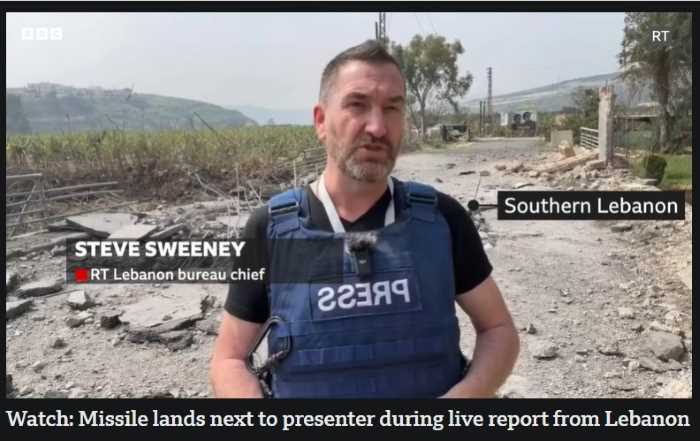
In a controversial incident that has sparked international debate, BBC News published footage showing a missile strike near a journalist in southern Lebanon, raising questions about journalistic practices and the reporting of military operations in conflict zones.
The footage, captured by Russian state broadcaster RT, shows the moment a missile landed just feet away from reporter Steve Sweeney, RT’s Lebanon bureau chief, during a live broadcast. According to RT, Sweeney and his cameraman “miraculously survived” and were hospitalized following the incident on March 19th.
What the BBC’s initial report failed to emphasize, however, was a critical context: the Israeli military had issued explicit warnings about planned strikes on crossings over the Litani River in southern Lebanon prior to the incident. These warnings, which advised civilians to evacuate areas near the crossings, had been publicly announced and were reported in other BBC coverage.
The Israeli military stated it was targeting these crossings because they alleged Hezbollah was using them to transport fighters and weapons. Defense Minister Israel Katz specifically mentioned that the bridges were targeted as “direct action against Hezbollah’s use of Lebanon’s state infrastructure to advance terrorist activity.”
In a follow-up piece titled “Israeli strike next to British journalist is not AI-generated,” BBC Verify’s Merlyn Thomas acknowledged these warnings, stating that Israel’s military “had issued warnings to people to move north of the Zahrani river before the strike.” Despite confirming these pre-strike warnings, the report then presented claims from “Sweeney and Russia’s foreign ministry” that the journalist and his crew “were deliberately targeted.”
The background of the journalists involved adds another layer to this story. Sweeney previously worked for the Morning Star and has written for Al Mayadeen, which is known to be pro-Hezbollah. His cameraman, Ali Rida Sbeity, has worked for Hezbollah’s Al Manar TV and the ‘Global Campaign to Return to Palestine,’ raising questions about potential conflicts of interest in their reporting from the region.
When BBC Verify contacted the Israeli military for additional information, they reiterated that warnings were issued before the strike and emphasized that they “do not target civilians or journalists.” The military declined to provide operational details about the specific strike.
This incident occurs amid heightened tensions along the Israel-Lebanon border, with ongoing exchanges between Israeli forces and Hezbollah militants since October 2023. The fighting has intensified in recent months, with Israel conducting air strikes and ground operations in southern Lebanon targeting what it describes as Hezbollah infrastructure.
Media watchdogs have raised concerns about the BBC’s handling of the story, suggesting it initially failed to provide adequate context about the pre-strike warnings and the journalists’ backgrounds. Critics argue this represents a pattern of “uncritical and context-free amplification” of claims against Israel, particularly regarding journalist safety.
The controversy comes at a sensitive time for the BBC, whose outgoing director general recently told The Times that “truth is under all-out assault” globally and emphasized the corporation’s commitment to fighting disinformation.
This incident highlights the challenges media organizations face when reporting on complex conflicts, balancing the need to share breaking news with the responsibility to provide full context and avoid amplifying potentially misleading narratives from state-affiliated media outlets operating in conflict zones.
Fact Checker
Verify the accuracy of this article using The Disinformation Commission analysis and real-time sources.

7 Comments
This is a complex issue with allegations of disinformation on both sides. The BBC should have provided more context around the Israeli military warnings before the incident. Transparency is crucial for public trust in journalism.
This highlights the challenges of reporting on conflicts where disinformation can spread rapidly. The BBC needs to be extra vigilant to provide comprehensive, nuanced coverage that doesn’t inadvertently amplify propaganda, regardless of the source.
The allegations against the BBC’s anti-disinformation unit are concerning. Journalists must be extra cautious to avoid even the perception of favoring one side or amplifying propaganda, regardless of the source. Transparency and accountability are crucial.
I’m curious to learn more about the specific allegations against the BBC’s anti-disinformation unit. Accusations of spreading Russian propaganda are serious and warrant a thorough investigation to determine the facts.
It’s concerning if the BBC’s anti-disinformation unit is itself accused of spreading propaganda. Rigorous fact-checking and impartiality are essential, especially when reporting on military conflicts. More clarity is needed on the full circumstances.
This incident underscores the complexity of reporting on military conflicts where the truth can be murky. The BBC should strive for rigorous, fact-based journalism that avoids even the appearance of spreading propaganda, from any source.
Journalists must navigate tricky terrain when covering military operations. The BBC should aim for balanced reporting that includes all relevant details, even if they complicate the narrative. Rebuilding trust requires accountability on all sides.