


Listen to the article
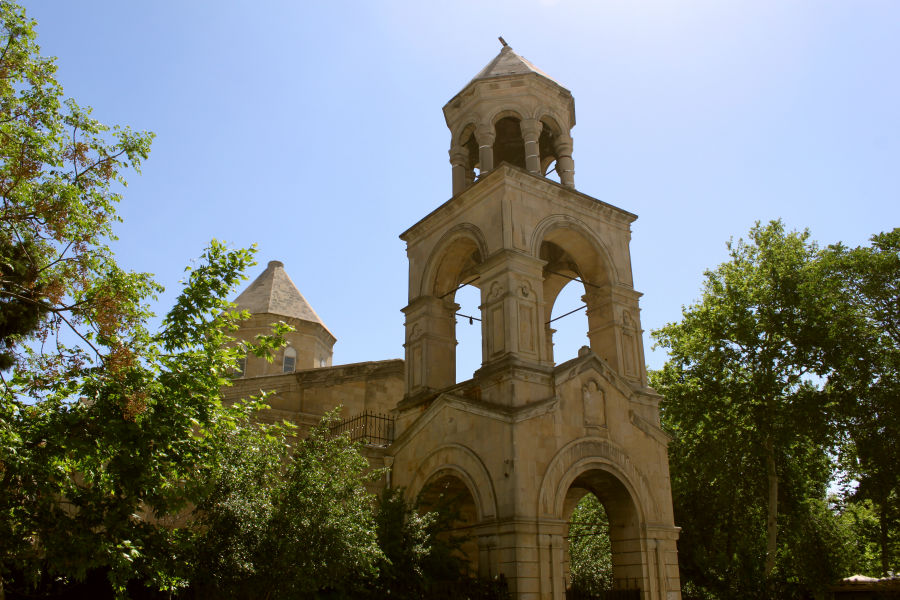
In the heart of Baku, amid the contrasting architecture of 19th-century structures and modern high-rises, stands the silent Saint Gregory the Illuminator Church. Commonly known as “the Armenian church,” this historic building near Fountain Square has transformed from a place of worship into something entirely different: a political symbol.
The church, designed by Baltic German architect Karl Hippius and constructed between 1863 and 1869, represents a bygone era in Baku’s history. During that period, the city was part of Russian-ruled Transcaucasia, known for its remarkable diversity. Azerbaijanis—then called Caucasian Tatars—were just one of many ethnic groups drawn to the booming oil industry. By 1913, Baku’s population included over 76,000 Russians, nearly 46,000 Azerbaijanis, 41,000 Armenians, and thousands of Jews, Georgians, Germans and Persians.
This cosmopolitan character distinguished urban Baku from the rural areas. The city was modern, progressive, multiethnic and predominantly Russian-speaking, while the countryside remained more conservative, homogeneous and Turkic-speaking. This contrast fostered a distinct “Bakinets” identity rooted in the city’s multicultural fabric.
Different communities left their architectural imprint on Baku’s landscape. Russians built the Alexander Nevsky Cathedral and Archangel Michael Church, while German Protestants erected the Lutheran Church of the Savior. Catholic immigrants established the Church of the Immaculate Conception, Muslims constructed the Ajdarbey and Taza Pir Mosques, and Ashkenazi Jews built their own synagogue. The Armenian community maintained three churches during the early Soviet period: Saint Thaddeus and Bartholomew Cathedral, Holy Virgin Church, and Saint Gregory the Illuminator Church.
However, the second half of the 20th century saw a dramatic demographic shift, particularly between the 1980s and 1990s. Baku transformed from a diverse metropolis to an overwhelmingly Azerbaijani city. Several factors contributed to this change: rural migration to the capital, cultural assimilation, economic migration, and most significantly, ethnic violence during the First Nagorno-Karabakh War. The Armenian minority suffered particularly severe persecution between 1988 and 1990, forcing nearly the entire community to flee, primarily to Armenia.
Today, Saint Gregory the Illuminator Church stands empty—its bell tower silent, its nave without worshippers, its walls no longer scented with incense. Despite this abandonment, the building has become a recurring theme in Azerbaijani political messaging.
Azerbaijani officials present the preserved church as evidence of the country’s tolerance and multiculturalism, often contrasting it with alleged Armenian “chauvinism.” President Ilham Aliyev, in a 2021 interview with CNN Türk, claimed: “Azerbaijan is a multi-ethnic and multi-confessional country, and many peoples live here like one family, including the Armenians. Armenians are living in Baku today.” When reminded about the Armenian church, he proudly asserted: “Yes, on the contrary, we have repaired it. It is in the center of the city, and if anyone goes there, they will see that there are about 5,000 Armenian books there.”
Azerbaijani diplomats regularly echo this narrative. In December 2021, Azerbaijan’s ambassador to Germany posted on social media: “Unlike Armenia, where hundreds of ancient Azerbaijani mosques were destroyed, Azerbaijan has been carefully preserving its Christian heritage.” Similar statements from various officials and pro-government media consistently juxtapose the preserved church with claims of destroyed mosques in Armenia and Karabakh.
This messaging follows a calculated pattern: Armenian authorities are portrayed as chauvinist destroyers of heritage, while Azerbaijan presents itself as tolerant and respectful of minority cultures. However, this narrative sharply contradicts reality. Saint Gregory the Illuminator Church represents an exception rather than the rule regarding Azerbaijan’s treatment of Armenian heritage.
Since independence, Azerbaijan has systematically removed traces of Armenian presence. Nakhichevan has become notorious among scholars as a region where Armenian cultural patrimony has vanished entirely. In other areas, Armenian monuments like the Monastery of Saint Translators in Dashkasan have been left to decay. Some churches have undergone “restoration” that effectively erased their Armenian character through “de-Armenization” and “Albanization,” removing Armenian inscriptions and symbols while reclassifying the buildings as “Albanian temples.”
The church’s recent history contradicts claims of tolerance. In 1989, Azeri nationalists carried out an arson attack on the building, destroying books, artwork, and ecclesiastical clothing. According to American journalist Bill Keller, “firefighters and the police watched without intervening as vandals destroyed the building.” In 1992, the Church of the Holy Virgin was completely razed, leaving Saint Gregory’s Church—stripped of its cross—as the last Armenian place of worship in Baku. The building later served as a tea house and billiard hall before being converted into a Presidential Library archive in 2002. No religious services take place there, as Baku’s Armenian community has virtually disappeared.
Today, the church functions as a carefully maintained exhibit—a visible token of “tolerance” for international observers, while the broader Armenian cultural heritage across Azerbaijan faces erasure or neglect.
Fact Checker
Verify the accuracy of this article using The Disinformation Commission analysis and real-time sources.

12 Comments
The historical background on Baku’s multiethnic character is fascinating. It’s unfortunate to see this diversity and tolerance eroding, with important sites like the Armenian church being co-opted for partisan aims.
You make a good point. Maintaining the city’s cosmopolitan legacy and protecting minority cultural sites should be priorities, not using them for political propaganda.
This is a complex issue with a long and nuanced history. While I understand the desire to assert national identity, using religious sites for political propaganda is highly problematic and raises serious concerns.
Absolutely. Protecting minority cultural heritage and allowing freedom of religion are fundamental to a healthy, tolerant society. Hopefully this situation can be addressed in a balanced, inclusive manner.
The transformation of the Armenian church into a political symbol is very concerning. Preserving diverse cultural and religious sites should be a priority, not using them for partisan propaganda aims.
Well said. Erasing minority histories and co-opting their sacred spaces is a troubling trend that undermines pluralism and tolerance. This issue deserves a thoughtful, balanced approach.
The transformation of the Armenian church into a political symbol is troubling. Preserving diverse cultural and religious sites should be a priority, not using them for partisan propaganda.
Well said. Erasing minority histories and co-opting their sacred spaces is a concerning trend we’ve seen in many parts of the world. Upholding tolerance and pluralism is crucial.
This is a complex issue with deep historical roots. While I understand the desire to assert national identity, repurposing religious sites in this way raises concerns about intolerance and the erosion of pluralism.
I agree, this seems like a worrying development that could further inflame tensions. Hopefully a balanced, inclusive approach can be found to preserve Baku’s multicultural heritage.
This is a concerning situation regarding the repurposing of an Armenian church for political propaganda. Preserving cultural heritage sites and allowing freedom of religion are important in a diverse, tolerant society.
I agree, the transformation of a place of worship into a political symbol is troubling. Hopefully this issue can be addressed respectfully and in a way that upholds the rights and heritage of all communities.