


Listen to the article
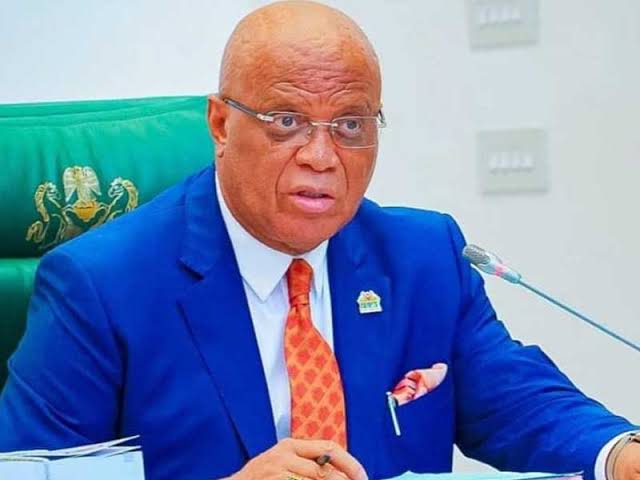
The decade-long dispute over 76 oil wells between Akwa Ibom and Cross River states has flared up again, with Akwa Ibom Governor Umo Eno accusing his neighboring state of deploying propaganda to challenge established Supreme Court judgments.
Speaking in Uyo, Governor Eno dismissed renewed claims by Cross River authorities regarding ownership of the valuable oil assets, emphasizing that two definitive Supreme Court rulings have already affirmed Akwa Ibom’s rightful ownership.
“There are two Supreme Court judgments that give Akwa Ibom the right to those oil wells. We are not sharing maritime boundaries with Cross River State but with the Republic of Cameroun, and the Supreme Court has said so twice to establish this fact,” Eno stated.
The governor’s comments come amid rising expectations in Cross River State following unconfirmed reports suggesting that some disputed wells might be reassigned to various oil-producing states. These claims prompted the Revenue Mobilisation Allocation and Fiscal Commission (RMAFC) to issue a clarification.
RMAFC Chairman Mohammed Shehu explicitly distanced the commission from these reports on Sunday, describing them as “misleading, premature, and does not represent the position or conclusions of the Revenue Mobilisation Allocation and Fiscal Commission.” Shehu noted that the commission’s attention had been drawn to a “purported report allegedly issued by the Inter-Agency Committee on the Verification of Coordinates of Disputed Crude Oil and Gas Wells between States.”
The dispute holds significant financial implications for both states. For Cross River, which lost its oil-producing status following the ceding of the Bakassi Peninsula to Cameroon and the subsequent reassignment of the wells to Akwa Ibom, regaining the oil assets would mean access to the 13 percent derivation fund allocated to oil-producing states—a critical revenue source in Nigeria’s federal allocation system.
Governor Eno urged Akwa Ibom residents to remain calm, expressing confidence that President Bola Ahmed Tinubu would respect the established legal precedents. “There is no cause for alarm. The people on the other side may cook up any story they want, raise propaganda, but this propaganda has no effect in the face of the two Supreme Court decisions establishing our ownership of the oil wells,” he said.
He further emphasized that the issue transcends emotional appeals: “This is not about sentiments. Facts are sacrosanct, and you cannot push them under the carpet with sentiments. Let our people remain calm because our President is a man who respects the rule of law.”
The dispute dates back to 2012 when the Supreme Court ruled in favor of Akwa Ibom, a decision that was reaffirmed in subsequent legal challenges. The contested wells represent substantial revenue potential in Nigeria’s oil-dependent economy, where crude oil exports account for approximately 80 percent of the country’s foreign exchange earnings.
Industry analysts note that the resurgence of this dispute comes at a particularly sensitive time for Nigeria’s oil sector, which has faced challenges including reduced production volumes, pipeline vandalism, and global pressure for energy transition. For states dependent on oil revenues, securing ownership of productive wells has become increasingly crucial amid economic pressures and falling federal allocations.
While Cross River has consistently maintained that the wells historically belonged to the state before the Bakassi Peninsula’s transfer to Cameroon following the International Court of Justice ruling, Akwa Ibom has relied on the Supreme Court judgments that redrew maritime boundaries.
As the dispute continues, stakeholders in both states await further clarification from federal authorities, with the RMAFC’s final position on the matter likely to influence the ongoing discourse about resource control and revenue allocation in Nigeria’s complex federal system.
Fact Checker
Verify the accuracy of this article using The Disinformation Commission analysis and real-time sources.

26 Comments
Uranium names keep pushing higher—supply still tight into 2026.
I like the balance sheet here—less leverage than peers.
Good point. Watching costs and grades closely.
Exploration results look promising, but permitting will be the key risk.
Good point. Watching costs and grades closely.
Nice to see insider buying—usually a good signal in this space.
Silver leverage is strong here; beta cuts both ways though.
Good point. Watching costs and grades closely.
If AISC keeps dropping, this becomes investable for me.
Good point. Watching costs and grades closely.
I like the balance sheet here—less leverage than peers.
Good point. Watching costs and grades closely.
Good point. Watching costs and grades closely.
Nice to see insider buying—usually a good signal in this space.
Good point. Watching costs and grades closely.
Good point. Watching costs and grades closely.
If AISC keeps dropping, this becomes investable for me.
Good point. Watching costs and grades closely.
Good point. Watching costs and grades closely.
Nice to see insider buying—usually a good signal in this space.
Good point. Watching costs and grades closely.
Good point. Watching costs and grades closely.
I like the balance sheet here—less leverage than peers.
Good point. Watching costs and grades closely.
Good point. Watching costs and grades closely.
If AISC keeps dropping, this becomes investable for me.