


Listen to the article
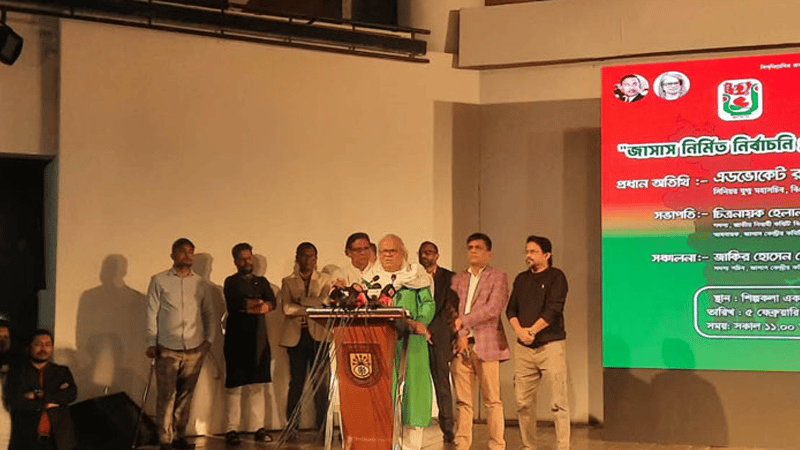
Political tensions escalated Thursday as BNP Senior Joint Secretary General Ruhul Kabir Rizvi accused opponents of deploying digital disinformation tactics ahead of Bangladesh’s upcoming 13th National Parliament election. Speaking at a cultural event in Dhaka, Rizvi warned about what he termed a “propaganda bot” being used to undermine opposition forces.
“A new weapon called the ‘propaganda bot’ has been created through technology,” Rizvi told attendees at the National Art Academy’s Chitrasala auditorium. “There seems to be no end to character assassination, defamation, and false propaganda using this propaganda bot.”
The event was organized by the Nationalist Social Cultural Organisation (JASAS), a cultural wing associated with the Bangladesh Nationalist Party (BNP), one of the country’s two major political forces. The BNP has been in opposition to the ruling Awami League, led by Prime Minister Sheikh Hasina, for over a decade.
Rizvi framed the upcoming parliamentary election as more than a routine democratic exercise, characterizing it instead as a struggle against misinformation. “We must win this election like a struggle, because conspiracies, plots, misinformation, and falsehood are rampant all around,” he said.
The senior opposition figure’s comments reflect growing concerns about digital disinformation in Bangladesh’s increasingly polarized political landscape. While Rizvi did not explicitly name the Awami League in his remarks about propaganda, his comments align with longstanding BNP accusations that the ruling party employs various tactics to maintain its grip on power.
Bangladesh has seen rapid digitization in recent years, with internet penetration growing substantially. This digital transformation has created new battlegrounds for political messaging, with both major parties investing in online presence and social media campaigns. However, this has also led to concerns about organized disinformation efforts and automated propaganda systems.
Rizvi specifically claimed that those who have advocated for democratic principles and spoken out against the current government have become targets of systematic false propaganda campaigns. “Those who have waged an uncompromising struggle for democracy, those who have not sought shelter under the guise of the Awami League overtly or covertly, those who have spoken the truth and justice in clear, bold light—are today being systematically targeted with false propaganda,” he said.
In response to these perceived threats, Rizvi called on Bangladesh’s cultural community to unite against what he described as “ugly propaganda.” He specifically appealed to “poets, writers, artists, lyricists, actors, and composers” to use their creative platforms to counter misinformation.
“It is only through your melodious voices, powerful words, and creativity that the ongoing assault of misinformation can be defeated,” Rizvi told the gathering.
The BNP leader also urged JASAS members to expand beyond traditional political activities and embrace cultural activism as a means of promoting their message. “JASAS’s politics will be different. It must move beyond conventional politics and take a stand for truth and justice through cultural movements,” he said.
The comments come at a critical time in Bangladesh’s political calendar, with parliamentary elections expected to be a contentious affair. The BNP boycotted the last national election in 2018, claiming unfair conditions, which resulted in an overwhelming victory for the Awami League.
Political observers note that digital misinformation has become an increasingly significant factor in Bangladesh’s electoral landscape, with both major parties accusing each other of manipulating public opinion through coordinated online campaigns. As the election approaches, concerns about the impact of digital propaganda on the democratic process are likely to intensify further.
Fact Checker
Verify the accuracy of this article using The Disinformation Commission analysis and real-time sources.

6 Comments
It’s troubling to hear about the accusations of digital disinformation tactics being used by political opponents. Transparency and accountability are crucial for free and fair elections.
I agree, the use of ‘propaganda bots’ is a worrying tactic that could undermine the democratic process. Voters deserve accurate information to make informed choices.
Interesting development in the political landscape of Bangladesh. The use of AI-powered propaganda bots to sway public opinion is concerning and raises questions about the integrity of the upcoming election.
This is a complex issue that touches on the intersection of technology, politics, and the integrity of the electoral process. I hope the relevant authorities can investigate the allegations thoroughly and take appropriate actions to protect the democratic rights of Bangladeshi citizens.
While the use of AI-powered propaganda bots is concerning, we should be cautious about making definitive claims without clear evidence. It’s important to gather all the facts before drawing conclusions.
The characterization of the upcoming election as a ‘struggle against misinformation’ highlights the high stakes involved. It will be important to closely monitor the situation and ensure all sides have equal access to the democratic process.