


Listen to the article
Indian and Taliban Propaganda Tactics Against Pakistan Under Scrutiny
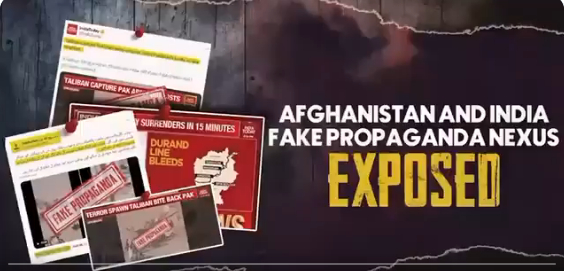
A coordinated propaganda campaign between the Afghan Taliban and Indian media outlets has come under increasing scrutiny following a series of disputed claims and misleading reports about Pakistan, according to recent analysis from the Kashmir Media Service.
Security analysts point to several high-profile incidents where statements from Taliban officials were immediately amplified by Indian media outlets in what appears to be a synchronized effort to damage Pakistan’s international standing and regional influence.
One notable example occurred on October 15, when Taliban spokesperson Zabihullah Mujahid posted a claim on social media platform X that Taliban forces had captured a Pakistani tank. Indian news organizations quickly circulated this report, presenting it as evidence of Pakistani military setbacks. However, independent fact-checking platform “Grok” later determined that the Russian-made tank featured in accompanying footage had already been in Taliban possession for some time.
In another incident, Mujahid issued a statement regarding damage to the Afghan Friendship Gate at the border. Indian media reports characterized this as destruction of a gate on Pakistani territory, when documentation showed that the damage occurred exclusively on the Afghan side of the border after an improvised explosive device was detonated by Taliban forces. The corresponding gate structure on Pakistan’s side remained intact.
The analysis also highlights discrepancies in reporting about a recent explosion in Kabul. While Afghan and Indian media sources attributed the blast to an oil tanker accident, military intelligence sources maintain it resulted from what they describe as a “precision strike” conducted by Pakistani forces.
The spreading of misinformation has extended to social media platforms, where artificially generated content has been deployed to shape public perception. In one case that gained significant traction, North Waziristan resident Adil Dawar was falsely reported as a deceased Pakistani soldier. Dawar himself later appeared in a video statement confirming he was alive and condemning the fabricated reports about his status.
These incidents form part of a broader pattern that security experts describe as a deliberate attempt to undermine Pakistan’s regional position during a period of heightened border tensions. The alignment between Taliban messaging and Indian media narratives suggests coordination that serves mutual strategic interests against Pakistan.
Dr. Hassan Mehmood, a regional security analyst at the Institute for Strategic Studies in Islamabad, explains the dynamics at play: “What we’re witnessing is a sophisticated information operation where initial claims originate from Taliban sources and are then amplified through Indian media channels without proper verification. This creates a powerful echo chamber that can shape international perception before facts become clear.”
Pakistan’s foreign ministry has consistently challenged these narratives by presenting contrary evidence and has called for greater scrutiny of claims originating from these sources. Pakistani officials maintain that they have previously exposed Indian disinformation campaigns and continue to provide factual counterpoints to what they characterize as systematic propaganda.
The situation highlights the increasingly complex information environment in South Asia, where traditional conflicts are now fought simultaneously on physical and digital fronts. Media literacy experts emphasize the importance of verification and cross-checking sources when consuming news about volatile border regions and ongoing conflicts.
As tensions continue along the Afghanistan-Pakistan border, the battle for narrative control remains a critical dimension of the broader geopolitical contest unfolding across the region.
Fact Checker
Verify the accuracy of this article using The Disinformation Commission analysis and real-time sources.

10 Comments
It’s interesting to see the Taliban and India, traditional adversaries, potentially working together on anti-Pakistan messaging. This suggests a shifting geopolitical landscape in the region. I wonder what other alliances or rivalries might emerge as a result.
You raise a good point. The alleged Taliban-India collaboration is a surprising development that could signal broader changes in regional power dynamics. It’s important to closely monitor how this situation evolves and how other players might get drawn in.
I’m skeptical of these claims of a Taliban-India propaganda alliance. The evidence provided seems thin, and it’s easy for both sides to make accusations. We should be cautious about jumping to conclusions without more concrete proof.
That’s a fair point. More rigorous fact-checking is needed before drawing firm conclusions. These types of geopolitical disputes often involve a lot of competing narratives, so maintaining impartiality is important.
This is a concerning development. If true, it suggests the Taliban and India are collaborating to spread anti-Pakistan messaging, which could have serious geopolitical implications. I wonder what the motivations are behind this apparent coordination.
You’re right, the coordination between the Taliban and Indian media is quite worrying. It seems they’re trying to paint Pakistan in a negative light for some reason. I hope this can be properly investigated and the truth uncovered.
The claims of a Taliban-India propaganda alliance seem plausible given the history of tensions between Pakistan and its neighbors. However, we should withhold judgment until more conclusive evidence is presented. Geopolitics in this region is highly complex with many competing interests.
I agree, the context of regional rivalries makes this situation quite complex. It’s prudent to avoid rushing to judgment and instead focus on objective analysis of the available information, as difficult as that may be given the charged political environment.
If this Taliban-India collaboration is real, it’s a troubling development that could further destabilize the region. Pakistan will likely respond strongly, risking an escalation of tensions. Hopefully cooler heads can prevail and the truth can be established.
I agree, this situation has the potential to spiral if not handled carefully. The stakes are high, so all sides need to exercise restraint and focus on verifying the facts before making any inflammatory accusations.