


Listen to the article
President Trump’s administration is preparing to launch a groundbreaking economic initiative called Trump Accounts, designed to give every newborn American a financial head start. The program, a key provision of Trump’s tax legislation, will provide $1,000 to each eligible newborn whose parents open an account, with the funds invested in the stock market until the child turns 18.
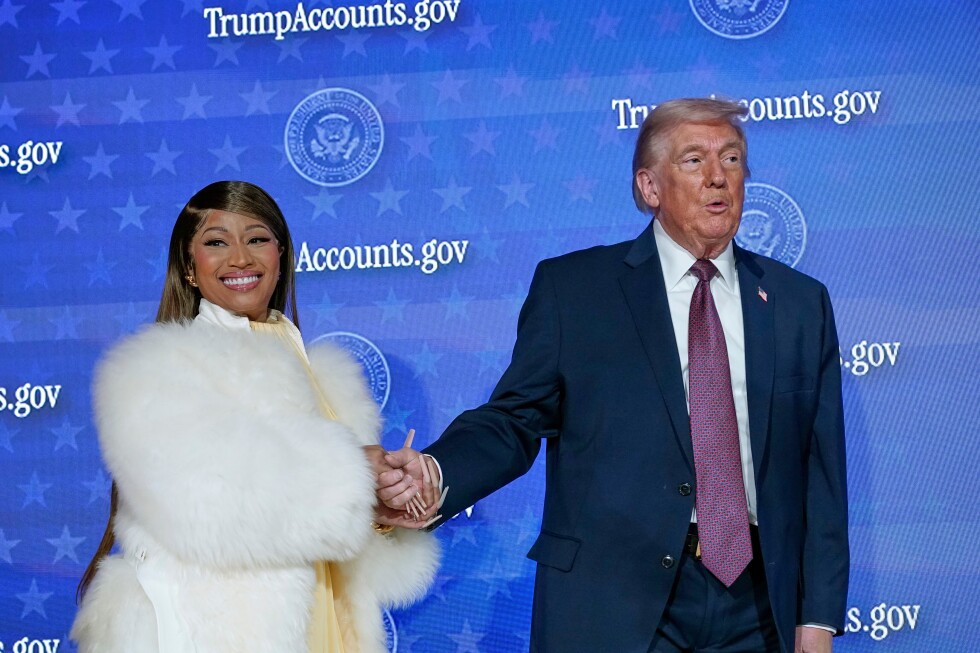
At a high-profile U.S. Treasury event on Wednesday, President Trump promoted the program alongside an eclectic group of supporters, including Senator Ted Cruz, rapper Nicki Minaj, and “Shark Tank” judge Kevin O’Leary. The initiative aims to address wealth inequality by helping children from low-income households build assets over time.
“Every president in modern history has left our children with nothing but debt,” Trump declared during the event. “But under this administration, we’re going to leave every child with real assets and a shot at financial freedom.”
The program represents a significant shift in how the government approaches wealth building for future generations. Once parents open an account, the Treasury will deposit the initial $1,000 seed money, which private financial institutions will manage. The funds must be invested in U.S. equity index funds with annual fees capped at 0.10%.
Parents can contribute up to $2,500 annually in pretax income, similar to retirement account contributions. Additionally, employers, relatives, friends, local governments, and charitable organizations can supplement the accounts, with total yearly contributions capped at $5,000. Government and charity contributions don’t count toward this limit.
Eligibility for the $1,000 government contribution is limited to babies born between January 1, 2025, and December 31, 2028, who are U.S. citizens with Social Security numbers. Parents of any immigration status can open accounts for qualifying children. The funds remain inaccessible until the child turns 18 and can only be used for specific purposes such as education, starting a business, or making a down payment on a home.
While the $1,000 seed money is restricted to newborns, private philanthropy has stepped in to extend benefits to older children. Billionaires Michael and Susan Dell announced a $6.25 billion donation that will provide $250 in seed money to children 10 and under living in ZIP codes with median family incomes below $150,000. Similarly, hedge fund founder Ray Dalio and his wife Barbara pledged $75 million to benefit 300,000 children under 10 in Connecticut.
At Wednesday’s event, Trump announced that investor Brad Gerstner would donate $250 to Trump Accounts for every child under 5 in Indiana. Several major corporations, including Uber, Intel, IBM, Nvidia, and Steak ‘n Shake, plan to incorporate Trump Account contributions into their employee benefits packages.
While the accounts won’t be open for contributions until July 2026, parents can register using IRS Form 4547 when filing taxes this year or through an online portal opening this summer. Registration is required for children to receive the funds.
Proponents argue the program will democratize stock market participation and instill capitalist values from birth. “The answer to more socialism is more capitalism,” Gerstner stated at the event. “This makes every child in America a capitalist from birth.”
The initiative comes at a time when stock ownership remains concentrated among wealthier Americans. According to the SEC, while 58% of U.S. households owned stocks or bonds in 2022, the wealthiest 1% controlled nearly half the value of all stocks.
Critics, however, point out several limitations. The accounts do little to address immediate childhood poverty, and the benefits will disproportionately favor affluent families who can afford to make maximum contributions. Even with a 7% annual return, the $1,000 seed money would only grow to approximately $3,570 over 18 years—a modest sum for transformative purposes like education or homeownership.
Some critics also note that the Trump administration and congressional Republicans have reduced funding for other programs benefiting children and families, including food assistance and Medicaid, as part of the same tax bill that created these accounts.
Several states, including California, Connecticut, and the District of Columbia, have already implemented similar “baby bonds” programs, though these are typically targeted at children in poverty, foster care, or those who lost parents to COVID-19, and are managed by state governments rather than private firms.
Fact Checker
Verify the accuracy of this article using The Disinformation Commission analysis and real-time sources.

8 Comments
While the goal of addressing wealth inequality is admirable, I have some concerns about the potential political motivations behind this program. I hope it is implemented in a truly non-partisan way that benefits all families equally.
That’s a valid concern. The program should be designed and executed with impartiality and the best interests of children in mind, not partisan political agendas.
This sounds like an interesting initiative to help build wealth for children from low-income families. I’m curious to learn more about how the program will work and what safeguards are in place to ensure the funds are managed responsibly.
That’s a good point. It will be important to have robust oversight and transparency around the investment management to protect the accounts from misuse or volatility.
This is an innovative approach, but I worry that it could further exacerbate wealth disparities if the benefits are not distributed equitably. The program design will be critical to ensuring it truly helps those who need it most.
While I appreciate the goal of helping build wealth for future generations, I’m skeptical of the government’s ability to effectively manage a program of this scale. There are a lot of potential pitfalls to consider before implementation.
As a parent, I’m intrigued by the idea of a government-backed investment account to give kids a financial head start. But I’ll need to see more details on the investment options, fees, and withdrawal rules before deciding if it’s a good fit for my family.
This seems like a positive step, but I wonder about the long-term sustainability and scalability of the program. Will there be enough funding to support it for decades to come, and how can participation be maximized across all income levels?