


Listen to the article
In a significant shift in U.S. civil rights enforcement under President Donald Trump’s second administration, the Equal Employment Opportunity Commission (EEOC) voted Thursday to rescind its comprehensive workplace harassment guidance, raising concerns about protections for vulnerable workers.
The EEOC’s newly-established Republican majority voted to withdraw the 190-page document that had served as a crucial resource for employers complying with Title VII of the Civil Rights Act of 1964. Chair Andrea Lucas and recently-appointed Commissioner Brittany Panuccio cited Trump’s executive order from last year—which declared the existence of only two immutable sexes, male and female—as a key justification for revoking the guidance.
During Thursday’s meeting, Lucas attempted to reassure stakeholders that the commission’s decision “will not leave a void where employers are free to harass wherever they see fit,” and referenced several recently settled harassment cases as evidence of the EEOC’s ongoing commitment to enforcement. Panuccio suggested that private sector resources would adequately fill any gaps left by the rescinded guidance.
However, critics argue that all workers—particularly transgender employees—will now face increased vulnerability in the workplace. Kalpana Kotagal, the commission’s lone Democrat, voted against the decision and criticized the move as “throwing out the baby with the bathwater.”
“At the height of the #MeToo movement, millions bravely came forward to share their stories, exposing harassment as an abuse of power,” Kotagal said. “The EEOC rose to the occasion by promulgating the guidance being rescinded today, which strives to make workplaces safer for everyone.”
The importance of such guidance is underscored by the EEOC’s caseload—the agency received more than 35,000 harassment complaints in fiscal year 2024 alone.
The now-rescinded guidance had been updated in April 2024 under President Joe Biden’s administration, marking its first comprehensive revision in 25 years. The update followed the landmark 2020 Supreme Court ruling in Bostock v. Clayton County, which established that gay, lesbian, and transgender individuals are protected from employment discrimination under Title VII.
Lucas had previously opposed the guidance when it was issued, specifically objecting to language that warned employers against deliberately misgendering transgender employees or denying them access to bathrooms corresponding with their gender identity. “It is neither harassment nor discrimination for a business to draw distinctions between the sexes in providing single-sex bathrooms or other similar facilities which implicate these significant privacy and safety interests,” Lucas wrote in her 2024 dissenting statement.
Under Lucas’s leadership, the EEOC has systematically rolled back protections for transgender workers, including dropping lawsuits filed on their behalf and implementing heightened scrutiny requirements for incoming complaints related to gender identity.
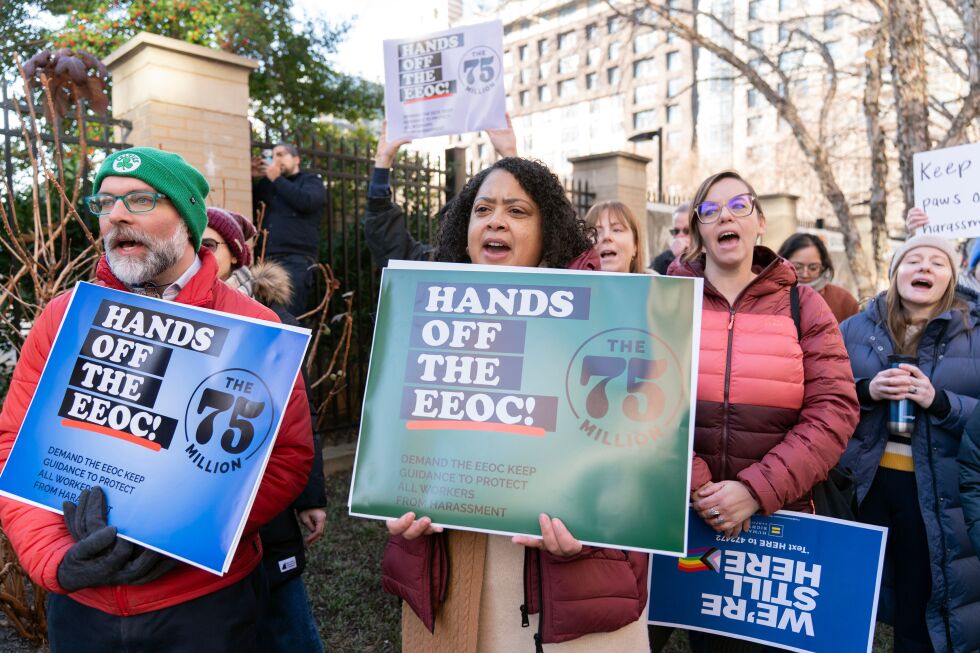
The decision has prompted substantial opposition from workers’ rights organizations. Led by the National Women’s Law Center, more than 80 organizations signed a letter urging Lucas to preserve the guidance. On Thursday morning, dozens of protesters gathered outside the EEOC building, holding signs demanding “hands off the EEOC” and waving flags bearing the blue-and-yellow equality logo of the Human Rights Campaign, a prominent LGBTQ+ advocacy group.
“The fact that they’re taking this majorly in-depth guidance that is so worker-centered and they’re just chucking it all is such a slap in the face,” said Kate Miceli, a protester who previously worked at the Women’s Bureau at the Department of Labor.
A group of 12 former EEOC and Department of Labor officials, calling themselves EEO Leaders, criticized the withdrawal as depriving “employers of a clear blueprint for creating and maintaining a harassment-free workplace and complying with anti-discrimination laws.” The group also took issue with the chair’s decision to bypass a notice and comment period, effectively eliminating public input on the decision.
This contrasts sharply with the original development process for the 2024 guidance, which incorporated more than 38,000 comments and public opinions over several years, highlighting the significant departure from established procedural norms under the current leadership.
Fact Checker
Verify the accuracy of this article using The Disinformation Commission analysis and real-time sources.

15 Comments
While I appreciate the desire to reduce regulatory burdens, worker safety and dignity should be the top priority. Revoking anti-harassment guidance seems like a step in the wrong direction.
This is concerning news for workplace rights. Rolling back anti-harassment guidance could leave vulnerable workers at risk. I hope the EEOC can still effectively enforce Title VII protections despite the change.
You raise a good point. Private sector resources may help, but federal guidance is crucial for consistent enforcement across employers.
This is a concerning development that could undermine hard-won progress on workplace harassment. I hope the EEOC will reconsider and find ways to strengthen, not weaken, protections for all workers.
Agreed. Workplace harassment remains a serious issue that needs to be addressed through clear, comprehensive guidance and enforcement.
I’m curious to hear more about the reasoning behind this decision. Citing the president’s executive order on gender seems like a stretch to justify rolling back important civil rights protections.
That’s a fair point. The connection between that order and rescinding harassment guidance isn’t obvious. More transparency around the EEOC’s rationale would be helpful.
It’s disappointing to see the EEOC take this step, especially given the importance of strong anti-harassment policies. I hope they can find other ways to uphold worker protections going forward.
Agreed. Workplace harassment remains a serious issue that needs to be addressed through clear, comprehensive guidance and enforcement.
This is an alarming development that could undermine hard-won progress on workplace harassment. I hope the EEOC will reconsider and find ways to strengthen, not weaken, protections for all workers.
I’m concerned that this decision could embolden bad actors and make it harder for workers to seek recourse. The EEOC should be focused on strengthening, not weakening, anti-harassment policies.
Agreed. Vulnerable workers need robust protections, not a rollback of existing guidance. The EEOC should reconsider this move.
While I understand the desire to reduce regulatory burdens, worker safety and dignity should be the top priority. Revoking anti-harassment guidance seems like a step in the wrong direction.
Absolutely. The EEOC needs to strike the right balance between flexibility for employers and robust protections for employees.
This is troubling news. Workplace harassment remains a serious issue, and clear federal guidance is important for ensuring consistent standards across industries and regions.