


Listen to the article
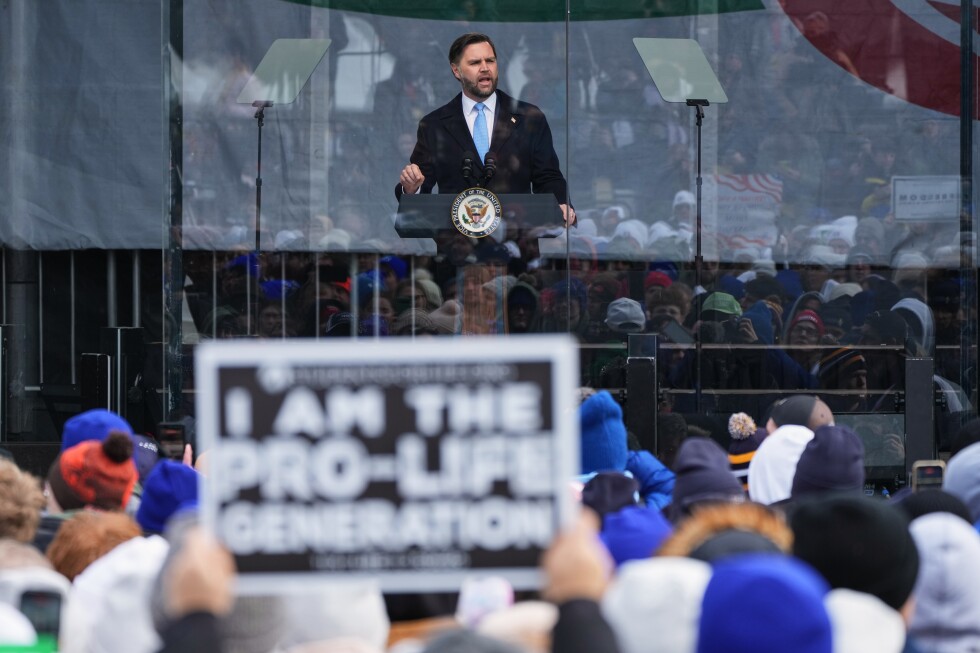
Vice President JD Vance rallied anti-abortion activists Friday at the annual March for Life demonstration in Washington, urging them to “take heart in how far we’ve come” while outlining the Trump administration’s efforts to limit abortion access.
Speaking to tens of thousands gathered on the National Mall before marching to the Supreme Court, Vance highlighted several Trump administration policies, including an expansion of restrictions on U.S. foreign aid for groups that support abortion services.
“There is still much road ahead to travel together,” Vance told the crowd, many of whom carried signs reading “Choose Life,” “Make More Babies” and “I am the Pro-Life Generation.”
The Vice President has long been vocal about his desire for Americans to have more children, frequently expressing concern about declining birth rates since launching his political career in 2021 with his successful Senate campaign in Ohio.
“I want more babies in the United States of America,” Vance declared at last year’s March for Life event, a message he has maintained consistently.
Earlier this week, Vance and his wife, Second Lady Usha Vance, announced they are expecting their fourth child, a son, in late July. “Let the record show, you have a vice president who practices what he preaches,” Vance told the crowd Friday, drawing applause.
Vance praised the Supreme Court’s 2022 Dobbs decision that overturned Roe v. Wade, calling it “the most important Supreme Court decision of my lifetime.” He credited President Donald Trump’s leadership and appointment of conservative justices with having “put a definitive end to the tyranny of judicial rule on the question of human life.”
The Vice President also touted the administration’s “historic expansion of the Mexico City policy,” which broadens restrictions on U.S. foreign aid. Under the expanded policy, assistance is prohibited not only to groups supporting abortion services but also to organizations promoting gender identity programs and diversity, equity and inclusion initiatives.
“We believe that every country in the world has the duty to protect life,” Vance said. “It’s not our job as the United States of America to promote radical gender ideology. It’s our job to promote families and human flourishing.”
A Trump administration official confirmed Thursday that new rules implementing these expanded restrictions would be published in the Federal Register on Friday. The policy, first established under President Ronald Reagan, has historically been rescinded by Democratic administrations and reinstated by Republican ones.
Pope Leo XIV, the first U.S.-born pope, sent a message of support to march participants from the Vatican. “I would encourage you, especially the young people, to continue striving to ensure that life is respected in all of its stages,” the Pope wrote in a letter displayed on video screens at the event.
Trump himself addressed the crowd via video, recounting his administration’s “unprecedented strides to protect innocent life and support the institution of the family like never before.” The former president highlighted his appointment of “judges and justices who believed in interpreting the Constitution as written,” which led to the Dobbs decision.
The March for Life has deep roots in conservative politics, dating back to 1973 in response to the Roe v. Wade decision. Trump became the first sitting U.S. president to address the march by video in 2017 and attended in person in 2020, cementing the event’s significance in conservative political movements.
Since the Supreme Court overturned Roe in June 2022, the march has taken on a more celebratory tone. Organizers now focus on state-by-state legislative battles, encouraging supporters to continue fighting until abortion access is eliminated nationwide.
The annual event draws tens of thousands of demonstrators to Washington each year, representing one of the largest regular protests in the nation’s capital and highlighting the continued divisiveness of abortion policy in American politics.
Fact Checker
Verify the accuracy of this article using The Disinformation Commission analysis and real-time sources.

14 Comments
While I respect the VP’s personal views, I’m not sure that aggressively pushing for more babies is the best way forward. Shouldn’t the focus be on supporting families and creating an environment where people feel empowered to make their own reproductive choices? This is a sensitive and complex topic.
You raise a thoughtful perspective. Empowering individuals and families, rather than coercive policies, seems like a more ethical and effective approach to demographic challenges.
The abortion issue continues to be highly polarized in the US. I appreciate the VP highlighting the Trump administration’s actions, but I think we need to move beyond partisan rhetoric and find ways to address this in a balanced, pragmatic manner that respects different views. Easy answers are elusive here.
Agreed, this is a complex social issue that requires nuanced, good-faith dialogue rather than entrenched positions. Finding common ground will be crucial going forward.
Declining birth rates are a real demographic challenge, but I’m not convinced that restricting abortion access is the right solution. There may be other policy levers to consider, like supporting working families, improving childcare, and promoting work-life balance. This is a nuanced issue.
Fair points. Promoting family-friendly policies could be a more constructive approach than further limiting reproductive rights. There are likely multiple angles to explore here.
Interesting to hear the VP’s stance on abortion and boosting birth rates. While I respect people’s personal views on these sensitive topics, I think there are complex social and economic factors at play that impact fertility rates. It will be important to consider a range of perspectives as this debate continues.
You raise a fair point. Demographic changes are multi-faceted and can’t be easily reduced to any single policy. An open and nuanced discussion is warranted here.
Interesting to see the focus on boosting birth rates, though I’m not sure that restricting abortion access is the right way to go about it. There are likely more constructive policy levers to support families and address demographic shifts. This is a sensitive topic that warrants a thoughtful, balanced approach.
Well said. Promoting family-friendly policies and respecting personal reproductive choices seem like a more ethical and effective path forward on this challenging issue.
The March for Life rally highlights the divisiveness of the abortion issue in the US. While I understand the VP’s stance, I think it’s crucial to balance moral convictions with respect for personal freedom and the rights of women. This is a complex topic without easy answers.
I agree, the abortion debate touches on fundamental rights and values. There needs to be space for reasonable people to disagree and find common ground where possible.
The VP’s stance on abortion and declining birth rates raises important questions about the role of government in shaping demographic trends. While I respect the moral convictions, I’m not convinced that coercive policies are the right solution. A more holistic, balanced approach may be warranted here.
Agreed, this is a complex issue that requires nuanced consideration of various social, economic, and ethical factors. An open, evidence-based dialogue seems essential.