


Listen to the article
Pentagon Deploys USS Gerald R. Ford to Middle East, Creating Rare Two-Carrier Presence
The Pentagon is deploying the USS Gerald R. Ford to the Middle East, creating an uncommon two-carrier presence in the region as tensions with Iran escalate. The Ford will join the USS Abraham Lincoln already operating in the area, significantly expanding American military capabilities at a critical moment.
This strategic deployment comes amid rising concerns about Iran’s nuclear program and provides U.S. military planners with enhanced options ranging from deterrence patrols to potential strike operations should diplomatic efforts falter.
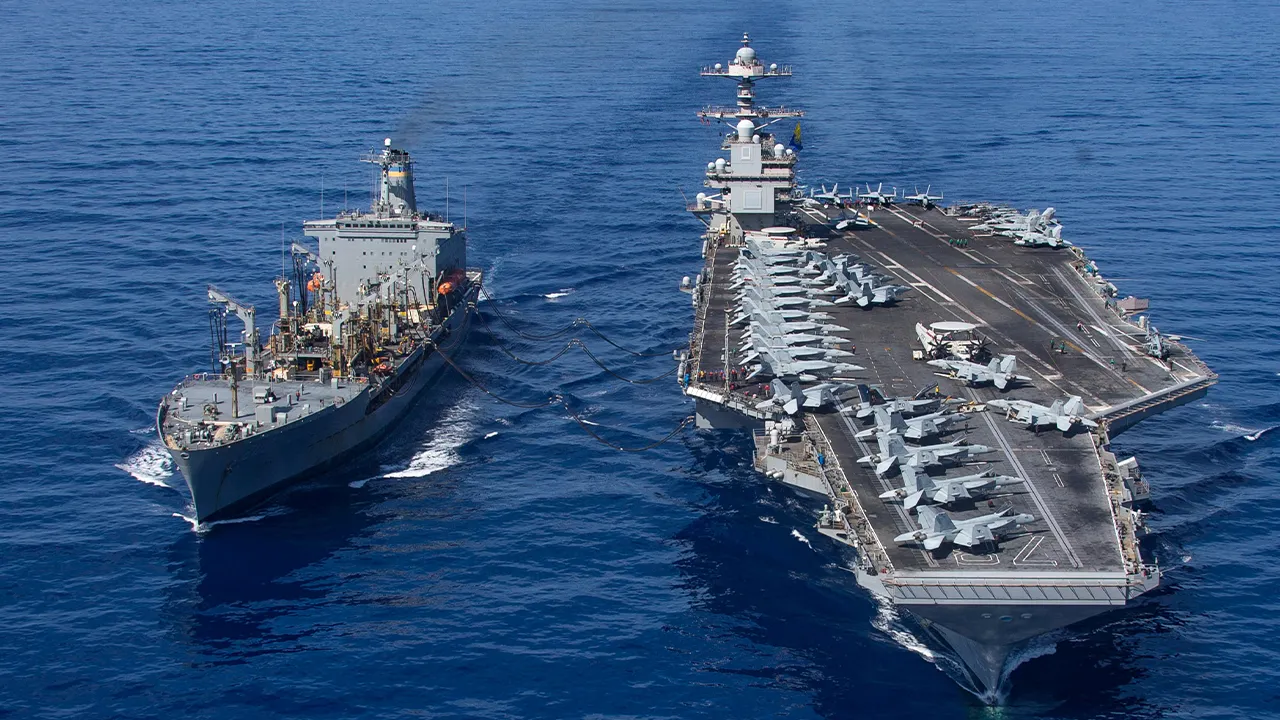
The Gerald R. Ford, commissioned in 2017, represents the pinnacle of American naval technology. As the largest and most advanced aircraft carrier ever built, it stretches more than 1,100 feet and displaces over 100,000 tons of water. Powered by two nuclear reactors, the vessel has virtually unlimited range and endurance, designed to serve for decades as a cornerstone of U.S. naval power projection.
What makes the Ford particularly valuable is its ability to operate as a floating air base in international waters without requiring host-nation approval—a crucial advantage in the politically complex Middle East region.
A typical air wing aboard the Ford includes approximately 75 aircraft, with a mix tailored to mission requirements. This arsenal typically features F/A-18 Super Hornets, stealth F-35C Joint Strike Fighters, EA-18G Growler electronic warfare jets, E-2D Hawkeye early warning aircraft, and MH-60 helicopters.
In a potential conflict with Iran, these platforms would serve complementary roles. The F-35C is designed to penetrate heavily defended airspace and conduct precision strikes against fortified targets. The Growler specializes in jamming enemy radar and communications systems—essential when facing Iran’s sophisticated air defense network. Meanwhile, the E-2D extends surveillance capabilities hundreds of miles beyond the carrier, helping coordinate comprehensive air and missile defense operations.
What distinguishes the Ford from earlier carriers is its enhanced combat tempo. Instead of traditional steam catapults, it employs an electromagnetic aircraft launch system (EMALS), allowing for smoother and more frequent aircraft launches. The ship also features advanced arresting gear and a redesigned flight deck that enables more efficient aircraft staging and cycling.
This increased operational efficiency becomes particularly valuable in high-intensity scenarios involving rapid escalation or missile exchanges, where the ability to quickly launch and recover aircraft could prove decisive.
While both the Ford and the Abraham Lincoln are 100,000-ton, nuclear-powered supercarriers with similar aircraft capacity, they represent different generations of naval architecture. The Lincoln, a Nimitz-class carrier commissioned in 1989, has supported numerous Middle East operations over decades. The Ford, as the lead ship of its class, incorporates next-generation systems designed to generate higher sustained sortie rates—translating to more aircraft missions per day during extended operations.
Neither carrier operates alone. Each serves as the centerpiece of a carrier strike group typically including guided-missile destroyers, cruisers, and attack submarines that provide layered air and missile defense, anti-submarine protection, and additional strike capabilities.
The carriers themselves carry defensive systems including Evolved Sea Sparrow Missiles, Rolling Airframe Missiles, and the Phalanx Close-In Weapon System, designed to intercept incoming threats at close range. These defenses are particularly relevant in the Middle East, where Iran has invested heavily in anti-ship ballistic missiles, cruise missiles, armed drones, naval mines, and fast-attack craft operated by the Islamic Revolutionary Guard Corps.
With both the Ford and Lincoln in the region, military commanders gain strategic flexibility beyond mere firepower. The dual-carrier presence allows for sustained operations across multiple areas simultaneously or continuous presence if one ship needs to reposition or resupply.
Such dual-carrier deployments are relatively uncommon and typically coincide with periods of heightened regional tension. The timing—amid ongoing negotiations with Tehran—underscores the strategic message being sent. Aircraft carriers serve not only as platforms for potential military action but also as powerful instruments of deterrence.
By positioning both ships in the region while diplomatic efforts continue, Washington signals that if negotiations break down, military options are already in place—a classic example of speaking softly while carrying a big stick.
Fact Checker
Verify the accuracy of this article using The Disinformation Commission analysis and real-time sources.

9 Comments
The deployment of the USS Gerald R. Ford, the Navy’s newest and most advanced aircraft carrier, to the Middle East is a clear show of force. While this may deter Iranian aggression, it also raises the risk of miscalculation and unintended conflict. Careful management of this situation is crucial.
Two U.S. aircraft carriers in the Middle East is a significant military presence. While it may serve as a deterrent, I worry this could also increase the risk of miscalculation or unintended escalation. Diplomatic efforts to reduce tensions should continue alongside this show of force.
As an energy and mining hub, the Middle East is a strategically important region. The presence of two U.S. aircraft carriers suggests the Pentagon is taking the threat of potential Iranian aggression very seriously. Hopefully, this show of force helps de-escalate the situation.
Deploying two aircraft carriers to the Middle East seems like a significant escalation amid rising tensions with Iran. I wonder what the strategic objectives are and how this move could impact the regional dynamics.
The deployment of the USS Gerald R. Ford carrier to the Middle East is a bold move by the U.S. military. Given the rising tensions with Iran, this suggests the Pentagon is prepared to respond forcefully if necessary. I wonder how Iran and its regional allies will react to this show of American naval might.
The Middle East is a complex and volatile region, and the U.S. military’s presence there is critical for protecting American interests and maintaining regional security. The deployment of the USS Gerald R. Ford carrier group is a clear signal of America’s resolve, but I hope it ultimately serves to prevent conflict rather than provoke it.
The USS Gerald R. Ford is an impressive piece of naval technology. Its nuclear propulsion and advanced capabilities will undoubtedly boost the U.S. military’s options in the region. However, I hope the deployment is primarily intended for deterrence rather than conflict.
The Middle East is a vital region for global energy and mineral resources, so the U.S. military’s presence there is understandable. However, I hope the deployment of these carriers is more about deterrence than preparation for potential conflict with Iran.
The deployment of two U.S. aircraft carriers to the Middle East is a significant military move that demonstrates America’s commitment to the region and its willingness to respond forcefully to any Iranian aggression. However, I hope the Pentagon’s primary goal is deterrence rather than preparing for conflict.