


Listen to the article
U.S. Navy Shoots Down Iranian Drone Near Aircraft Carrier, Escalating Regional Tensions
A U.S. Navy fighter jet shot down an Iranian drone that was approaching the aircraft carrier USS Abraham Lincoln in the Arabian Sea on Tuesday, according to U.S. Central Command. The incident occurred amid rising tensions between Washington and Tehran, as the Trump administration signals possible military action to pressure Iran into negotiations.
The Iranian Shahed-139 drone “aggressively approached” the aircraft carrier with “unclear intent” and continued its trajectory “despite de-escalatory measures taken by U.S. forces operating in international waters,” said Central Command spokesman Captain Tim Hawkins in a statement.
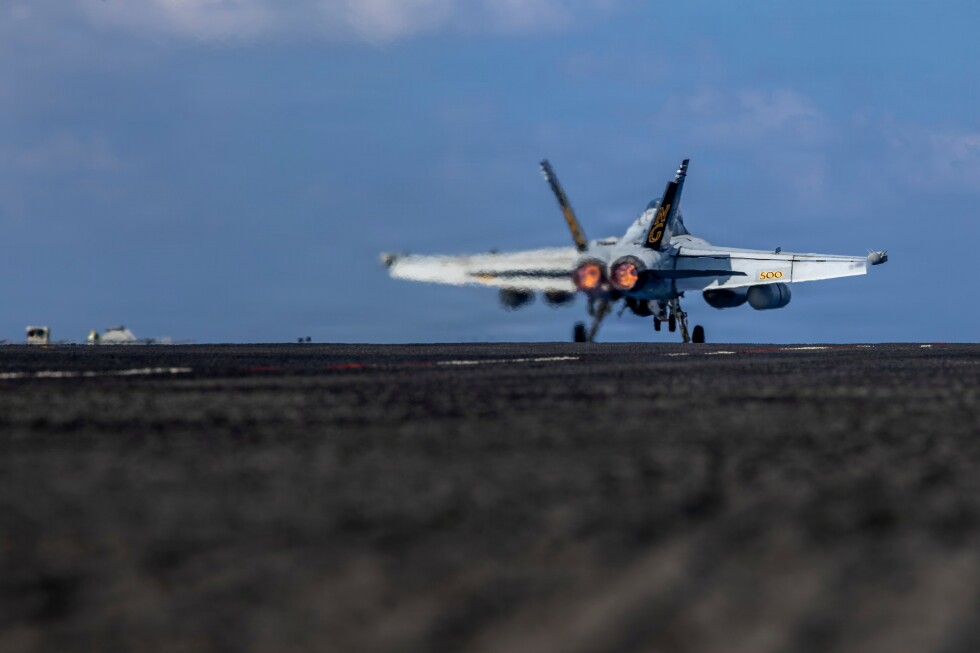
An F-35C fighter jet from the USS Abraham Lincoln, sailing approximately 500 miles from Iran’s southern coast, intercepted and destroyed the drone. U.S. officials confirmed no American troops were harmed and no equipment was damaged during the confrontation.
Within hours of the shootdown, Iranian Revolutionary Guard forces reportedly harassed the U.S.-flagged and U.S.-crewed merchant vessel Stena Imperative in the Strait of Hormuz. According to U.S. military officials, two Iranian boats and a Mohajer drone approached the ship “at high speeds and threatened to board and seize the tanker.”
The destroyer USS McFaul responded to the situation, providing escort to the merchant vessel “with defensive air support from the U.S. Air Force.” The military confirmed the Stena Imperative is now sailing safely.
These developments come as the Trump administration has significantly built up its military presence in the region. In recent weeks, the USS Abraham Lincoln carrier strike group, bringing approximately 5,700 additional service members, has joined three destroyers and three littoral combat ships already stationed there. Analysts tracking flight data have also observed dozens of U.S. military cargo planes heading to the Middle East.
The military buildup resembles similar preparations last year when the U.S. deployed air defense hardware, including Patriot missile systems, anticipating Iranian retaliation following American strikes on three key Iranian nuclear sites.
Despite the escalation, diplomatic channels remain open. White House press secretary Karoline Leavitt confirmed that planned talks between U.S. special envoy Steve Witkoff and Iranian officials are still scheduled to proceed.
“President Trump is always wanting to pursue diplomacy first, but obviously it takes two to tango,” Leavitt said after the incidents. “As always, though, of course, the president has a range of options on the table with respect to Iran.”
In a potentially significant development, Iranian President Masoud Pezeshkian stated Tuesday that he instructed his foreign minister to “pursue fair and equitable negotiations” with the United States. This marks one of the first clear signals from Tehran of willingness to engage in direct talks with Washington.
Iranian Foreign Minister Abbas Araghchi reported on Telegram that he had spoken with counterparts in Kuwait, Qatar, Turkey, and Oman about regional developments and the importance of protecting “regional stability and security.”
The current tensions have multiple catalysts, including Iran’s recent crackdown on widespread protests that began in December over economic conditions before expanding into broader challenges to the ruling theocracy. Trump had previously promised to “rescue” Iranians from their government’s response to these demonstrations.
The administration has also renewed pressure on Tehran regarding its nuclear program, despite Trump’s claims that Iranian nuclear sites were “obliterated” in U.S. strikes in June.
“We have talks going on with Iran. We’ll see how it all works out,” Trump told reporters Monday. When asked about his threshold for military action, he declined to provide specifics, saying only, “I’d like to see a deal negotiated. Right now, we’re talking to them, we’re talking to Iran, and if we could work something out, that’d be great. And if we can’t, probably bad things would happen.”
Turkey has reportedly been working behind the scenes to facilitate negotiations between the two countries, although the exact location for the talks remains uncertain.
The U.S. maintains several bases across the Middle East, including Al Udeid in Qatar, which hosts thousands of American troops and serves as the forward headquarters for U.S. Central Command.
Fact Checker
Verify the accuracy of this article using The Disinformation Commission analysis and real-time sources.

7 Comments
This is a concerning incident that highlights the fragility of the situation in the region. Cooler heads must prevail to prevent this from spiraling into a larger conflict.
The US must balance protecting its assets with avoiding further escalation. I hope both sides can find a way to ease tensions through diplomatic channels rather than military means.
Concerning incident with the Iranian drone. The US military must maintain vigilance to protect its assets and personnel in the region. It’s crucial to avoid further escalation, though.
The US response seems justified, but I worry this could lead to a dangerous escalation. Hopefully both sides can find a way to defuse the tensions through diplomatic means.
The US has a responsibility to defend its forces and interests in the region. However, I hope both sides exercise restraint to prevent a dangerous conflict from unfolding.
Interesting development in the ongoing tensions between the US and Iran. De-escalation should be the priority, as an unintended confrontation could have severe consequences.
The US seems justified in taking action to protect its military forces, but I worry this could lead to a cycle of retaliation. Diplomacy and open communication are crucial to defuse the situation.