


Listen to the article
Six service members have died following a KC-135 refueling aircraft crash in western Iraq on Thursday afternoon, according to U.S. Central Command. The incident, which occurred around 2 p.m. ET, involved a mid-air incident with a second aircraft that managed to land safely.
CENTCOM officials confirmed early Friday that all six crew members aboard the KC-135 perished in the crash. Military authorities emphasized that the loss of the aircraft was not the result of hostile fire or friendly fire. As is standard protocol, the identities of the deceased service members are being withheld pending notification of next of kin and will be released 24 hours after those notifications are complete.
The exact circumstances surrounding the incident remain under investigation, but a U.S. official reported that the second KC-135 involved in the incident safely landed in Israel, according to information from Israel’s ambassador to the United States.
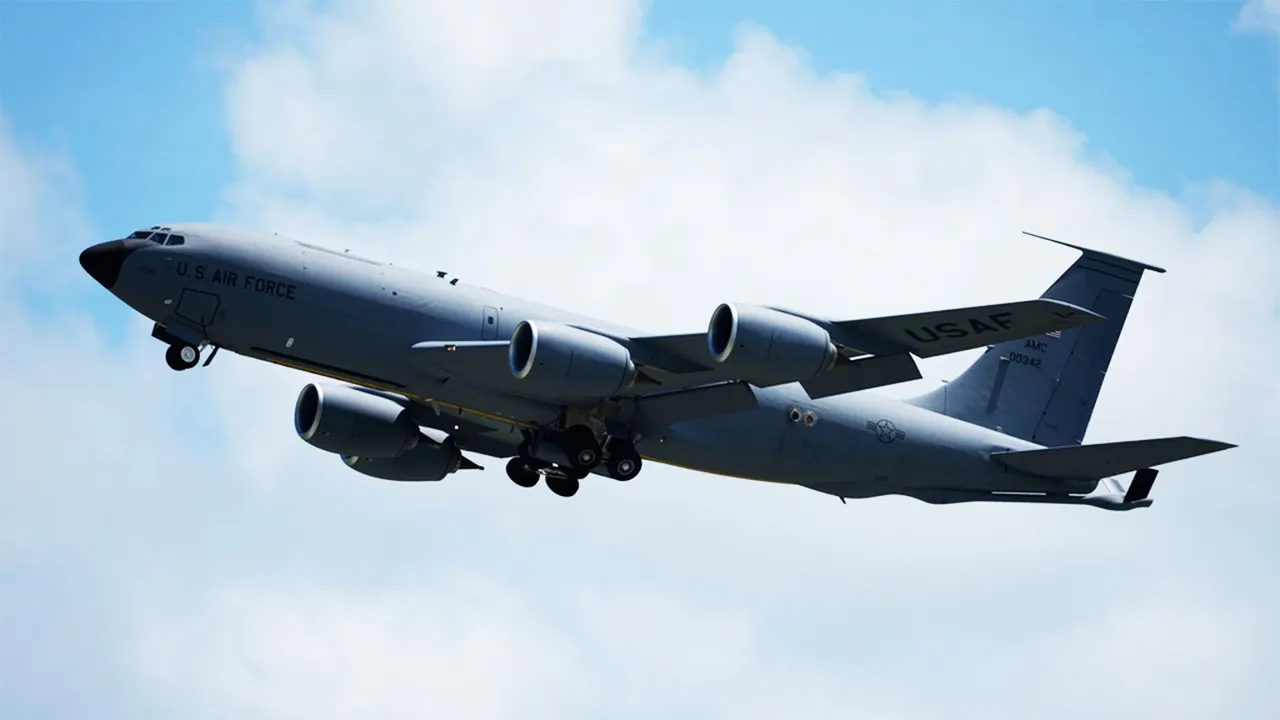
The KC-135 Stratotanker plays a crucial role in U.S. military operations, serving as an aerial refueling platform that extends the range and operational capability of other aircraft. Based on the Boeing 707 design, these aircraft have been workhorses for the Air Force for more than six decades, supporting operations across all military branches and allied forces.
A typical KC-135 crew consists of a pilot, co-pilot, and a boom operator who controls the refueling apparatus from the rear of the aircraft. Some variants are equipped with additional wing-mounted refueling pods and can be configured to transport cargo or passengers when needed.
Despite ongoing modernization efforts, the aging KC-135 fleet has raised durability concerns among military planners. According to the Congressional Research Service, the Air Force operated approximately 376 KC-135 tankers last year, distributed across active duty, Air National Guard, and Air Force Reserve units. The Air Force is gradually phasing in the next-generation KC-46A Pegasus tankers as replacements.
This tragic incident follows a separate mishap last week when three U.S. F-15E fighter jets were mistakenly shot down by Kuwaiti air defenses in what was described as a friendly fire incident. Both events highlight the inherent risks of complex military operations, even during non-combat missions.
The loss of a refueling tanker takes on additional strategic significance given current regional tensions. Should conflicts with Iran or other regional adversaries escalate, aerial refueling capabilities would become increasingly vital for U.S. forces conducting extended operations throughout the Middle East. Refueling tankers enable fighter jets and other aircraft to remain airborne for longer periods and reach targets at greater distances without returning to base.
U.S. forces maintain a significant presence in Iraq despite the official end of combat operations in 2021. American troops continue to operate in advisory roles and conduct counter-terrorism missions against remaining Islamic State elements, while also monitoring activities by Iran-backed militias that have targeted U.S. installations in the region.
The KC-135 involved in Thursday’s crash was likely supporting these ongoing operations, providing crucial aerial refueling capabilities to U.S. and coalition aircraft operating in the region. Military officials have not yet provided details about the specific mission the tanker was conducting at the time of the incident.
As the investigation proceeds, officials will examine both aircraft, interview survivors from the second plane, and analyze flight data to determine what caused the fatal mid-air incident.
Fact Checker
Verify the accuracy of this article using The Disinformation Commission analysis and real-time sources.

8 Comments
This incident highlights the risks our service members face in carrying out their duties. My heart goes out to the families and colleagues of the fallen. I hope the investigation can provide answers and lessons to enhance safety going forward.
This is a tragic incident. My condolences to the families of the fallen service members. The KC-135 is a critical asset, and its loss will impact military operations. I hope the investigation can shed light on the causes to prevent similar accidents in the future.
Agreed. The KC-135 is the backbone of aerial refueling for the US military. Its loss will be felt across many operations.
Midair collisions, while rare, can have devastating consequences. My condolences to the families and colleagues of the fallen service members. I hope the investigation can shed light on the causes and lead to enhanced safety protocols for aerial refueling missions.
Aerial collisions can happen even with the most advanced aircraft and training. While the loss of life is devastating, I’m relieved the second KC-135 was able to land safely. Investigating the causes will be crucial to improving safety protocols.
You make a good point. Maintaining flight safety is an ongoing challenge, even for veteran pilots and well-maintained aircraft.
The KC-135 is a workhorse for the US military, providing essential aerial refueling capabilities. While the loss of life is tragic, I’m relieved the second aircraft was able to land safely. Thorough investigation is crucial to prevent similar accidents.
Agreed. Maintaining the KC-135 fleet is critical for US military operations worldwide. Improving safety measures will be a top priority.