


Listen to the article
U.S. Launches Major Military Strikes Against ISIS in Syria Following Deadly Ambush
The Trump administration conducted extensive military strikes across central Syria on Friday, targeting Islamic State group fighters and weapons sites in response to an ambush that killed two U.S. troops and an American civilian interpreter nearly a week ago.
Pentagon officials described the operation as “large-scale,” striking 70 targets across central Syria containing ISIS infrastructure and weapons caches. Defense Secretary Pete Hegseth characterized the action not as the beginning of a war but as a “declaration of vengeance,” emphasizing that the United States “will never hesitate and never relent to defend our people.”
U.S. officials, speaking on condition of anonymity, indicated that additional strikes should be expected in the coming days as part of the ongoing operation.
The military response utilized a significant array of U.S. firepower, including F-15 Eagle jets, A-10 Thunderbolt ground attack aircraft, and AH-64 Apache helicopters. The operation was supported by F-16 fighter jets from Jordan and HIMARS rocket artillery. U.S. Central Command reported that American forces deployed more than 100 precision munitions during the attack.
President Donald Trump, who had pledged “very serious retaliation” following the deadly ambush, hailed the operation during a speech in North Carolina Friday evening, describing it as a “massive strike” that eliminated “ISIS thugs in Syria who were trying to regroup.”
In a stark warning posted on social media, Trump addressed potential future attacks on American personnel with an all-caps threat: “YOU WILL BE HIT HARDER THAN YOU HAVE EVER BEEN HIT BEFORE IF YOU, IN ANY WAY, ATTACK OR THREATEN THE U.S.A.”
The military action comes at a pivotal moment for U.S. foreign policy, as the administration has publicly prioritized its focus on matters in the Western Hemisphere. Recent movements have included building up naval forces in the Caribbean Sea to target alleged drug-smuggling vessels and seizing sanctioned oil tankers as part of a pressure campaign against Venezuela. These strategic shifts have redirected significant military resources away from the Middle East, including the redeployment of an advanced aircraft carrier from the Mediterranean to South American waters.
Despite this rebalancing, hundreds of U.S. troops remain deployed in eastern Syria as part of a coalition fighting ISIS, highlighting the persistent threat posed by the militant group despite significant territorial losses in recent years.
The attack also represents a critical test for recently improved relations between the United States and Syria following the ouster of former leader Bashar Assad approximately one year ago. Trump emphasized that Syrian forces were fighting alongside U.S. troops and stated that current Syrian President Ahmad al-Sharaa was “extremely angry and disturbed” by the ambush. This cooperation comes as the U.S. military has been expanding its partnership with Syrian security forces.
Syria’s foreign ministry issued a statement following the U.S. strikes, noting that last week’s attack “underscores the urgent necessity of strengthening international cooperation to combat terrorism in all its forms.” The statement reaffirmed Syria’s commitment “to fighting ISIS and ensuring that it has no safe havens on Syrian territory.”
Syrian state television reported that the American strikes hit targets in rural areas of Deir ez-Zor and Raqqa provinces, as well as the Jabal al-Amour area near the historic city of Palmyra, focusing on “weapons storage sites and headquarters used by ISIS as launching points for its operations in the region.”
The Islamic State has not claimed responsibility for the ambush on U.S. service members, though the group has claimed two subsequent attacks on Syrian security forces, including one that killed four Syrian soldiers in Idlib province.
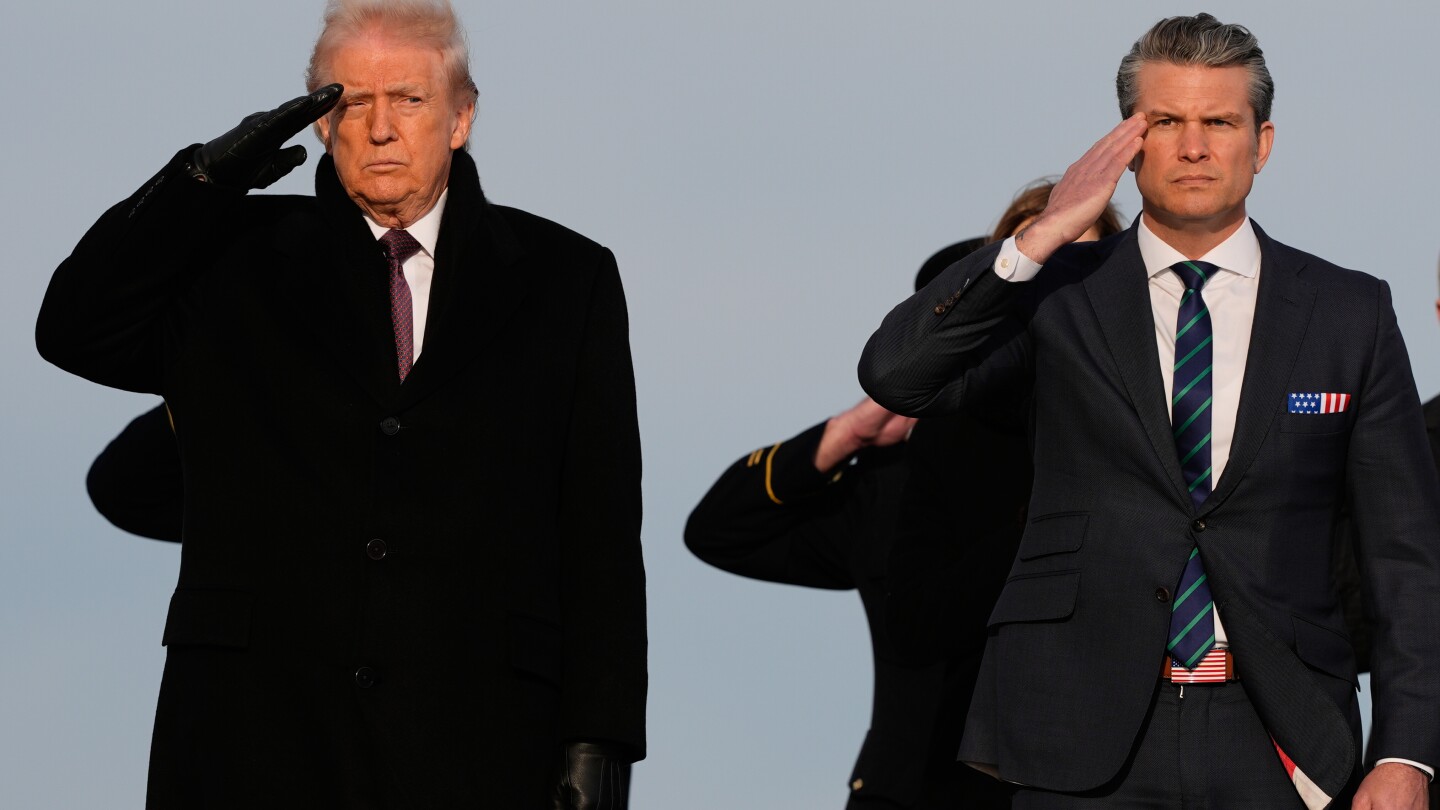
Earlier this week, Trump met privately with the families of the slain Americans at Dover Air Force Base in Delaware before joining military officials for the dignified transfer ceremony honoring the fallen service members. The guardsmen killed in Syria were identified as Sgt. Edgar Brian Torres-Tovar, 25, of Des Moines, and Sgt. William Nathaniel Howard, 29, of Marshalltown. Ayad Mansoor Sakat, of Macomb, Michigan, a U.S. civilian working as an interpreter, was also killed in the attack.
The shooting near Palmyra wounded three additional U.S. troops as well as members of Syria’s security forces. According to Interior Ministry spokesperson Nour al-Din al-Baba, the assailant had joined Syria’s internal security forces as a base security guard two months prior and had recently been reassigned due to suspicions about potential ISIS affiliation. The gunman reportedly stormed a meeting between U.S. and Syrian security officials during lunch and opened fire after confronting Syrian guards. He was killed during the incident.
Fact Checker
Verify the accuracy of this article using The Disinformation Commission analysis and real-time sources.

16 Comments
Strikes against ISIS are necessary to protect our troops and civilians. The US must remain vigilant and respond decisively to any attacks on American forces.
I agree. The US has a duty to safeguard its citizens and interests abroad. Decisive action is warranted in the face of such threats.
While the loss of American lives is tragic, the US response seems proportionate and necessary. Targeting ISIS infrastructure and weapons caches is an appropriate way to degrade their capabilities in the region.
I agree. The US must be willing to take decisive action to protect its personnel and interests abroad. Allowing attacks on American forces to go unanswered would only embolden terrorist groups.
I’m curious to see if these strikes will have a meaningful impact on ISIS capabilities in the region. Degrading their infrastructure and weapons is a good start, but a more comprehensive strategy may be needed.
That’s a fair point. One-off strikes may not be enough to fully dismantle ISIS in Syria. Sustained pressure and coordination with allies will likely be required for long-term stability.
This operation seems like a measured response to the tragic loss of American lives. Targeting ISIS infrastructure and weapons caches is an appropriate way to degrade their capabilities.
I hope these strikes send a clear message that attacks on US personnel will not be tolerated. Maintaining security and stability in the region is critical.
While unfortunate, this military action was necessary to protect American lives and prevent further ISIS attacks. The US must remain vigilant and willing to take swift action when provoked.
Agreed. The US cannot afford to appear weak in the face of terrorism. A strong response is warranted to deter future aggression against American interests.
While military action is regrettable, protecting American personnel and interests must be the top priority. These strikes appear to be a measured response to the recent attack on US forces.
Absolutely. The US cannot afford to appear weak or unwilling to defend its citizens. A robust counterterrorism strategy is essential to maintaining security and stability in the region.
The US must maintain its resolve in combating ISIS and other terrorist groups that threaten American lives. These strikes seem like an appropriate response, but continued vigilance will be essential.
I agree. Eliminating the ISIS threat in Syria should remain a top priority for US military and counterterrorism efforts. Consistent pressure is key to preventing resurgence.
These strikes highlight the continued threat posed by ISIS, even as the group has lost much of its territorial control. Remaining vigilant and disrupting their operations is crucial to preventing future attacks.
Good point. ISIS may have been pushed back, but they clearly still have the capacity to threaten US forces. Sustained military pressure will be needed to fully neutralize this threat.