


Listen to the article
U.S. Military Intensifies Air Campaign Against Iran, Targeting Ground Aircraft
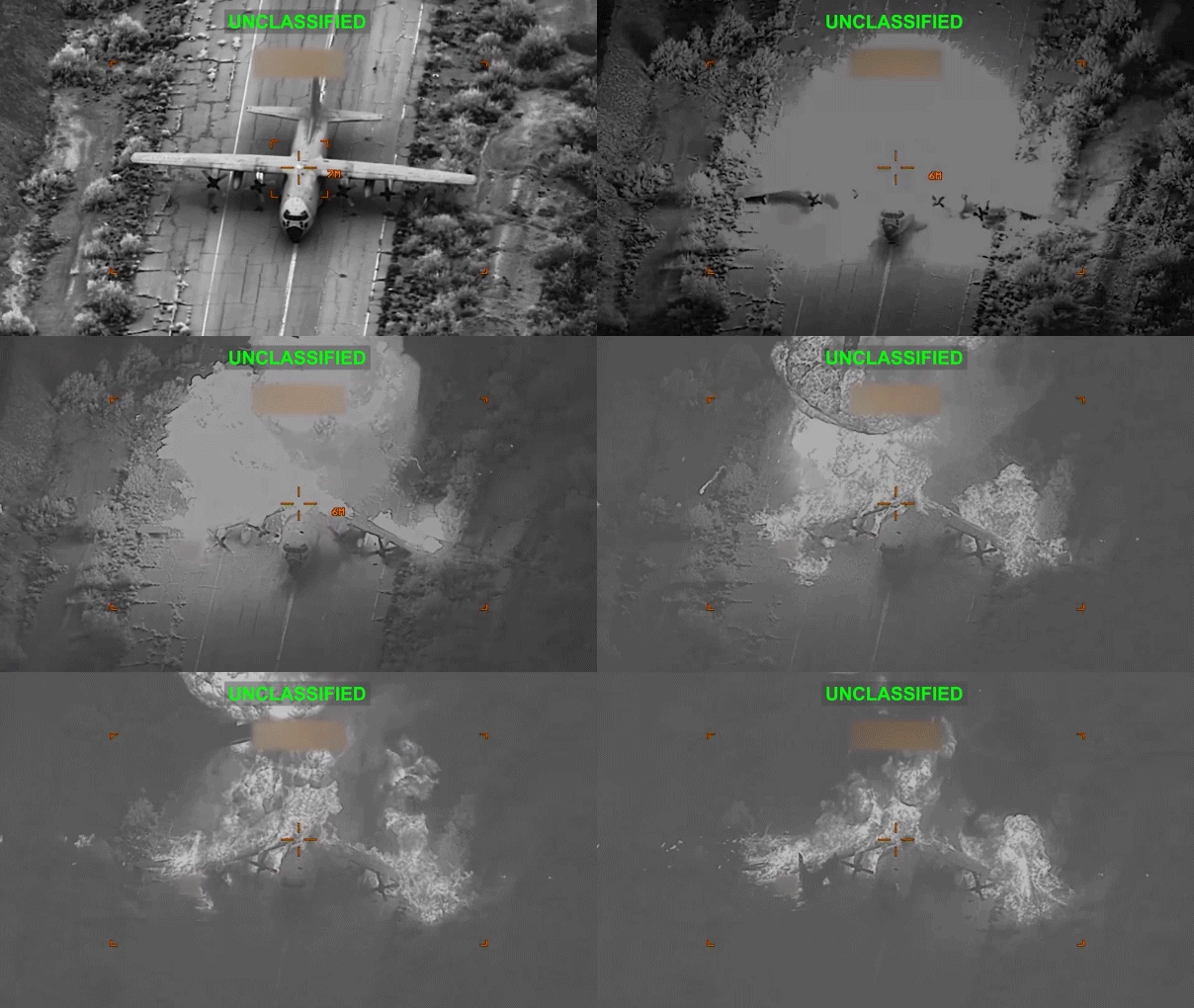
U.S. Central Command (CENTCOM) released footage Wednesday showing American forces striking Iranian aircraft on the ground, highlighting the ongoing air superiority campaign against the Islamic Republic.
“The Iranian regime is losing air capability day by day,” CENTCOM stated in a social media post. “U.S. forces aren’t just defending against Iranian threats, we are methodically dismantling them.”
The video shows precision strikes on Iranian aircraft stationed at military facilities, part of a broader effort to degrade Iran’s air defense and offensive capabilities. The footage captures moments before and after explosions, with clear views of targeted aircraft being destroyed.
Military analysts point to a significant disparity between the two nations’ air power. According to the Wall Street Journal, while U.S. and Israeli forces operate modern aircraft including F-35 stealth fighters, Iran relies on an aging air fleet that has been severely limited by decades of international sanctions. This vulnerability has forced Iran to develop its ballistic missile program as a primary deterrent—a program now under systematic attack from U.S. and Israeli forces.
In response to the ongoing offensive, Iranian officials have attempted to claim battlefield successes. CENTCOM firmly rejected these assertions, stating: “An IRGC leader has claimed that a U.S. F-15 was shot down today south of Tehran. LIE. No U.S. fighter aircraft have been shot down by Iran. U.S. forces continue to exercise air superiority over vast swaths of Iran. TRUTH.”
The conflict has not been without American losses, however. Earlier this month, CENTCOM reported that three U.S. F-15E Strike Eagle fighter jets were downed in “an apparent friendly fire incident” involving Kuwaiti air defenses. The March 2 press release confirmed that all six aircrew members safely ejected and were recovered.
“During active combat — that included attacks from Iranian aircraft, ballistic missiles, and drones — the U.S. Air Force fighter jets were mistakenly shot down by Kuwaiti air defenses,” the statement explained. “Kuwait has acknowledged this incident, and we are grateful for the efforts of the Kuwaiti defense forces and their support in this ongoing operation.”
The escalating conflict has raised significant concerns domestically. Several Democratic lawmakers have threatened to “grind the Senate to a halt” to force public hearings on the war, seeking greater transparency about military objectives, expected duration, and exit strategy.
Meanwhile, former President Trump has reportedly expressed increasing concern about the conflict, particularly as American casualties mount and Iran continues to find ways to retaliate. Defense experts suggest this may reflect growing public unease about the prospects of a prolonged military engagement in the region.
The campaign against Iran represents one of the most significant U.S. military operations in the Middle East since the Iraq War. Beyond targeting aircraft, American strikes have systematically hit Iranian oil facilities, military installations, and missile sites across the country. Images from Tehran show significant damage to infrastructure, with smoke and flames visible from targeted facilities.
Regional security analysts note that while the U.S. maintains clear technological superiority, Iran’s asymmetric warfare capabilities—including its network of proxy militias across the Middle East—remain a serious concern for military planners.
As operations continue, the Pentagon has emphasized precision targeting to minimize civilian casualties while maximizing impact on Iran’s military infrastructure. However, humanitarian organizations have expressed growing alarm about the conflict’s toll on Iranian civilians and critical infrastructure.
Fact Checker
Verify the accuracy of this article using The Disinformation Commission analysis and real-time sources.

13 Comments
While the U.S. clearly has air superiority, I wonder about the long-term strategic value of these strikes. Degrading Iran’s air fleet may have short-term benefits, but could also provoke retaliation or escalate tensions in unpredictable ways.
That’s a fair point. The risk of unintended consequences is always present with these types of military operations. Careful diplomacy and de-escalation will be crucial moving forward.
It’s interesting to see the technological disparity between the U.S. and Iranian air forces on display. The U.S. clearly has the upper hand, but I wonder if this will drive Iran to invest even more in their missile program as a deterrent.
This footage serves as a stark reminder of the U.S. military’s technological edge over Iran’s aging air fleet. While the strikes may degrade Iran’s air capabilities in the short term, the long-term implications for regional stability are concerning.
Agreed. Maintaining a delicate balance in the region will be critical, as Iran may feel compelled to respond in ways that could escalate tensions further.
The footage provides clear evidence of the U.S. military’s campaign to systematically degrade Iran’s air defense capabilities. While this may bolster U.S. air superiority in the region, it also risks provoking a dangerous escalation.
You’re right to be concerned about the potential for escalation. These types of asymmetric military actions often have complex ripple effects that are difficult to predict.
The U.S. strikes on Iranian aircraft highlight the significant asymmetry in air power between the two nations. While this may provide tactical advantages for the U.S., it could also incentivize Iran to invest more in their missile program and other asymmetric capabilities.
Interesting to see the U.S. military’s ongoing campaign to degrade Iran’s aging air fleet. This seems like a targeted effort to weaken Iran’s military capabilities, though I wonder about the broader strategic implications.
You raise a good point. Degrading Iran’s air power could limit their ability to project force, but it may also increase regional tensions. Curious to see how this plays out diplomatically.
From a military perspective, the U.S. strikes appear to be tactically sound, targeting Iran’s aging air assets. But the broader geopolitical implications are concerning – this could further destabilize an already volatile region.
The footage confirms that the U.S. is systematically dismantling Iran’s air defenses. Given the technological gap, this is not surprising, but I imagine it will drive Iran to double down on other military assets like their missile program.
Agreed. Iran’s ballistic missiles have become a key deterrent, so they’re likely to continue investing heavily in that area to offset their air power disadvantage.