


Listen to the article
Trump’s Board of Peace Faces International Pushback as Nations Reaffirm UN Commitment
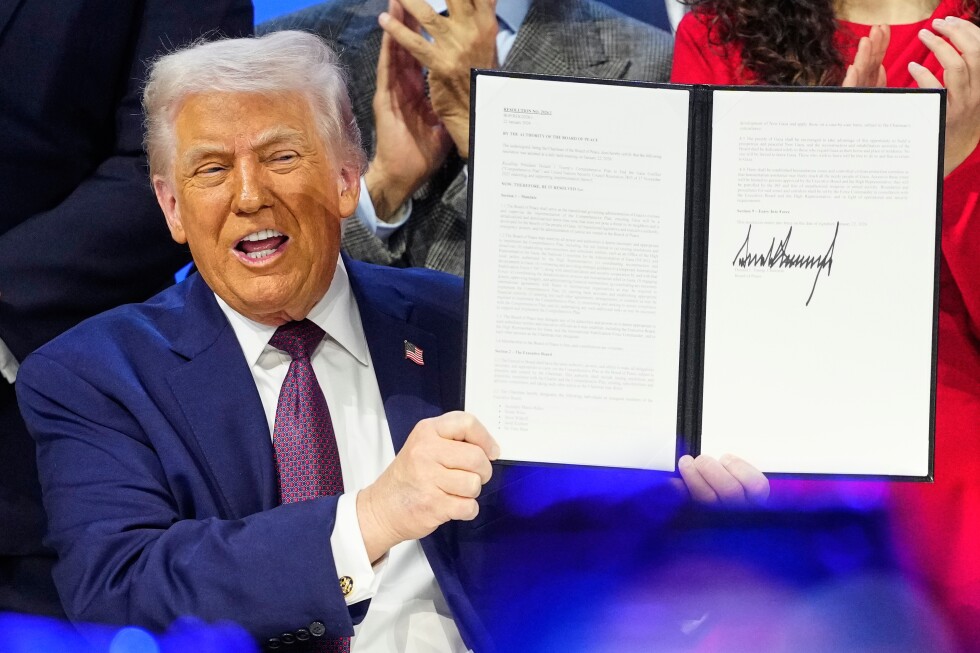
President Donald Trump’s recent initiative to create a “Board of Peace” has encountered significant resistance from global powers, with many nations explicitly rejecting his vision for the board to supersede United Nations functions. What began as a focused effort to oversee Gaza ceasefire implementation has evolved into what critics describe as an attempt to circumvent the established international order.
The board, which Trump intends to chair indefinitely with veto power over actions and membership, was initially conceived as a small group of world leaders overseeing his Gaza peace plan. However, the president’s expanding ambitions for the body to mediate worldwide conflicts has raised concerns that it represents a direct challenge to the UN Security Council’s mandate.
Secretary of State Marco Rubio attempted to downplay these concerns at a congressional hearing Wednesday, stating: “This is not a replacement for the U.N., but the U.N. has served very little purpose in the case of Gaza other than the food assistance.” Despite such assurances, Trump’s public suggestions that the board “might” eventually replace the UN have alarmed international leaders.
UN Secretary General Antonio Guterres firmly rejected the notion that any body could supplant the Security Council’s authority. “The basic responsibility for international peace and security lies with UN, lies with the Security Council,” Guterres said Thursday. “Only the Security Council can adopt decisions binding on all, and no other body or other coalition can legally be required to have all member states to comply with decisions on peace and security.”
The timing of Trump’s initiative has proven particularly problematic. Invitation letters to potential “founding members” coincided with the president’s controversial statements about taking over Greenland, a semi-autonomous Danish territory, which provoked sharp rebukes from Canada, Denmark, and other NATO allies before Trump subsequently reversed course.
Of approximately 60 invited countries, only about 26 have joined the board, with all four other veto-wielding Security Council members—China, France, Russia, and the United Kingdom—declining or withholding commitment. Major economic powers like Japan and Germany have similarly kept their distance.
“The U.S. rollout of the much broader Board of Peace charter turned the whole exercise into a liability,” observed Richard Gowan, UN program director at the International Crisis Group. “Countries that wanted to sign on to help Gaza saw the board turning into a Trump fan club. That was not appealing.”
European nations have been particularly vocal in their opposition. British Prime Minister Keir Starmer met with Guterres and reaffirmed “the UK’s enduring support for the UN and the international rules-based system.” French President Emmanuel Macron expressed concern that the board “raises serious questions, in particular with respect to the principles and structure of the United Nations, which cannot be called into question.” Spain’s Prime Minister Pedro Sánchez cited the exclusion of the Palestinian Authority and the body’s operation “outside the framework of the United Nations” as reasons for declining.
China’s UN ambassador, Fu Cong, delivered perhaps the most pointed critique during a Security Council meeting, saying: “No single country should dictate terms based on its power, and a winner-takes-all approach is unacceptable.” He added that nations “shall not cherry-pick our commitments to the organization, nor shall we bypass the U.N. and create alternative mechanisms.”
The eight Muslim nations that did join the board—Turkey, Saudi Arabia, Egypt, Jordan, Indonesia, Pakistan, Qatar, and the UAE—issued a joint statement supporting its Gaza mission and the advancement of Palestinian statehood, conspicuously omitting any endorsement of Trump’s global peacemaking ambitions.
Human Rights Watch UN director Louis Charbonneau was particularly scathing in his assessment: “It’s hardly surprising that very few governments want to join Trump’s wannabe-U.N., which so far looks more like a pay-to-play club of human rights abusers and war crimes suspects than a serious international organization.”
As Trump’s ceasefire plan for Gaza already faces setbacks, analysts suggest the Board of Peace is unlikely to present a lasting challenge to the United Nations’ role in global affairs.
Fact Checker
Verify the accuracy of this article using The Disinformation Commission analysis and real-time sources.

12 Comments
The ‘Board of Peace’ proposal raises valid concerns about the balance of power in global affairs. The UN, despite its flaws, remains the most inclusive and broadly accepted forum for international cooperation and conflict resolution.
Agreed. Any efforts to circumvent or diminish the UN’s authority should be viewed with a critical eye by the international community.
This ‘Board of Peace’ idea seems like a worrying attempt to consolidate US influence over global affairs. While the goal of promoting peace is laudable, the UN remains the most legitimate and multilateral platform for addressing international conflicts.
Absolutely. Unilateral actions, no matter how well-intentioned, can often undermine the very stability they aim to achieve.
I’m skeptical of this ‘Board of Peace’ concept. The UN may be imperfect, but it represents a multilateral approach that is crucial for maintaining international order and legitimacy. Concentrating too much power in the hands of one leader is a risky proposition.
Exactly. Weakening the UN’s role could have unintended consequences that outweigh any potential benefits of this new board.
While the goal of promoting peace is admirable, the idea of a unilateral ‘Board of Peace’ chaired by the US president is concerning. The UN system, despite its challenges, offers a more inclusive and legitimate platform for global diplomacy.
Agreed. Unilateral power plays by individual nations often backfire and undermine the very stability they claim to promote.
While the desire for more effective conflict resolution is understandable, the ‘Board of Peace’ seems like a worrying power grab that could undermine the UN’s hard-won legitimacy. Maintaining a rules-based global order should be the priority.
Well said. Preserving the UN’s role as an impartial arbiter is essential, even if it requires reforms to improve its efficiency.
The proposed ‘Board of Peace’ seems like an overreach of executive authority, potentially undermining the UN’s long-standing role in global conflict resolution. I’m curious to see how this plays out diplomatically.
You raise a good point. The UN, for all its flaws, provides an established framework for international cooperation that shouldn’t be cast aside lightly.