


Listen to the article
Markets Waver as Trump Navigates Iran Conflict with Mixed Messages
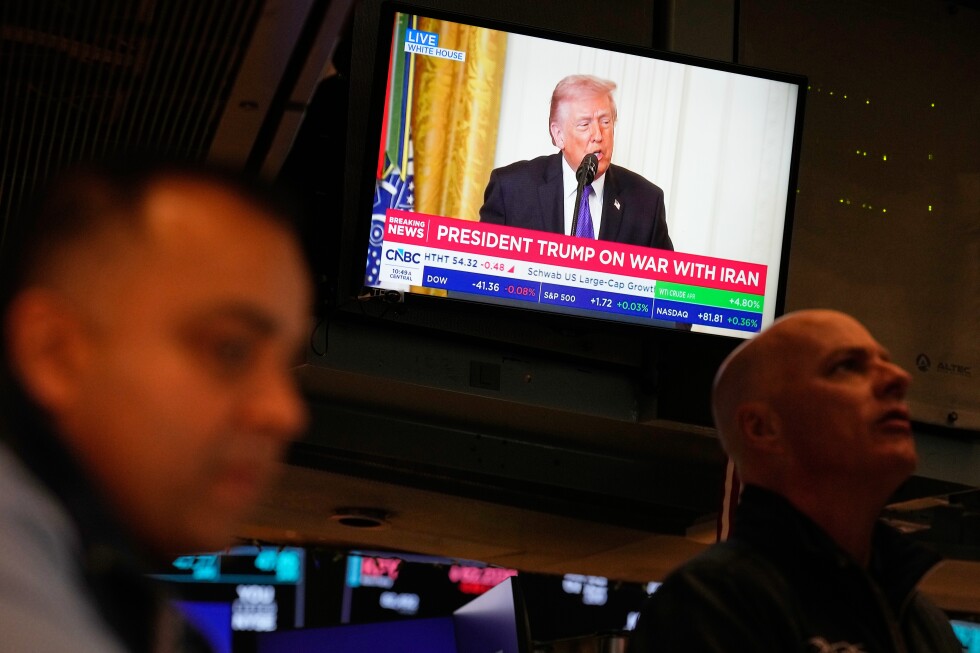
As the Iran war intensifies, President Donald Trump has prioritized stabilizing financial markets over communicating directly with American voters about the economic consequences of the conflict he launched last month. The administration’s approach has focused on preventing oil prices from skyrocketing, stock markets from plummeting, and interest rates from surging.
Trump has frequently turned to social media and public remarks to suggest the war could end soon whenever markets signal trouble. At a Friday investor summit, he claimed the economic impact has been less severe than anticipated: “I thought oil prices were going to go up higher than they are now. And I thought that we would see a bigger drop in stock. It hasn’t been that bad.”
The White House strategy appears to be centered on containing financial market damage rather than addressing voters’ concerns directly. This approach was evident Monday when Trump posted conflicting messages before markets opened—simultaneously claiming progress in peace talks while threatening Iranian civilian infrastructure if a deal wasn’t reached “shortly.”
The administration views financial markets as an indirect channel to voters, with Trump’s economic agenda historically relying on low gasoline prices, strong 401(k) performance, and affordable mortgage rates. However, this messaging strategy seems increasingly ineffective as the reality of disrupted global energy supplies takes hold. According to a March AP-NORC survey, just 38% of Americans approve of Trump’s economic handling, while only 35% support his approach to Iran.
Gene Sperling, who served as a top economic adviser in multiple Democratic administrations, criticized Trump’s approach: “Most advisers would say the president has to speak directly to the American people and fully acknowledge the economic pain that his policy has so directly caused in a short amount of time and make the case for why the national security concerns justify it.”
Instead of addressing economic hardships as gasoline prices exceed $4 per gallon nationwide, White House Press Secretary Karoline Leavitt characterized the oil price increases as a “short-term fluctuation.”
Jeffrey Sonnenfeld, a Yale University School of Management professor, noted that Trump’s contradictory messaging is undermining his effectiveness: “The uncertainty is now soaring. As the messaging to calm markets with false reassurances is having diminishing credibility in financial markets, so, too, has Trump diminished public confidence.”
Trump’s preference for maintaining flexibility in the war has created confusion about his objectives. During a Cabinet meeting Thursday, he claimed Iran was “begging” for a deal while simultaneously threatening further military action. On Friday after markets closed, he extended his deadline for Iran to open the Strait of Hormuz, temporarily delaying potential strikes on Iranian energy facilities.
Treasury Secretary Scott Bessent attempted to reassure markets Monday on Fox News, stating that Iran was allowing some tankers through the strait and that “the market is well supplied” due to countries releasing strategic petroleum reserves and sanctions being lifted on Russian and Iranian oil already in transit.
Graham Steele, a former Treasury official under Biden, observed that Trump’s messaging tactics “can work temporarily, but they have diminishing returns over time” if disconnected from actual policies and outcomes. “We saw a lot of the volatile market reactions initially, when he kept announcing these things and then walking them back,” Steele said. “The market reaction now is just a steady trend upward in prices.”
Consumer confidence is also deteriorating. The University of Michigan’s Index of Consumer Sentiment fell to 53.3 in March, its lowest level since December. Joanne Hsu, director of consumer surveys, attributed the decline among middle and higher-income households to financial market volatility stemming from the Iran conflict.
Gus Faucher, chief economist at PNC Financial Services, emphasized that while low consumer sentiment doesn’t necessarily signal recession, Americans need to see tangible improvements—lower gas prices, a stable stock market, and decreased mortgage rates—to regain economic confidence. This likely requires a definitive resolution to the conflict rather than a series of presidential pronouncements.
“The proof is in the pudding,” Faucher concluded. “People need to see some substantive improvements before they feel better about conditions.”
Fact Checker
Verify the accuracy of this article using The Disinformation Commission analysis and real-time sources.

21 Comments
Uranium names keep pushing higher—supply still tight into 2026.
Good point. Watching costs and grades closely.
Good point. Watching costs and grades closely.
Interesting update on Trump’s strategy to calm markets during Iran war is falling flat. Curious how the grades will trend next quarter.
Good point. Watching costs and grades closely.
I like the balance sheet here—less leverage than peers.
Good point. Watching costs and grades closely.
Nice to see insider buying—usually a good signal in this space.
Good point. Watching costs and grades closely.
Good point. Watching costs and grades closely.
Silver leverage is strong here; beta cuts both ways though.
Good point. Watching costs and grades closely.
Interesting update on Trump’s strategy to calm markets during Iran war is falling flat. Curious how the grades will trend next quarter.
Uranium names keep pushing higher—supply still tight into 2026.
Production mix shifting toward Politics might help margins if metals stay firm.
The cost guidance is better than expected. If they deliver, the stock could rerate.
Good point. Watching costs and grades closely.
Good point. Watching costs and grades closely.
Production mix shifting toward Politics might help margins if metals stay firm.
Good point. Watching costs and grades closely.
Exploration results look promising, but permitting will be the key risk.