


Listen to the article
In a significant break with tradition, the National Governors Association has withdrawn from facilitating the annual governors’ meeting at the White House after President Donald Trump excluded two Democratic governors from the invitation list.
The dispute erupted when Trump refused to include Colorado Governor Jared Polis and Maryland Governor Wes Moore, claiming on social media they were “not worthy of being there.” While Friday’s White House gathering with governors will still proceed, it won’t be under the auspices of the NGA, an organization established more than a century ago to help state leaders from both parties advocate for their interests in Washington.
The incident highlights Trump’s increasingly confrontational approach toward state leaders who don’t align with him politically. In recent months, the president has threatened to withhold federal funding or deploy troops over the objections of local officials. Now, even ceremonial White House functions have become political battlegrounds.
“He’s not putting his mind to it,” acknowledged Utah’s Republican Governor Spencer Cox about Trump’s lack of interest in national unity. “He’s said very clearly that that’s not who he is.”
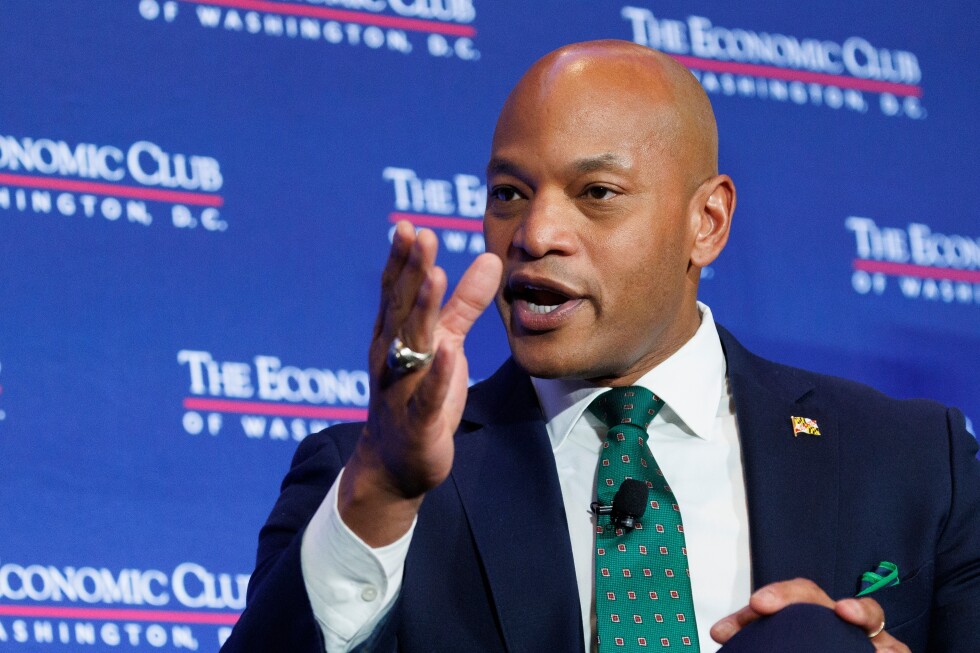
For his part, Maryland Governor Moore, who serves as the NGA’s vice chair, expressed disappointment but maintained a dignified response. “I didn’t run for governor like, man, I can’t wait so me and the president can go toe to toe,” Moore said. “But the fact that he is waking up in the middle of the night and tweeting about me, I just, I pray for him and I just feel bad for him because that has just got to be a really, really hard existence.”
The controversy stands in stark contrast to the bipartisan spirit that NGA leadership has attempted to foster. Throughout the week, Moore and Oklahoma Governor Kevin Stitt, the Republican NGA chair, appeared together multiple times, exchanging jokes and praise.
Stitt had attempted to resolve the standoff between the White House and the Democratic governors last week, only to have Trump label him a “RINO” (Republican In Name Only) and accuse him of misrepresenting the president’s position. Despite this public rebuke, Stitt maintained a conciliatory tone, acknowledging the difficulties of the presidency.
“Politics has a way of just beating you down over time so I can’t imagine being president of the United States,” Stitt remarked. “He’s got a tough job to do.”
Former Maryland Governor Larry Hogan, a Republican who occasionally clashed with Trump during his tenure, criticized the White House’s decision. “There never was a huge amount of real work that got accomplished but it was a nice thing annually to bring all the governors — Republicans and Democrats — together,” Hogan said. “It can’t hurt to be in the same room together.”
Beyond the immediate controversy, many governors expressed concerns about the expanding power of the executive branch. Governor Cox lamented Congress’s failure to check presidential authority: “Presidents aren’t supposed to do this stuff. Congress needs to get their act together. And stop performing for TikTok and actually start doing stuff.”
As the governors’ conference proceeded, speculation about potential 2028 presidential candidates added another dimension to the gathering. Several governors in attendance, including Moore and Pennsylvania’s Josh Shapiro, are considered possible Democratic contenders, while others like California’s Gavin Newsom and Illinois’ JB Pritzker were absent.
Kentucky Governor Andy Beshear, who recently announced a forthcoming book, took questions about a potential presidential run, saying he would consider his options with his family after focusing on Kentucky for the remainder of the year.
The breakdown of this bipartisan tradition underscores the deepening polarization in American politics, where even long-established ceremonies of governance have become casualties of partisan division.
Fact Checker
Verify the accuracy of this article using The Disinformation Commission analysis and real-time sources.

32 Comments
I like the balance sheet here—less leverage than peers.
Good point. Watching costs and grades closely.
Nice to see insider buying—usually a good signal in this space.
Good point. Watching costs and grades closely.
Good point. Watching costs and grades closely.
Exploration results look promising, but permitting will be the key risk.
Good point. Watching costs and grades closely.
Exploration results look promising, but permitting will be the key risk.
Good point. Watching costs and grades closely.
Good point. Watching costs and grades closely.
Interesting update on Trump’s refusal to invite all governors to a White House meeting prompts group to back out. Curious how the grades will trend next quarter.
Good point. Watching costs and grades closely.
Good point. Watching costs and grades closely.
If AISC keeps dropping, this becomes investable for me.
Good point. Watching costs and grades closely.
Silver leverage is strong here; beta cuts both ways though.
Nice to see insider buying—usually a good signal in this space.
Good point. Watching costs and grades closely.
Uranium names keep pushing higher—supply still tight into 2026.
Good point. Watching costs and grades closely.
Good point. Watching costs and grades closely.
If AISC keeps dropping, this becomes investable for me.
Uranium names keep pushing higher—supply still tight into 2026.
Good point. Watching costs and grades closely.
Good point. Watching costs and grades closely.
Uranium names keep pushing higher—supply still tight into 2026.
Good point. Watching costs and grades closely.
Good point. Watching costs and grades closely.
If AISC keeps dropping, this becomes investable for me.
The cost guidance is better than expected. If they deliver, the stock could rerate.
Good point. Watching costs and grades closely.
If AISC keeps dropping, this becomes investable for me.