


Listen to the article
Europe’s Far-Right Leaders Break with Trump over Iran War
When President Donald Trump returned to the White House, he aimed to strengthen ties with Europe’s right-wing leaders who once embraced him. But the war with Iran has dramatically altered this political landscape, creating unexpected rifts between Trump and his former allies across Europe.
Many conservative and far-right European leaders who once aligned with Trump are now openly criticizing his foreign policy decisions. Italian Prime Minister Giorgia Meloni refused American requests to use a Sicilian air base for attacks on Iran. Marine Le Pen, leader of France’s National Rally, described Trump’s war goals as “erratic,” while the head of Germany’s Alternative for Germany party demanded that U.S. troops leave German bases.
This backlash represents a significant shift in the once-cozy relationship between Trump and Europe’s nationalist movements. The tensions follow earlier friction when Trump demanded that Denmark give Greenland to the United States, a move that shocked many NATO allies.
“Getting a blessing from Donald Trump is now a mixed blessing,” noted Charles Kupchan, a Georgetown University professor and senior fellow at the Council on Foreign Relations.
Trump himself connected these issues on Wednesday, complaining on social media: “NATO WASN’T THERE WHEN WE NEEDED THEM, AND THEY WON’T BE THERE IF WE NEED THEM AGAIN. REMEMBER GREENLAND, THAT BIG, POORLY RUN, PIECE OF ICE!!!”
Despite the fragile ceasefire now in place with Iran, the damage to Trump’s international relationships appears substantial. Former ambassador Daniel Baer, now with the Carnegie Endowment for Peace, explained why Trump’s vision of an international nationalist alliance faces fundamental challenges: “Building some sort of international coalition around national chauvinism is very difficult. It’s clear the majority of people in these countries, if not anti-American, have turned anti-Trump.”
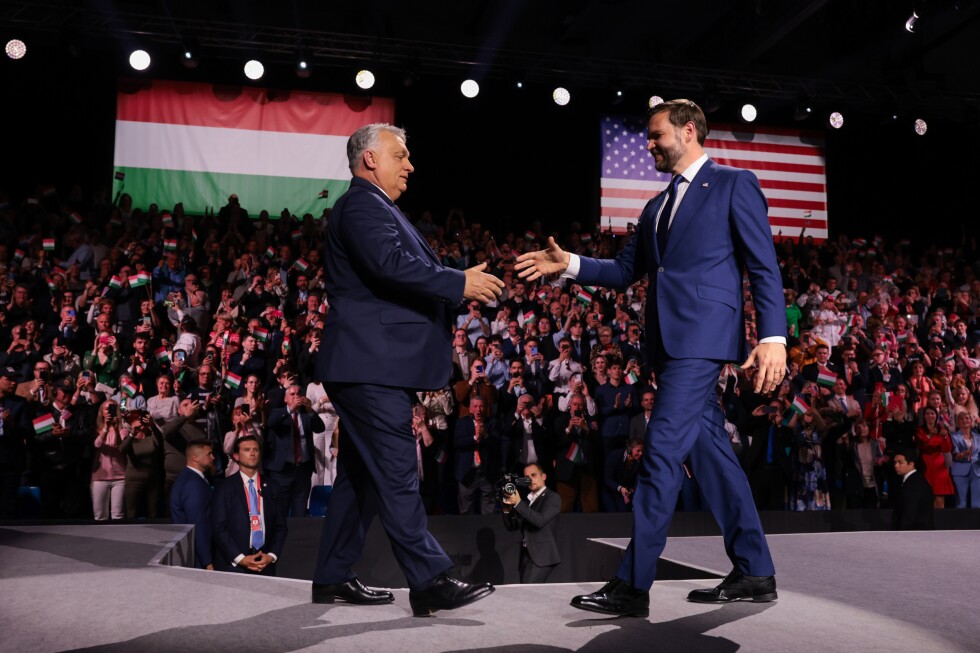
Hungarian Prime Minister Viktor Orbán stands as a notable exception to this trend. While other European far-right leaders distance themselves from Trump, Orbán has maintained his support. This week, Vice President JD Vance campaigned for Orbán ahead of Hungary’s weekend election, criticizing European Union leaders for what he called “foreign interference” in the Hungarian electoral process.
Orbán has deliberately cultivated his relationship with Trump, presenting himself to Hungarian voters as uniquely positioned to represent their interests on the world stage through his connections with global figures like Trump and Russian President Vladimir Putin. When asked about the Iran conflict, Orbán carefully avoided criticism, telling British broadcaster GB News: “The question is whether [Trump] has started a war or a peace. It hasn’t been decided yet, historians will make a decision on that.”
During his visit to Hungary, Vance briefly addressed the “fragile truce” with Iran while speaking at an elite Hungarian educational institution that has received substantial funding from Orbán’s government. The vice president praised the school for “trying to build up the foundations of Western civilization,” echoing the Trump administration’s efforts to exert greater influence over American universities—a strategy that mirrors Orbán’s approach in Hungary.
However, analysts question whether Orbán’s continued alignment with Trump will ultimately benefit him politically. “Vance’s visit could have the opposite effect on Orbán’s popularity than the one intended,” warned Mario Bikarsku, senior Europe analyst at risk intelligence company Verisk Maplecroft. Public opinion toward the Trump administration has grown increasingly negative even within Hungary.
After 16 years in power, Orbán faces a challenging election. The global political climate has shifted against incumbents, potentially endangering his long tenure. “We’re living in an age where being an incumbent sucks,” Kupchan observed.
The strained relationship between Trump and Europe’s nationalist leaders reveals the limitations of building international alliances based on nationalist ideologies. While these far-right parties have established their own political foundations independent of American influence, Trump’s controversial policies—particularly regarding Iran—have made association with him increasingly problematic for many European politicians seeking to maintain domestic support.
Fact Checker
Verify the accuracy of this article using The Disinformation Commission analysis and real-time sources.

10 Comments
The diverging views between Trump and his erstwhile nationalist European allies on the Iran situation is a fascinating dynamic to observe. It shows how fluid and unpredictable international politics can be, even among ostensibly aligned parties.
It’s notable that leaders like Meloni, Le Pen, and the AfD are now openly criticizing Trump’s foreign policy. This shows how much the dynamics have shifted compared to a few years ago when they were seen as MAGA allies.
You’re right, the report indicates a significant realignment happening. The Iran conflict seems to be a key inflection point where these nationalist European figures are distancing themselves from Trump.
Interesting how the Iran situation is driving a wedge between Trump and his former far-right European allies. Seems the nationalists have their own foreign policy priorities that don’t always align with the US president’s agenda.
Yeah, the report highlights a real shift in the relationship. Trump’s unpredictable approach on Iran appears to be testing the limits of his European nationalist partnerships.
This article highlights the complex geopolitical maneuvering happening around the Iran conflict. It’s noteworthy that Trump’s relationships with some key European nationalist allies appear to be fraying over this issue.
Agreed, the shifting alliances and tensions are worth watching closely, as they could have broader implications for global energy markets and commodities.
This geopolitical fallout over Iran could have major ramifications for global energy markets and commodity prices. The rift with Europe complicates Trump’s ability to pursue his preferred Iran strategy.
Absolutely, the tensions will likely lead to more uncertainty and volatility, especially for industries like oil and gas that are tied to the Iran situation.
The backlash from Trump’s former far-right partners in Europe over the Iran situation is an interesting development. It suggests these leaders have their own strategic interests that don’t always align with the US president’s agenda.