


Listen to the article
Trump Administration Signals Potential Reduction in Immigration Enforcement in Minnesota
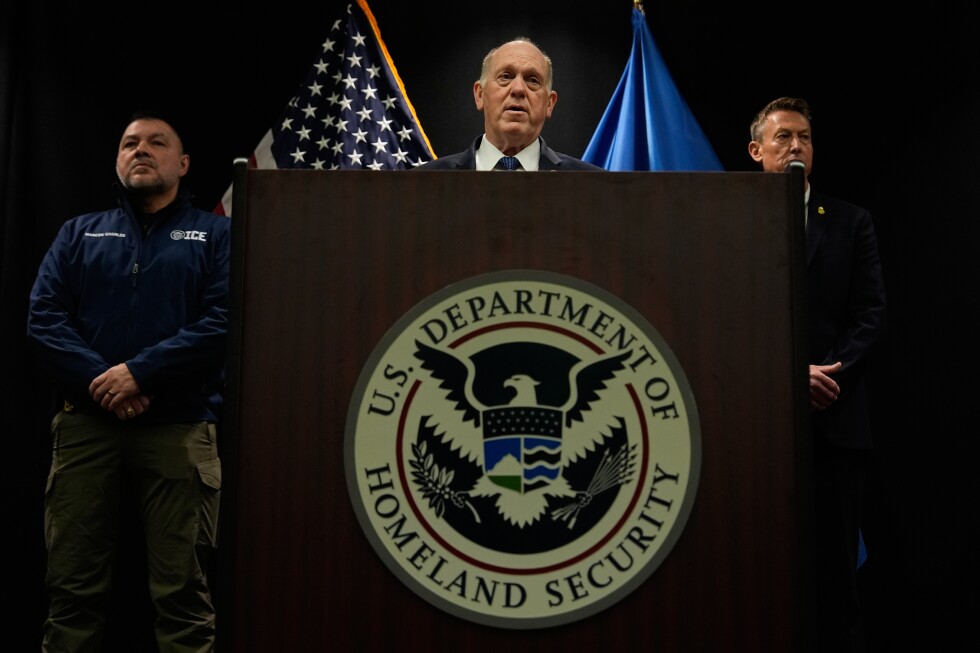
The Trump administration may scale back its immigration enforcement presence in Minnesota, but only if state and local officials increase their cooperation with federal authorities, according to the president’s border czar Tom Homan, who addressed reporters in Minneapolis on Thursday.
Homan’s comments mark his first public statement since President Trump dispatched him to the Twin Cities following the weekend’s fatal shooting of protester Alex Pretti by federal officers. This incident represents the second such fatality this month during the ongoing immigration enforcement operation in the area.
“I do not want to hear that everything that’s been done here has been perfect. Nothing’s ever perfect,” Homan acknowledged, suggesting a willingness to adjust tactics while still maintaining the administration’s core immigration enforcement goals.
Despite hinting at a possible drawdown of the approximately 3,000 federal officers currently operating in the region, Homan emphasized that any reduction depends on greater cooperation from local leadership and decreased interference from protesters.
“The drawdown is going to happen based on these agreements,” Homan stated. “But the drawdown can happen even more if the hateful rhetoric and the impediment and interference will stop.”
The border czar took a firm stance against protesters who have been demonstrating against the federal operation, warning that those who assault officers or impede enforcement activities would face consequences. “Zero tolerance” was the term he used to describe his approach to such actions.
The Trump administration’s Minneapolis operation has become increasingly contentious following two fatal shootings by federal officers. On Saturday, 37-year-old Alex Pretti died during a confrontation with Border Patrol agents. Earlier this month, Renee Good, also 37, was shot in her vehicle by an Immigration and Customs Enforcement (ICE) officer. Homan declined to address either shooting during his remarks.
Homan announced plans for internal reforms within federal immigration enforcement agencies but provided few specifics beyond saying, “The mission is going to improve because of the changes we’re making internally.”
Minneapolis Mayor Jacob Frey expressed cautious optimism about reducing the federal presence during his own press conference in Washington on Thursday. Frey emphasized that while local police would fulfill their responsibilities, they would not do “somebody else’s” job, referring to federal immigration enforcement duties.
The standoff between federal authorities and Minnesota officials hinges largely on jail policies. Homan stressed the importance of local jails notifying ICE about inmates who could be deported, arguing that direct transfers from jails to ICE custody are safer and require fewer officers in the field.
“Give us access to illegal aliens, public safety threats in the safety and security of a jail,” Homan urged.
Minnesota officials counter that cooperation already exists in most jurisdictions. Paul Schnell, head of the state Department of Corrections, pushed back against federal claims last week, stating that state prisons “always honor ‘detainers,'” which are federal requests to hold immigrants until agents can take custody.
“At best, DHS fundamentally misunderstands Minnesota’s correctional system,” Schnell told reporters. “At worst, it is pure propaganda.”
While state facilities and many county jails do cooperate with federal authorities, notable exceptions include jails in Hennepin County (Minneapolis) and Ramsey County (St. Paul), which only transfer inmates to federal custody when presented with a judge-signed warrant.
Homan suggested a renewed focus on what ICE calls “targeted operations” aimed specifically at apprehending immigrants with criminal histories. “Targeted strategic enforcement operations” prioritizing “public safety threats” would become the emphasis, according to his remarks.
Critics remain skeptical that these adjusted tactics will truly reduce community impacts. Sameera Hafiz, policy director with the Immigrant Legal Resource Center, questioned Homan’s premise that deportations enhance public safety.
“His comments still seem to be based on the false premise that deporting people or deportation will make our community safer,” Hafiz said. “All the evidence and data has shown that deportations don’t make our communities safer. They destabilize families, they tear communities apart, they hurt our economy.”
The developments in Minnesota come as the administration has ended its “enhanced operations” in Maine, though Homan made clear the administration isn’t relenting on its broader immigration crackdown nationwide.
When asked about his timeline for remaining in Minnesota, Homan was direct: “I’m staying until the problem’s gone.” He added that he has been meeting with community leaders, law enforcement, and elected officials in search of common ground.
Despite President Trump’s softened rhetoric about Minnesota officials—recently saying they were on a “similar wavelength”—protests continue outside federal facilities in Minneapolis, with demonstrators braving frigid temperatures to express opposition to the operation.
Fact Checker
Verify the accuracy of this article using The Disinformation Commission analysis and real-time sources.

14 Comments
Interesting to see the administration weighing a potential drawdown in immigration enforcement in Minnesota, but only if local cooperation improves. Strikes me as a pragmatic approach to address the concerns raised by recent incidents.
Striking the right balance between enforcement and community relations will be critical. Hopeful the two sides can find common ground.
This move could signal a willingness by the administration to adjust tactics and be more responsive to local concerns. Remains to be seen if it leads to meaningful changes on the ground.
Cooperation between federal and local authorities is crucial for effective and responsible immigration enforcement. Curious to see how this plays out.
The border czar’s comments hint at a potential drawdown, but seem to put the onus on local officials to increase their cooperation. Will be interesting to monitor if this leads to any substantive policy shifts.
Balancing immigration enforcement with community relations is an ongoing challenge. Cautiously optimistic this could be a step in the right direction.
Seems the administration is open to adjusting its approach in Minnesota, but only if local authorities are willing to work more closely with federal agents. A pragmatic compromise, though the details will be important.
Finding the right equilibrium between enforcement and community needs is critical. Hopeful this signals a willingness to find common ground.
The border czar’s comments suggest the administration may be open to adjusting its approach in Minnesota, but only if local leaders step up their cooperation. A nuanced position, though the details will be key.
Balancing immigration enforcement with community relations is an ongoing challenge. Cautiously optimistic this could lead to a mutually agreeable compromise.
Interesting that the administration is hinting at a potential drawdown in immigration enforcement in Minnesota, but making it contingent on greater local cooperation. Curious to see how this plays out on the ground.
Finding the right balance between federal and local priorities is critical. Hopeful this signals a willingness to find common ground and address community concerns.
Intriguing that the border czar is hinting at a potential drawdown, but contingent on increased local cooperation. Curious to see if this leads to any tangible changes in immigration enforcement tactics in the region.
Strikes me as a pragmatic approach that could help address local concerns while still maintaining the administration’s core enforcement goals. Will be interesting to monitor the follow-through.