


Listen to the article
President Donald Trump’s newly proposed “Board of Peace” is raising significant questions about the future role of the United Nations and its Security Council in resolving global conflicts. The initiative appears to be the latest in a series of American moves to bypass the UN Security Council, potentially diminishing the relevance of the 80-year-old international organization.
Trump is establishing this board, which will reportedly include invited heads of state, at a time when the UN has been undertaking major reforms to modernize itself for the 21st century. These reform efforts gained momentum after the Trump administration moved to slash billions in funding for international organizations and humanitarian assistance last year.
In response to American pressure, the UN has implemented several cost-cutting measures, including reducing humanitarian programs, consolidating agencies, and relocating personnel from its New York headquarters. These changes come as the organization attempts to maintain support from the United States, traditionally its largest financial contributor.
The Trump administration and its allies have frequently criticized the UN for failing to reach its potential, describing its agencies as “bloated” and redundant, and accusing them of promoting “woke” ideology. The criticism culminated in the U.S. withholding mandatory dues to the organization last year.
A particular focus of Trump’s criticism has been the UN Security Council’s inability to resolve major conflicts, including those in Gaza and Ukraine. “The U.N. just hasn’t been very helpful. I’m a big fan of the U.N.’s potential, but it has never lived up to its potential,” Trump told reporters during a recent White House press briefing. “The U.N. should have settled every one of the wars that I settled. I never went to them. I never even thought to go to them.”
Despite these criticisms, Trump has acknowledged the organization’s importance, adding that “I believe you got to let the U.N. continue, because the potential is so great.”
The Security Council authorized the Board of Peace in November as a transitional body to oversee a U.S.-brokered ceasefire in the Israel-Hamas war in Gaza. However, Trump has since described the board’s role as extending to other global conflicts, potentially positioning it as a rival to the Security Council.
Retired U.S. Ambassador Robert Wood, who served at the U.S. Mission to the United Nations under both Republican and Democratic administrations, expressed skepticism about the broader initiative. “If Trump is trying to replace the Security Council with a Board of Peace dealing with issues beyond Gaza, I don’t think there’s going to be a lot of interest,” Wood told The Associated Press.
“What I would say to U.N. member states, including the United States: Let’s try to work together to try to make the United Nations a better instrument. It really is the best instrument we have, given all its warts,” Wood added. “But trying to recreate something new in this type of era, with all the divisions that exist and the fact that most of the developing world puts a lot of emphasis on the United Nations and the conflict resolution mechanism, I just don’t see how this would work.”
UN officials have downplayed concerns about the board replacing established multilateral peacekeeping efforts. “There have been any number of organizations—regional organizations, defense alliances and others—that have coexisted with the U.N. over the 80 years that the U.N.’s been in existence,” said Farhan Haq, UN deputy spokesperson.
The international response to Trump’s initiative has been mixed. Eight Muslim countries—including Qatar, Pakistan, and the United Arab Emirates—have accepted invitations to join the board but emphasized their commitment to its original Gaza-focused mission. France, a permanent Security Council member, has declined the invitation, while Russia, China, and Britain are still considering their positions. Norway, Sweden, and Slovenia have also declined to participate.
One European diplomat noted that EU countries feel “a bit awkward” about the initiative and would prefer discussions about the board’s Gaza-focused plan before engaging with its broader mandate.
Canadian Prime Minister Mark Carney warned at Davos that the rules-based international order is under threat. “The multilateral institutions on which the middle powers have relied…the very architecture of collective problem solving, are under threat,” he said, specifically mentioning the United Nations.
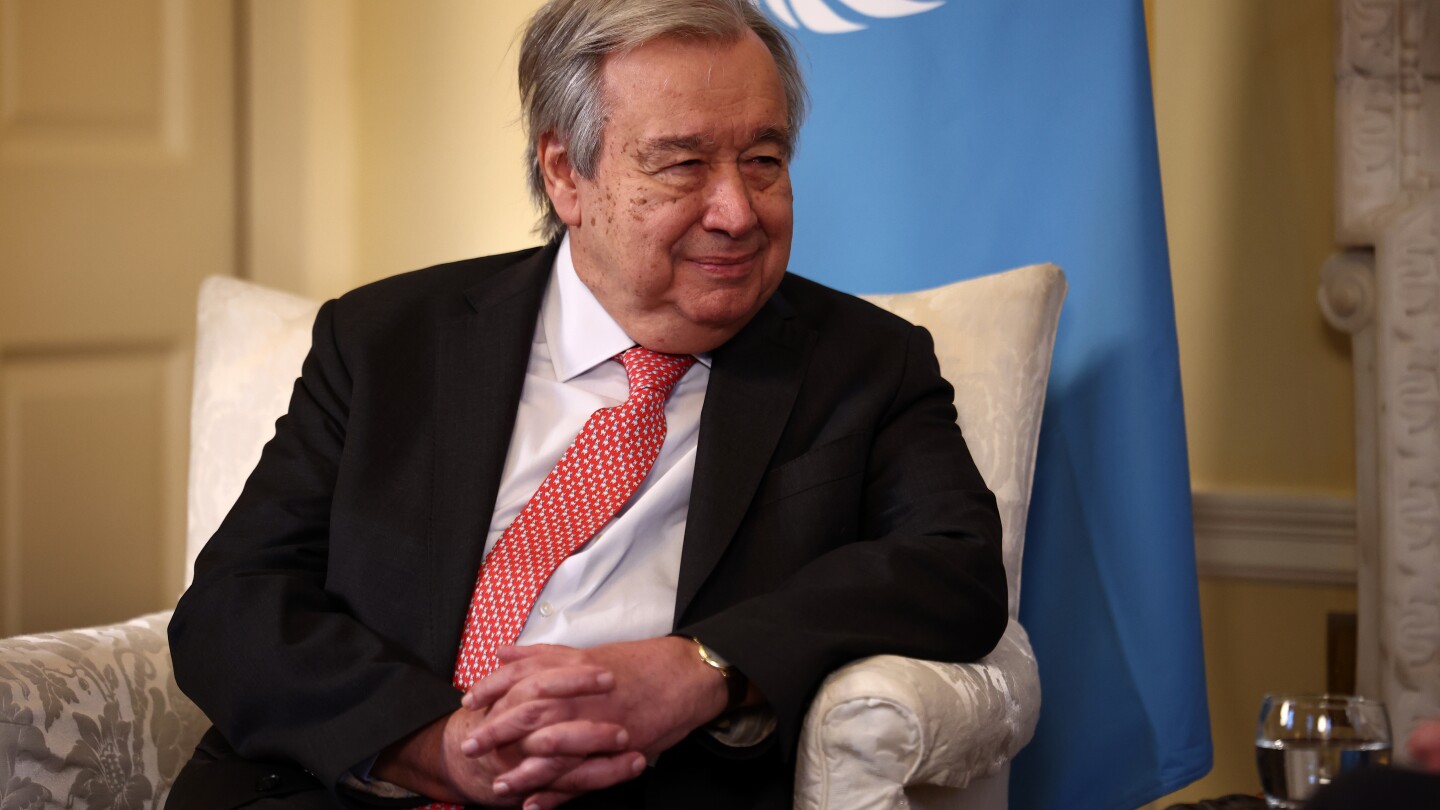
Despite these challenges, UN Secretary-General António Guterres remains optimistic. When asked by the BBC if the United Nations can survive the Trump presidency, he responded, “I have no doubt about it.”
Fact Checker
Verify the accuracy of this article using The Disinformation Commission analysis and real-time sources.

29 Comments
If AISC keeps dropping, this becomes investable for me.
Good point. Watching costs and grades closely.
Good point. Watching costs and grades closely.
Silver leverage is strong here; beta cuts both ways though.
Good point. Watching costs and grades closely.
Nice to see insider buying—usually a good signal in this space.
Good point. Watching costs and grades closely.
Good point. Watching costs and grades closely.
Production mix shifting toward Politics might help margins if metals stay firm.
Good point. Watching costs and grades closely.
Good point. Watching costs and grades closely.
If AISC keeps dropping, this becomes investable for me.
Good point. Watching costs and grades closely.
Good point. Watching costs and grades closely.
Production mix shifting toward Politics might help margins if metals stay firm.
Good point. Watching costs and grades closely.
Good point. Watching costs and grades closely.
If AISC keeps dropping, this becomes investable for me.
Good point. Watching costs and grades closely.
Good point. Watching costs and grades closely.
The cost guidance is better than expected. If they deliver, the stock could rerate.
Good point. Watching costs and grades closely.
Uranium names keep pushing higher—supply still tight into 2026.
I like the balance sheet here—less leverage than peers.
Good point. Watching costs and grades closely.
Good point. Watching costs and grades closely.
Interesting update on Trump’s Board of Peace poses latest in a series of US challenges to the United Nations. Curious how the grades will trend next quarter.
Nice to see insider buying—usually a good signal in this space.
If AISC keeps dropping, this becomes investable for me.