


Listen to the article
In a city where economic anxiety meets political fatigue, Allentown residents struggle to reconcile White House optimism with their daily reality. Idalia Bisbal, who left New York City three years ago hoping for a more affordable life in Pennsylvania, now finds herself deeply disillusioned.
“It’s worse than ever,” said the 67-year-old retiree who depends on Social Security. “The prices are high. Everything is going up. You can’t afford food because you can’t afford rent. Utilities are too high. Gas is too expensive. Everything is too expensive.”
Bisbal’s sentiment emerged shortly after Vice President JD Vance visited the area, part of the Trump administration’s intensified focus on Pennsylvania. During his visit, Vance acknowledged affordability concerns while blaming the Biden administration and promising better days ahead. He later served food to homeless men in Allentown.
The administration’s heightened attention to economic anxiety reflects growing concerns in both political parties. These worries represent a vulnerability for Republicans in competitive congressional districts like Allentown’s, which could determine control of the U.S. House in next year’s midterms.
Yet the administration’s messaging risks appearing disconnected from ground-level realities. Only 31% of Americans approve of Trump’s economic handling, down from 40% in March, according to an Associated Press-NORC Center for Public Affairs Research poll. Despite this, Trump has labeled affordability concerns a “hoax” and awarded his economic policies an “A+++++” — a grade that prompted scorn from Bisbal.
“In the rich man’s world,” she responded. “In our world, trust me, it’s not an ‘A.’ To me, it’s an ‘F,’ ‘F,’ ‘F,’ ‘F,’ ‘F,’ ‘F.'”
Allentown, with approximately 125,000 residents, anchors Pennsylvania’s third-largest metropolitan area, the Lehigh Valley. In interviews with local officials, business leaders, and residents across the political spectrum, one point of consensus emerged: prices are simply too high. The specifics varied — some highlighted gas prices, others grocery costs, healthcare expenses, or housing — but few shared Trump’s unbridled economic optimism.
Tony Iannelli, president and CEO of the Greater Lehigh Valley Chamber of Commerce, called Trump’s grade a “stretch,” suggesting “we have a strong economy but I think it’s not yet gone to the next stage of what I would call robust.”
Health and benefits consultant Tom Groves assessed the economy at a “B+,” citing the Affordable Care Act’s contribution to higher health costs along with stock and labor market volatility. Joe Vichot, chairman of the Lehigh County Republican Committee, diplomatically referred to Trump’s grade as a “colloquialism.”
Far from Washington’s political theater, Allentown residents showed little agreement on who bears responsibility for high prices or how to address them. What did emerge clearly was widespread exhaustion with the constant political combat.
Pat Gallagher, finishing lunch near Bisbal, recalled meeting her late husband when they both worked at Bethlehem Steel, the manufacturing giant that closed in 2003. Now retired and living with her daughter to manage costs, she notices rising grocery prices but has grown weary of political discourse. “I get so frustrated with hearing about the politics,” she said.
This fatigue is understandable in a city that frequently hosts national political debates. Billy Joel’s 1982 song “Allentown” cemented the city in American consciousness, capturing both disillusionment and hope amid factory closures. Since then, Pennsylvania has become a crucial presidential battleground, with Allentown serving as backdrop for countless candidate visits and media coverage.
“Every race here, all the time,” recalled Allentown’s Democratic Mayor Matt Tuerk, describing last year’s election intensity.
The political spotlight’s persistence has made some residents reluctant to discuss economics or politics, fearing backlash from previous comments. Nevertheless, as attention shifts toward next year’s midterms, Allentown remains firmly in the political crosshairs.
Trump’s 2024 victory helped other Republicans like U.S. Rep. Ryan Mackenzie unseat a three-term Democrat. Now Mackenzie faces vulnerability as one of the most endangered House Republicans, needing to mobilize Trump voters while appealing to independents.
His balancing act was evident when he addressed Republican supporters before Vance’s speech, criticizing “Bidenomics” failures. A day later in Washington, Mackenzie joined three fellow House Republicans in breaking ranks to force a vote on extending soon-to-expire healthcare subsidies.
Lehigh County swung toward Trump in 2024, with Vice President Harris winning by just 2.7 percentage points, the narrowest Democratic presidential margin since 2004. However, Democrats have regained momentum following strong performances in recent county executive races.
Recapturing Mackenzie’s congressional seat is now a Democratic priority. Governor Josh Shapiro, facing reelection next year and considered a potential 2028 presidential contender, has already endorsed firefighter union head Bob Brooks for the May primary.
Democrats, just a few seats shy of regaining House majority, welcome continued economic focus. They quickly noted that the Uline facility where Vance spoke sits just miles from a Mack Trucks plant that cut approximately 200 jobs this year — reductions the company partially attributed to Trump-imposed tariffs, a point Shapiro emphasized in response to Vance’s visit.
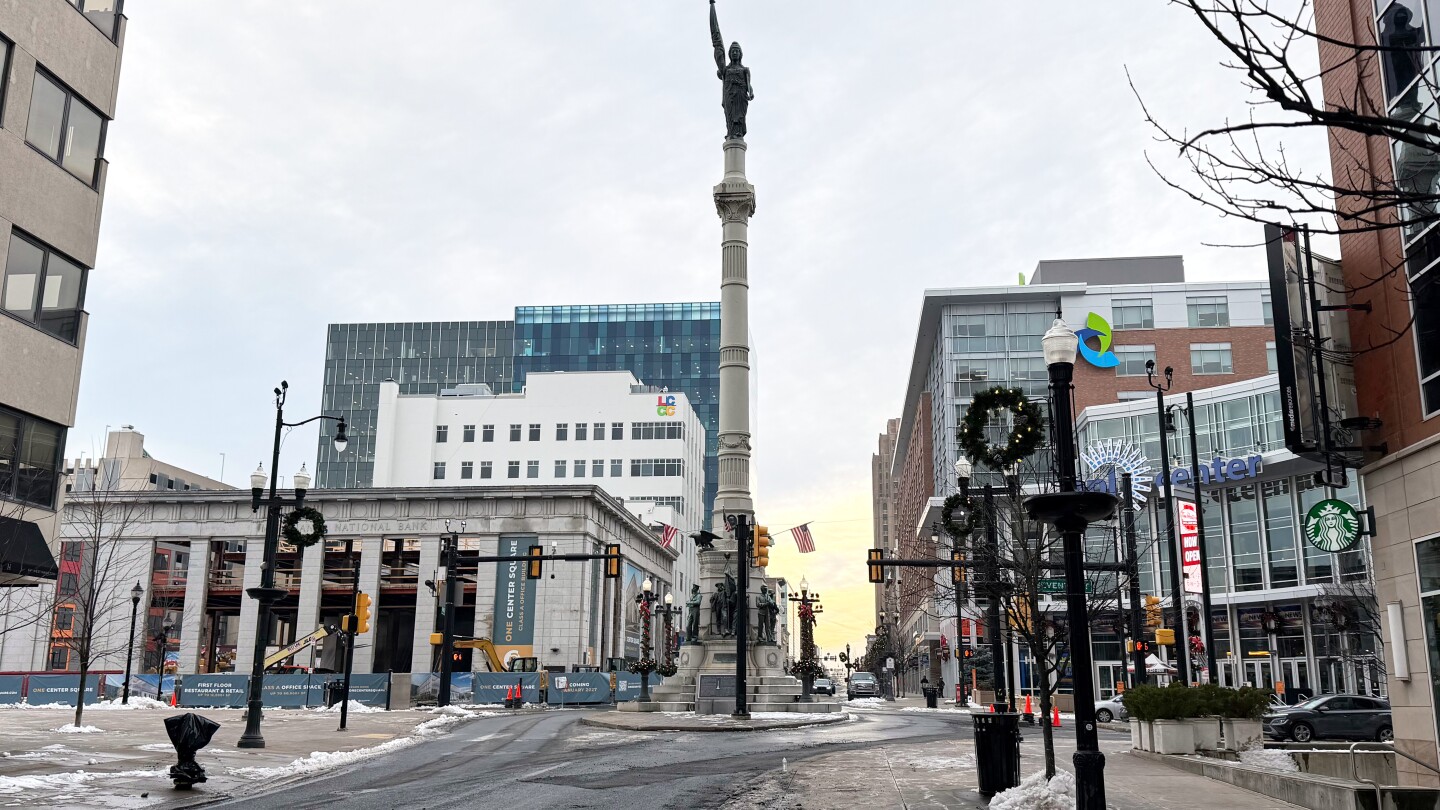
The image of Allentown as purely a manufacturing town is outdated. Its downtown features row homes, trendy hotels, and a modern arena hosting hockey games and major concerts. Latinos now comprise the majority of the city’s population, with significant Puerto Rican, Mexican, and Dominican communities.
“This is a place of rapid change,” said Mayor Tuerk, the city’s first Latino mayor. “It’s constantly changing and I think over the next three years until that next presidential election, we’re going to see a lot more change. It’s going to be an interesting ride.”
Fact Checker
Verify the accuracy of this article using The Disinformation Commission analysis and real-time sources.

10 Comments
This highlights the challenges of trying to paint a uniform picture of the economy when individual experiences can vary greatly. Curious to see how this plays out in the midterms.
Agreed, the economic landscape is uneven, and the political messaging needs to better reflect the on-the-ground realities.
It’s concerning to hear about the rising costs squeezing residents in this critical swing district. The administration’s focus on the area makes sense, but they’ll need to offer more than just rhetoric.
Exactly, empty promises won’t cut it – tangible solutions to address the affordability crisis are what’s needed here.
This is a great example of how the national economic narrative can diverge from local realities. Policymakers would do well to listen closely to the concerns of communities like Allentown.
Agreed. Bridging that gap between rhetoric and reality will be crucial for politicians looking to connect with voters in this key swing district.
Interesting to see the economic realities on the ground colliding with the rosy rhetoric from the White House. It’s a complex situation with valid concerns from both sides.
Absolutely, it’s a nuanced issue without easy answers. Residents’ struggles with affordability are real and need to be addressed, regardless of political affiliations.
The dichotomy between the White House’s rosy outlook and the everyday struggles of Allentown residents is stark. Curious to see how this dynamic evolves ahead of the midterms.
Well said. The political implications of this disconnect could be significant, and it will be interesting to see how both parties navigate the economic complexities.