


Listen to the article
State and Local Officials Challenge Federal Immigration Detention Expansion
Amid rising tensions over federal immigration enforcement, state and local officials across the United States are pushing back against the Biden administration’s plans to house thousands of detained immigrants in their communities.
Federal officials have been scouting locations nationwide as part of a massive $45 billion expansion of detention facilities funded by recent tax legislation. The initiative comes as Immigration and Customs Enforcement (ICE) faces intensified scrutiny following the fatal shootings of Renee Good and Alex Pretti during immigration enforcement actions in Minnesota.
These incidents have galvanized opposition to proposed detention centers in multiple states. In Hanover County, Virginia, hundreds of residents attended a contentious public hearing last week regarding a proposed ICE facility just north of Richmond.
“You want what’s happening in Minnesota to go down in our own backyard? Build that detention center here, and that’s exactly what will happen,” resident Kimberly Matthews told county officials during the meeting.
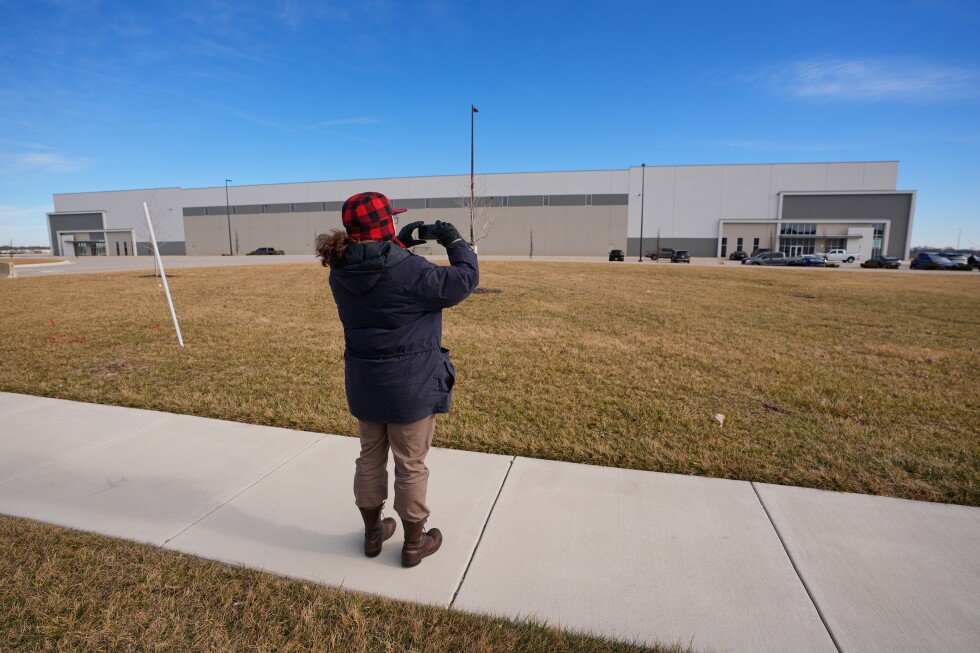
The resistance extends beyond Virginia. In Kansas City, Missouri, officials rushed to pass an ordinance to block a potential detention site after learning ICE was considering a nearly 1-million-square-foot warehouse capable of housing 7,500 detainees. Mayors in Oklahoma City and Salt Lake City recently announced that property owners would not be selling or leasing their facilities for immigration detention purposes after raising concerns about building permits.
Meanwhile, Democratic-led state legislatures are advancing bills aimed at preventing or discouraging ICE facilities. New Mexico lawmakers are targeting local government agreements to detain immigrants, while California has proposed a novel approach: imposing a 50% tax on proceeds from companies operating ICE facilities, effectively encouraging their departure from the state.
The expansion reflects significant growth in ICE detention capacity under the current administration. As of late December, more than 70,000 immigrants were in ICE custody, up from 40,000 at the beginning of the previous administration. The number of detention facilities used by ICE has nearly doubled to 212 sites across 47 states and territories, primarily through existing contracts with the U.S. Marshals Service or agreements to use empty beds in county jails.
Recent acquisitions demonstrate ICE’s commitment to establishing larger detention centers. In January alone, the agency paid $102 million for a warehouse in Washington County, Maryland, $84 million for one in Berks County, Pennsylvania, and more than $70 million for a facility in Surprise, Arizona. ICE is also considering a warehouse purchase in Chester, New York, despite the property being located in a flood plain.
“They will be very well structured detention facilities meeting our regular detention standards,” ICE said in a statement. “It should not come as news that ICE will be making arrests in states across the U.S. and is actively working to expand detention space.”
Despite widespread opposition, state and local governments face legal limitations in blocking these facilities. Danielle Jefferis, an associate law professor at the University of Nebraska who specializes in immigration and civil litigation, notes that while local governments can decline to lease space to ICE, they generally cannot prevent private landowners from using their property for federal immigrant detention centers.
Recent court decisions have reinforced these limitations. In 2023, a federal court invalidated a California law barring private immigrant detention facilities, ruling it infringed on federal powers. Similarly, a federal appeals court panel struck down a New Jersey law prohibiting agreements to operate immigrant detention facilities.
Some local governments are exploring regulatory approaches. After ICE officials toured a warehouse in Orlando, Florida, local officials investigated potential restrictions, but City Attorney Mayanne Downs advised that “ICE is immune from any local regulation that interferes in any way with its federal mandate.”
In Hanover County, Board of Supervisors Chair Sean Davis acknowledged similar constraints: “The federal government is generally exempt from our zoning regulations.”
Despite these legal obstacles, communities continue seeking creative solutions. Kansas City’s five-year moratorium on non-city-run detention facilities represents one approach, while County Legislator Manny Abarca is proposing a countywide ban on permits, zoning changes, and development plans for facilities not operated by local government.
“When federal power is putting communities on edge, local government has a responsibility to act where we have authority,” Abarca stated.
Other communities, including Social Circle, Georgia, El Paso, Texas, and Roxbury Township, New Jersey, have raised infrastructure concerns, questioning whether warehouses can be adequately serviced with water and sewer capacity for detention purposes.
The New Mexico House recently passed legislation banning state and local government contracts for ICE detention facilities, with similar bills pending in Hawaii, Massachusetts, New York, and Rhode Island. This could affect facilities like the Otero County Processing Center, which houses over 1,000 detainees and includes four immigration courtrooms.
Otero County Attorney Roy Nichols has indicated the county is prepared to challenge the legislation, citing a state law preventing impairment of outstanding revenue bonds. The county financed the facility’s construction in 2007 as a revenue source and plans to pay off the remaining $16.5 million debt by 2028.
As legal battles loom and communities organize, Professor Jefferis observes that the effectiveness of local deterrence strategies remains uncertain: “We’re currently in a moment where it is being tested. So there is no clear answer as to how the courts are going to come down.”
Fact Checker
Verify the accuracy of this article using The Disinformation Commission analysis and real-time sources.

30 Comments
The cost guidance is better than expected. If they deliver, the stock could rerate.
Good point. Watching costs and grades closely.
Good point. Watching costs and grades closely.
Exploration results look promising, but permitting will be the key risk.
Silver leverage is strong here; beta cuts both ways though.
Good point. Watching costs and grades closely.
Good point. Watching costs and grades closely.
Interesting update on Trump’s $45 billion expansion of immigrant detention sites faces pushback from communities. Curious how the grades will trend next quarter.
The cost guidance is better than expected. If they deliver, the stock could rerate.
Exploration results look promising, but permitting will be the key risk.
Good point. Watching costs and grades closely.
Good point. Watching costs and grades closely.
I like the balance sheet here—less leverage than peers.
Good point. Watching costs and grades closely.
Good point. Watching costs and grades closely.
Exploration results look promising, but permitting will be the key risk.
Good point. Watching costs and grades closely.
Interesting update on Trump’s $45 billion expansion of immigrant detention sites faces pushback from communities. Curious how the grades will trend next quarter.
Good point. Watching costs and grades closely.
Exploration results look promising, but permitting will be the key risk.
Good point. Watching costs and grades closely.
Good point. Watching costs and grades closely.
Uranium names keep pushing higher—supply still tight into 2026.
Silver leverage is strong here; beta cuts both ways though.
Good point. Watching costs and grades closely.
Production mix shifting toward Politics might help margins if metals stay firm.
I like the balance sheet here—less leverage than peers.
Good point. Watching costs and grades closely.
Good point. Watching costs and grades closely.
If AISC keeps dropping, this becomes investable for me.