


Listen to the article
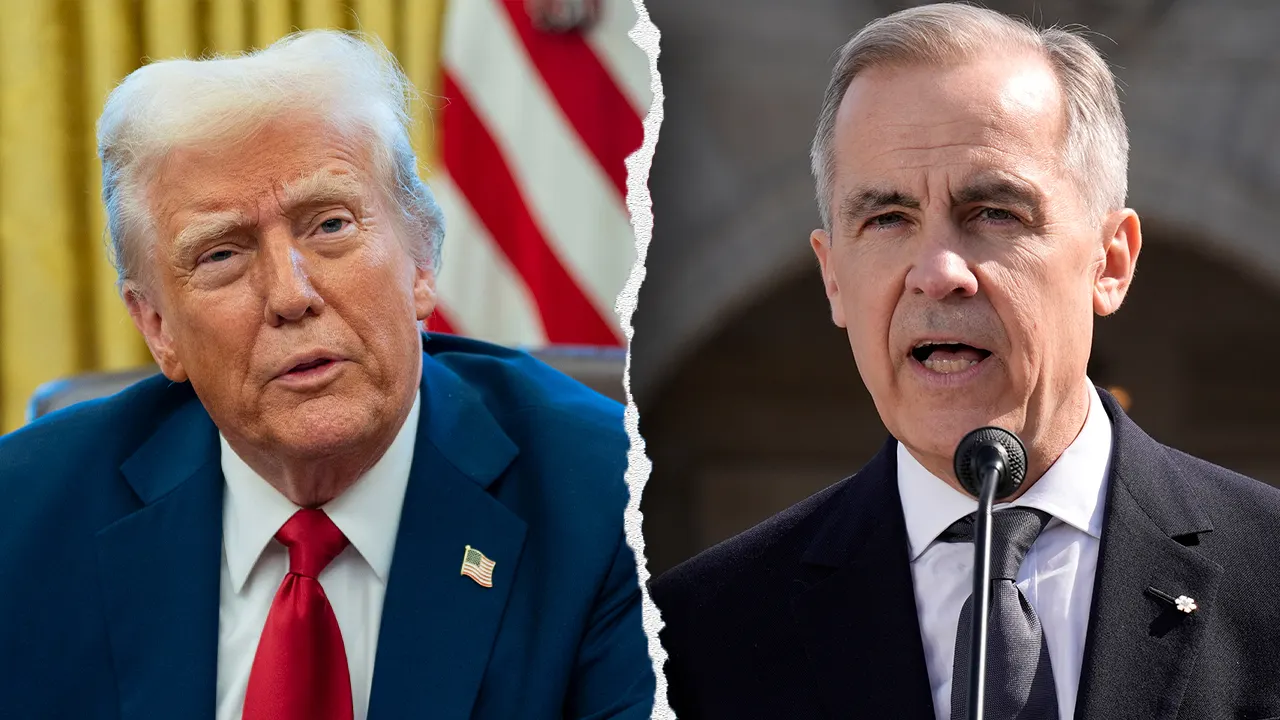
President Donald Trump has withdrawn Canada’s invitation to his newly formed Board of Peace, citing dissatisfaction with remarks made by Canadian Prime Minister Mark Carney during the World Economic Forum in Davos, Switzerland.
In a statement posted on Truth Social, Trump informed Carney that Canada could no longer join what he described as “the most prestigious Board of Leaders ever assembled.” The move comes just one day after Trump unveiled the board during a signing ceremony in Davos, where he was joined by leaders from Latin America, Europe, the Middle East, and Asia.
The diplomatic rift appears to stem from Trump’s comments about U.S. plans to develop a missile defense system in Greenland, which he referred to as a “Golden Dome.” During his forum appearance, Trump suggested that Canada should show greater appreciation for American security provisions.
“We’re building a Golden Dome that’s going to, just by its very nature, going to be defending Canada. Canada gets a lot of freebies from us, by the way. They should be grateful also,” Trump said. “Canada lives because of the United States. Remember that, Mark, the next time you make your statements.”
Trump’s rebuke was apparently triggered by Carney’s earlier remarks at the forum, where the Canadian Prime Minister—without naming Trump specifically—warned that the rules-based international order is deteriorating as major powers increasingly use economic and security leverage to pressure allies. Carney urged “middle powers” like Canada to recognize that compliance does not guarantee security and advocated for a strategy based on diversification, collective action, and respect for sovereignty.
The Board of Peace represents one of Trump’s most ambitious foreign policy initiatives since returning to office. According to announcements made at Davos, Trump will chair the board, which will include prominent political, diplomatic, and business figures such as his son-in-law Jared Kushner, Secretary of State Marco Rubio, U.S. Special Envoy Steve Witkoff, and billionaire Marc Rowan.
Despite Canada’s removal, Trump has extended invitations to numerous other nations to join the board, including Russia, Belarus, France, Germany, Vietnam, Finland, Ukraine, Ireland, Greece, Israel, and China. The diverse list of potential members reflects Trump’s stated goal of creating an influential international coalition, though some foreign policy experts have questioned how such disparate nations—some with competing interests—would function cohesively under this framework.
The establishment of the Board of Peace comes amid Trump’s renewed interest in acquiring Greenland, an autonomous territory of Denmark. Trump has suggested that control of Greenland would allow the United States to build a large-scale missile defense system that would protect both American and Canadian interests. This revival of his interest in Greenland, which first emerged during his previous administration, has raised concerns in Copenhagen and Ottawa about territorial sovereignty in the Arctic.
The tensions between Trump and Carney highlight broader challenges in U.S.-Canada relations, which have historically been among the most stable bilateral relationships in the world. The two nations share the world’s longest undefended border and maintain deep economic ties through trade agreements including the United States-Mexico-Canada Agreement (USMCA).
Trade between the U.S. and Canada exceeds $2 billion daily, with the two countries being each other’s largest trading partners. Any significant deterioration in diplomatic relations could potentially impact this economic relationship, creating uncertainty for businesses and investors on both sides of the border.
As the situation develops, international observers are closely watching how this diplomatic disagreement might affect broader North American cooperation on issues ranging from trade to continental defense.
Fact Checker
Verify the accuracy of this article using The Disinformation Commission analysis and real-time sources.

10 Comments
Interesting geopolitical move by Trump. Seems he’s looking to consolidate power and influence around the world. I wonder how Canada will respond to this diplomatic snub.
Trump’s comments about Canada getting “freebies” are rather provocative. I suspect this will further strain relations between the two countries.
Trump’s comments about the “Golden Dome” and Canada getting “freebies” seem to reflect a more transactional view of international relations. This could have far-reaching implications.
It will be interesting to see how this plays out and whether Canada can find a way to mend fences with the US.
This highlights the tensions between the US and its allies, even longtime partners like Canada. Trump appears to be taking a more confrontational approach on the global stage.
It will be important to see how Canada navigates this situation and whether they can find a way to de-escalate the dispute with the US.
The withdrawal of Canada’s invitation is a concerning development. Maintaining strong international cooperation is crucial, especially on issues of global security and stability.
I wonder if this is part of a broader shift in US foreign policy under the Trump administration, moving away from traditional alliances.
This is a concerning development that could undermine regional security and cooperation. I hope the two countries can find a way to resolve their differences through diplomatic channels.
Trump’s approach seems to be driven more by personal grievances than a coherent foreign policy strategy. This could have serious consequences for US-Canada relations.