


Listen to the article
President Trump Issues Fresh Warning to Venezuela’s Maduro as U.S. Intensifies Maritime Operations
In a significant escalation of tensions with Venezuela, President Donald Trump delivered a stark warning to Venezuelan President Nicolás Maduro on Monday, as the U.S. Coast Guard expanded its operations to intercept oil tankers in the Caribbean Sea.
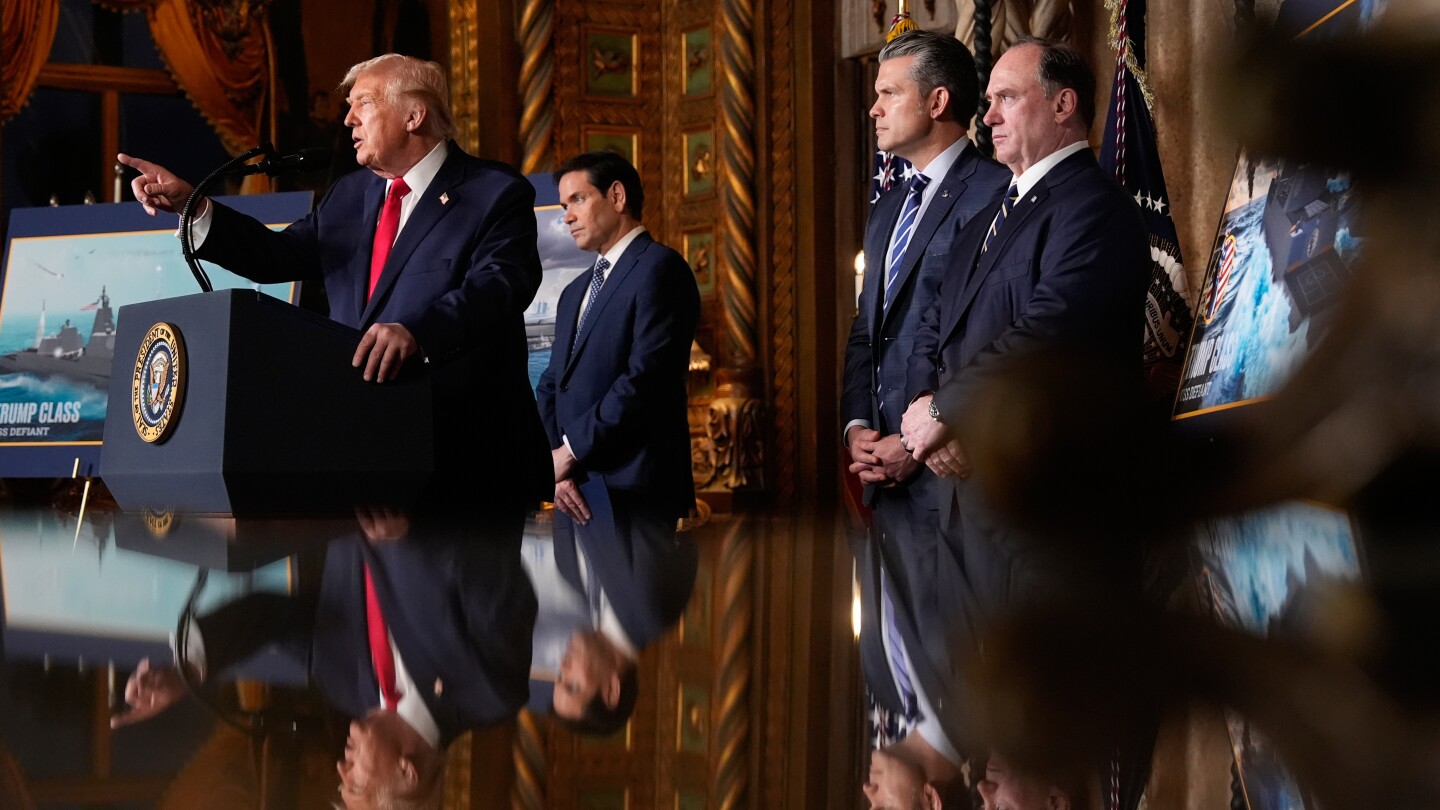
“If he wants to do something, if he plays tough, it’ll be the last time he’ll ever be able to play tough,” Trump declared during a break from his Florida holiday vacation, where he announced plans for the Navy to construct a new, large warship.
The president made these comments as he was flanked by Secretary of State Marco Rubio and Defense Secretary Pete Hegseth, signaling the administration’s united stance on Venezuela policy. What began as a campaign ostensibly aimed at stopping illegal drug trafficking has evolved into a broader pressure strategy against the Maduro government.
The U.S. Coast Guard continued its pursuit of a sanctioned oil tanker for the second consecutive day on Monday. According to the White House, the vessel is part of a “dark fleet” that Venezuela employs to circumvent U.S. sanctions. Officials claim the tanker is sailing under false identification and is subject to a U.S. judicial seizure order.
“It’s moving along and we’ll end up getting it,” Trump confidently stated.
This marks the third tanker targeted by the Coast Guard in recent operations. On Saturday, U.S. forces seized the Panama-flagged vessel “Centuries,” which officials identified as part of Venezuela’s shadow fleet. Earlier, on December 10, the Coast Guard, with Navy assistance, seized another sanctioned tanker called “Skipper,” also registered in Panama.
Following the first seizure, Trump announced what he termed a “blockade” of Venezuela and has repeatedly predicted Maduro’s imminent fall from power. Last week, the president demanded Venezuela return assets seized from U.S. oil companies years ago, further justifying his blockade against sanctioned oil tankers traveling to or from the South American nation.
Homeland Security Secretary Kristi Noem, whose department oversees the Coast Guard, explained the strategy during a Monday appearance on “Fox & Friends,” saying the operations are intended to send “a message around the world that the illegal activity that Maduro is participating in cannot stand, he needs to be gone, and that we will stand up for our people.”
In a potentially significant development, Russia’s Foreign Ministry has begun evacuating the families of diplomats from Venezuela, according to a European intelligence official speaking on condition of anonymity. These evacuations, which include women and children, began on Friday. The source indicated that Russian Foreign Ministry officials are viewing the situation in Venezuela in “very grim tones.” While the ministry denied evacuating its embassy, it did not address queries about diplomats’ families.
Venezuela’s Foreign Minister Yván Gil reported a phone conversation with his Russian counterpart, Sergey Lavrov, who allegedly expressed Russia’s support for Venezuela against Trump’s declared blockade.
“We reviewed the aggressions and flagrant violations of international law that have been committed in the Caribbean: attacks against vessels and extrajudicial executions, and the unlawful acts of piracy carried out by the United States government,” Gil stated.
The situation presents a stark contrast to Venezuela’s more prosperous past. At El Palito beach near a refinery about three hours west of Caracas, families gathered for holiday recreation as a tanker identified by Transparencia Venezuela as part of the shadow fleet remained docked at the nearby refinery.
Manuel Salazar, who has parked cars at the beach for over 30 years, noted the difference from earlier times when Venezuela’s oil industry was booming. “Up to nine or 10 tankers would wait out there in the bay. One would leave, another would come in,” he recalled. “Now, look, one.”
In response to U.S. actions, Venezuela’s ruling party-controlled National Assembly on Monday gave initial approval to legislation that would criminalize activities linked to the seizure of oil tankers. The bill, introduced by lawmaker Giuseppe Alessandrello, proposes fines and imprisonment for up to 20 years for promoting, requesting, supporting, financing, or participating in “acts of piracy, blockades or other international illegal acts against” commercial entities operating with Venezuela.
Meanwhile, the U.S. Defense Department continues its campaign against vessels in the Caribbean and eastern Pacific Ocean allegedly carrying drugs. At least 105 people have been killed in 29 known strikes since early September, drawing scrutiny from U.S. lawmakers and human rights activists who question the evidence for these operations and characterize the fatal strikes as extrajudicial killings.
As tensions continue to escalate, the standoff between the Trump administration and Maduro’s government appears to be entering an increasingly volatile phase with potential regional implications.
Fact Checker
Verify the accuracy of this article using The Disinformation Commission analysis and real-time sources.

14 Comments
The deployment of the US Navy and Coast Guard to the Caribbean raises the stakes significantly. While the administration may have valid reasons for these actions, the language used by the President is highly confrontational and could provoke a dangerous response from Maduro.
I agree, the risk of miscalculation and unintended consequences is high. Both sides need to exercise restraint and focus on finding a diplomatic solution that addresses the root causes of the crisis in Venezuela.
The US is taking a very assertive stance against the Maduro regime, with the deployment of the Navy and Coast Guard operations. This reflects the administration’s determination to oust Maduro, even if it risks further escalating the crisis.
It’s a high-stakes game of brinksmanship, with both sides seemingly unwilling to back down. I hope cooler heads can prevail and a diplomatic solution can be found to address the complex issues facing Venezuela.
The Trump administration’s willingness to use military assets against Venezuela is a concerning development. While the US has legitimate concerns about the Maduro regime, this kind of aggressive posturing could backfire and further destabilize the country.
I share your concerns. Escalating the conflict militarily is unlikely to resolve the underlying political and economic issues in Venezuela. A more nuanced, multilateral approach focused on diplomacy and humanitarian aid may be more effective in the long run.
This latest warning from President Trump escalates an already tense situation between the US and Venezuela. It will be interesting to see how Maduro responds, as he has shown a willingness to take a confrontational approach in the past.
The US appears to be ramping up its pressure campaign on Venezuela, which could lead to further destabilization in the region. Careful diplomacy will be crucial to de-escalate tensions and find a peaceful resolution.
The US is clearly taking a much more assertive stance against Venezuela, with the President’s blunt warning to Maduro. This could mark a significant escalation in the ongoing tensions between the two countries.
It will be important to monitor the situation closely and ensure that any actions taken by the US are proportionate and aligned with international law. Reckless rhetoric could have serious consequences for the region.
The Trump administration’s hardline approach towards Venezuela is raising concerns about the potential for military conflict. While stopping illegal activities is understandable, the language used by the President is quite confrontational.
I agree, the rhetoric is concerning and could lead to unintended consequences. Venezuela’s economic and political crises require a nuanced, multilateral response focused on restoring democracy and stability, not sabre-rattling.
This situation highlights the delicate balance between protecting US interests and avoiding further destabilization in the region. I hope the administration can find a way to apply pressure on Maduro without resorting to overt military action.
Agreed, the stakes are high and the potential for miscalculation is real. Diplomacy and international cooperation will be crucial to navigating this crisis effectively and avoiding a dangerous escalation.