


Listen to the article
Trump’s State of the Union Outlines Key Legislative Priorities Amid Congressional Pushback
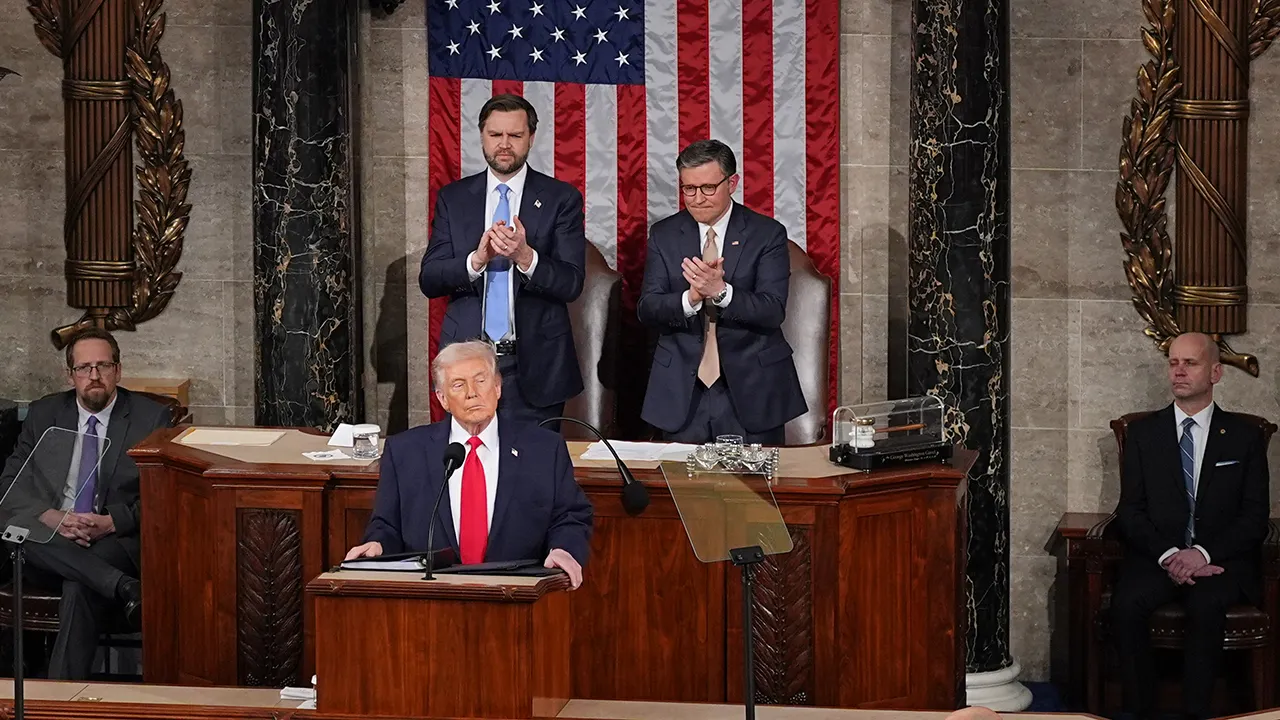
State of the Union addresses traditionally serve as platforms for presidential aspirations, and President Donald Trump’s recent address was no exception. During his speech to Congress, the president outlined two significant legislative requests while also sending a clear message about his tariff policies.
The president called on Congress to pass the Safeguard American Voter Eligibility (SAVE) Act, which would require proof of citizenship for voting in federal elections. He also pushed lawmakers to approve a stock trading ban that would prevent members of Congress from dealing in stocks while in office. At the same time, Trump warned Congress not to interfere with his tariff policies.
Trump touted his new tariffs as eventually replacing the nation’s income tax and made it clear he doesn’t believe congressional approval is necessary for his tariff actions. “Congressional action will not be necessary,” Trump stated regarding his new tariffs, despite the Constitution explicitly granting Congress the power to impose tariffs—a position the Supreme Court recently upheld.
The president’s stance on tariffs has already created friction within his own party. Some House Republicans, particularly those representing districts negatively affected by tariffs, have attempted to reclaim congressional authority over trade policy. Several weeks ago, the House voted to eliminate a special rule that House Speaker Mike Johnson and other Republican leaders had implemented to block members from unwinding tariffs for a year. The House then adopted a plan to reverse tariffs with Canada specifically.
The SAVE Act represents Trump’s most urgent legislative priority. It aligns with his narrative about illegal immigration and claims of voter fraud in the 2020 election. “They want to cheat. They have cheated. And their policy is so bad that the only way they can get elected is to cheat,” Trump said of Democrats during his address, adding that “cheating is rampant.”
However, these claims contrast with findings from the conservative Heritage Foundation, which determined that instances of election fraud are extremely rare. For example, Pennsylvania, a crucial swing state, has documented only 39 cases of voting fraud over the past three decades.
While the House has already passed the SAVE Act, its future in the Senate remains uncertain. The legislation currently has the support of 50 Republican senators, but would need to reach the 60-vote threshold to overcome a potential filibuster. Notably, Trump did not explicitly call for ending the filibuster during his address.
Senate Majority Leader John Thune (R-S.D.) has consistently opposed altering the Senate’s filibuster rules to pass the SAVE Act. Some Republican senators, including Mike Lee (R-Utah) and Ted Cruz (R-Texas), have advocated for implementing a “talking filibuster,” requiring senators to actually hold the floor for hours rather than simply objecting procedurally. However, Thune noted that “the talking filibuster issue is one on which there is not a unified Republican conference,” adding that “there isn’t the support for doing that at this point.”
The president’s call for a congressional stock trading ban received bipartisan applause, including from Senator Elizabeth Warren (D-Mass.). Speaker Johnson indicated that the House is trying to “move the bill as aggressively and as quickly as we can,” but acknowledged they currently lack the necessary votes for passage.
The tension between presidential proposals and congressional action reflects the constitutional separation of powers. While a Republican-controlled Congress may align with many of Trump’s priorities, legislators maintain their own political calculations, especially those facing competitive reelection campaigns who might be wary of controversial votes.
As the political adage goes, the president “proposes” and Congress “disposes.” Even with Republican majorities in both chambers, some of Trump’s legislative wishes may face significant obstacles as lawmakers weigh the president’s agenda against their own political interests and constitutional responsibilities.
Fact Checker
Verify the accuracy of this article using The Disinformation Commission analysis and real-time sources.

10 Comments
The president’s direct challenge to Congress on tariffs is bold, but it remains to be seen if he has the political capital to push that through. Curious to see how lawmakers respond.
Interesting to see the president push for the SAVE Act to address voter eligibility. While election integrity is important, I’m curious how this would impact voter access and participation.
Agreed, the details of the SAVE Act will be critical. Ensuring secure elections while maintaining democratic participation is a delicate balance.
A stock trading ban for Congress could help address conflicts of interest, but the details would be important. Curious to see if this proposal gains traction.
Agreed, a congressional stock trading ban is an interesting idea, but the implementation would be crucial. Transparency and accountability should be the priority.
The president’s stance on tariffs is rather bold, going against Congress’s constitutional powers. I wonder how that will play out politically and economically.
Yes, the president’s unilateral approach to tariffs is concerning. Congressional oversight and approval is essential for major economic policies like that.
The SAVE Act and congressional stock trading ban are thought-provoking ideas, but the details will be critical. Balancing security, access, and integrity is a delicate challenge.
The president seems to be taking a very assertive approach on key issues like voter eligibility, tariffs, and congressional stock trading. It will be interesting to see how lawmakers respond.
While the president’s policy proposals aim to address important issues, his unilateral stance on tariffs is concerning. Checks and balances are essential in a democracy.