


Listen to the article
President Donald Trump announced Saturday that he plans to impose a 10% import tax starting in February on goods from eight European nations due to their opposition to American control of Greenland. The tariff would increase to 25% on June 1 if no agreement is reached for “the Complete and Total purchase of Greenland” by the United States.
The targeted countries include Denmark, Norway, Sweden, France, Germany, the United Kingdom, the Netherlands, and Finland—all NATO allies. This dramatic escalation threatens to further strain the 75-year-old alliance that provides collective security across Europe and North America.
Legal experts question how Trump could implement such tariffs under U.S. law, though he may attempt to invoke economic emergency powers, which are currently being challenged in the U.S. Supreme Court.
According to Trump’s post on Truth Social, the tariffs are a response to recent diplomatic visits to Greenland by representatives from Britain, the Netherlands, and Finland, as well as general European resistance to his efforts to acquire the semi-autonomous Danish territory. Trump has repeatedly claimed Greenland is essential for what he calls the “Golden Dome” missile defense system, suggesting Russia and China might otherwise attempt to take control of the island.
European opposition to Trump’s Greenland ambitions has intensified in recent months, even as several European nations previously acquiesced to his 15% tariffs last year to maintain economic and security ties with Washington.
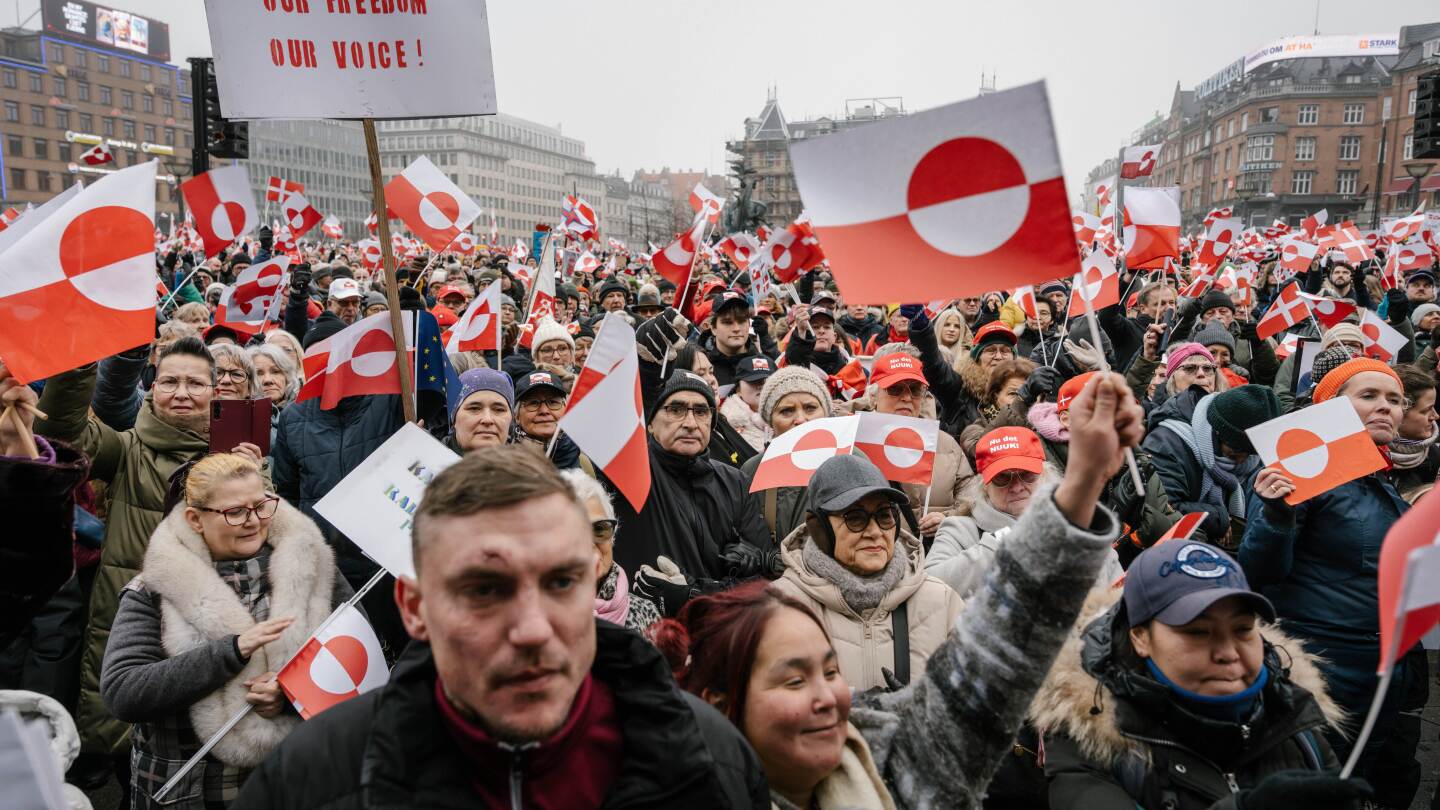
On Saturday, hundreds of Greenlanders marched through near-freezing conditions in Nuuk, the territory’s capital, waving red-and-white national flags and carrying signs with messages like “We shape our future,” “Greenland is not for sale,” and “Greenland is already GREAT.” Similar demonstrations occurred across the Danish kingdom, drawing thousands of participants.
In Copenhagen, thousands marched carrying Greenlandic flags and signs with slogans including “Make America Smart Again” and “Hands Off.”
“This is important for the whole world,” Danish protester Elise Riechie told the Associated Press while holding Danish and Greenlandic flags. “There are many small countries. None of them are for sale.”
Meanwhile, a bipartisan U.S. congressional delegation in Copenhagen attempted to ease tensions. Senator Chris Coons (D-Del.) expressed concern about the escalating rhetoric and sought to reassure Denmark of America’s commitment to their alliance.
“I hope that the people of the Kingdom of Denmark do not abandon their faith in the American people,” Coons said, emphasizing U.S. respect for Denmark and NATO “for all we’ve done together.”
Denmark has responded by increasing its military presence in Greenland. Danish Major General Søren Andersen, leader of the Joint Arctic Command, told the AP that European troops were recently deployed to Nuuk for Arctic defense training. He emphasized that he “would never expect a NATO country to attack another NATO country.”
The Danish military organized a planning meeting Friday in Greenland with NATO allies, including the U.S., to discuss Arctic security. American forces were also invited to participate in Operation Arctic Endurance in Greenland in the coming days.
Andersen contradicted Trump’s claims of Chinese and Russian vessels off Greenland’s coast, stating that in his two-and-a-half years as commander, he hasn’t observed any Chinese or Russian combat vessels or warships near the territory.
Trump has previously insisted that the U.S. should control Greenland, calling anything less than American ownership “unacceptable.” He has repeatedly cited the territory’s vast reserves of critical minerals as justification, along with alleged Chinese and Russian designs on the island—claims Senator Coons directly refuted, stating, “There are no current security threats to Greenland.”
Earlier this week, foreign ministers from Denmark and Greenland met with Vice President JD Vance and Secretary of State Marco Rubio in Washington. While the meeting produced an agreement to establish a working group, Denmark and the White House subsequently offered contradictory public interpretations of its purpose.
European leaders have maintained that decisions regarding Greenland’s status are solely for Denmark and Greenland to determine.
“There is almost no better ally to the United States than Denmark,” Coons said. “If we do things that cause Danes to question whether we can be counted on as a NATO ally, why would any other country seek to be our ally or believe in our representations?”
Fact Checker
Verify the accuracy of this article using The Disinformation Commission analysis and real-time sources.

12 Comments
Seems like another escalation in Trump’s efforts to acquire Greenland. Imposing tariffs on NATO allies over diplomatic visits is a concerning move. I wonder if there are legal grounds for such unilateral action, or if this is more political posturing.
Trump certainly has a penchant for unconventional trade tactics. It will be interesting to see how the European nations respond to these proposed tariffs.
Greenland is a strategic territory, but undermining NATO alliances over it seems shortsighted. I hope cooler heads can prevail and find a diplomatic solution that benefits all parties involved.
You raise a good point. Preserving the NATO alliance should be a priority, even when geopolitical interests clash.
From a mining and resources perspective, Greenland does have significant untapped potential. But at what cost? These tariffs could have ripple effects across global commodity markets.
Agreed. The potential mineral wealth of Greenland is intriguing, but the geopolitical risks may outweigh the rewards if this dispute escalates further.
Greenland’s mineral wealth is undoubtedly attractive, but the political fallout from these proposed tariffs is troubling. Maintaining global alliances should be a priority, even when geopolitical interests clash.
Well said. Preserving stability and cooperation within NATO should take precedence over unilateral attempts to acquire Greenland, no matter the potential resource benefits.
I’m curious to see how this plays out legally. Can the President unilaterally impose such tariffs, or will there be challenges in the courts? Either way, it’s a high-stakes game of diplomatic chess.
Good question. The legality of these proposed tariffs will likely be heavily scrutinized, given the potential impact on international trade and alliances.
As a supporter of free and fair trade, I’m skeptical of these tariffs. Antagonizing NATO partners over Greenland seems counterproductive and could have broader economic ramifications.
I share your concerns. Escalating trade tensions with Europe is a risky move that could backfire and hurt US interests in the long run.